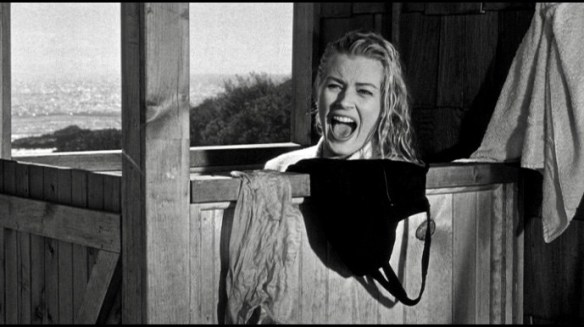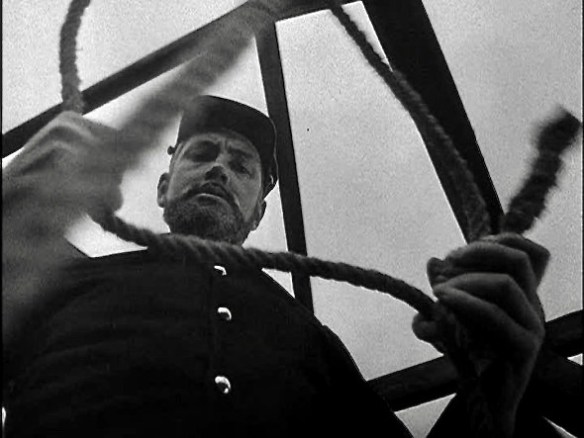
For years I held the opinion that Swedish director Jan Troell and his films were generally overrated by movie critics and scholars until the 2008 Telluride Film Festival where a retrospective of his work proved to me that I had been sadly mistaken. The two films that changed my perspective were the American premiere of Everlasting Moments (original title: Maria Larssons eviga ogonblick, 2008), a turn-of-the-century drama about a working class mother who becomes a professional photographer, and Here’s Your Life (original title: Har har du ditt liv, 1966), which marked his feature film debut. The latter film, in particular, was a revelation and remains one of my all-time favorite movies. Continue reading
Author Archives: JStafford
Not Your Typical Hit Man
What other living actor has the sort of cult following that Ron Perlman does? Ever since his film debut in Jean-Jacques Annaud’s prehistoric epic Quest for Fire (1981), Perlman’s unique screen presence has been a key component in more than 200 films and TV shows. Sure, some of them are dreck or forgettable but then there are The Name of the Rose (1986), where he played the hunchback Salvatore, the critically acclaimed TV series Beauty and the Beast (1987-1990), Marc Caro & Jean-Pierre Jeunet’s The City of Lost Children (1995) and several films by Guillermo Del Toro including the lead in Hellboy (2004) and Hellboy II: The Golden Army (2008). In a change of pace from these often grotesque and larger-than-life anti-heroes, Perlman tries something different in Asher, which opens in theaters around the country on December 7th. Continue reading
Operation Chastise: The Movie
The biggest box office hit of 1955 in England and honored with three BAFTA nominations for Best British Film, Best British Screenplay and Best Film from any Source, The Dam Busters (1955) is less well known in the U.S. but is nonetheless one of the most realistic and faithful accounts of an incident in WWII that is credited with hastening Germany’s defeat in the war. Continue reading
Embryonic Journey

A young Japanese butterfly collector sees a rare species in his part of Japan in Silence Has No Wings (aka Tobenai Chinmoku, 1966), directed by Kazuo Kuroki.
What happens when you take an idea for a nature documentary short about a specific type of butterfly like the Nagasaki Swallowtail (papilla memnon) and expand it into an experimental narrative feature incorporating stylistic influences of the French New Wave with allegorical and sociological overtones? The result is Silence Has No Wings (aka Tobenai Chinmoku, 1966), a visually astonishing and rarely seen film by Japanese director Kazuo Kuroki, who began his career as an assistant director before helming several public relations and documentary shorts like Electric Rolling Stock of Toshiba (aka Toshiba Sharyo, 1958) and The Seawall (aka Kaiheki, 1959). Continue reading
William A. Seiter’s If You Could Only Cook (1935)
Whenever the subject of screwball comedy comes up, I usually think of the same handful of titles in this short-lived movie genre which began sometime in the early thirties with such models of the form as Twentieth Century (1934) and It Happened One Night (1934) and ended sometime in the early forties between the time of Preston Sturges’ The Palm Beach Story (1942) and Frank Capra’s Arsenic and Old Lace (1944). Like the film noir genre which continues to yield overlooked gems like Crime Wave (1954) and Highway 301 (1950), many lesser known and almost forgotten entries in the screwball comedy category continue to resurface on Turner Classic Movies, reminding us that occasionally you might find a diamond in the rough. Such is the case with If You Could Only Cook (1935). Continue reading
Highlights from VFF 2018
The annual Virginia Film Festival (VFF) in Charlottesville recently celebrated its 31st year of operation on Nov.1-4 and offered attendees the opportunity to select from over 150 films, many of which arrived leaden with awards and critical acclaim from previous festivals like Cannes and Telluride. Programming content focused on specific themes and topics is also part of the VFF tradition and the 2018 event included a film series on Race in America, which included the premiere of Paul Robert’s Charlotteville about the tragic events of Aug. 11 & 12, 2017, and sidebars on Orson Welles, Virginia filmmakers, American folk culture and music and a vast array of international films. Continue reading
The Streetwise Anthropologist
The name Garry Winogrand might not be familiar to you but you have probably seen some of his most famous photographs over the years. There are his candid celebrity shots that include a young John F. Kennedy amid attendees at the Democratic National Convention in Los Angeles circa 1960 and Marilyn Monroe on the set of Billy Wilder’s The Seven Year Itch (1955) as she stands over a subway grate, her skirt billowing around her. More typical are his street scenes and public places portraits such as the one of a young couple frolicking in the surf at Coney Island or the acrobat caught in mid-air above the sidewalk. All of these and many more are included in a deep dive of his four-decade archive in Sasha Waters Freyer’s engrossing documentary, Garry Winogrand: All Things Are Photographable. Continue reading
Curse of the Doll People
Some phobias, often triggered by movies, develop in childhood and stick with you for life like an overwhelming fear of circus clowns or anxiety about being alone in the dark. For me, ventriloquist dummies or anything similar to that like oversized human dolls still gives me the creeps and the horror film that best visualizes this is 1961’s Curse of the Doll People (Mexican title: Munecos Infernales, which translates roughly as “Infernal Dolls”), directed by Benito Alazraki. Continue reading
Dietrich and von Sternberg’s Last Tango
When The Scarlet Empress (1934), Josef von Sternberg’s lavish historical epic starring Marlene Dietrich as Catherine the Great, proved to be a critical and commercial disaster for Paramount, the director realized his days were numbered at the studio. So why not go for broke in one last picture? The result was The Devil is a Woman (1935). Continue reading
Remembering Hal Ashby
Mark Harris’s best-seller Pictures at a Revolution: Five Movies and the Birth of the New Hollywood pointed to 1967 as the year that the studio system crumbled and a new order emerged while Peter Biskind’s Easy Riders, Raging Bulls profiled the subsequent rise of the young turk directors in the seventies who changed cinematic conventions with their idiosyncratic films. Martin Scorsese, Steven Spielberg, Francis Ford Coppola, George Lucas, Peter Bogdanovich are usually singled out as the prime movers and shakers by film historians of that era while the once high profile Hal Ashby is often underrated and relegated to the sidelines. Hal, Amy Scott’s new documentary on the director, is a welcome homage that attempts to elevate and restore this influential figure to his rightful place in Hollywood history. Continue reading