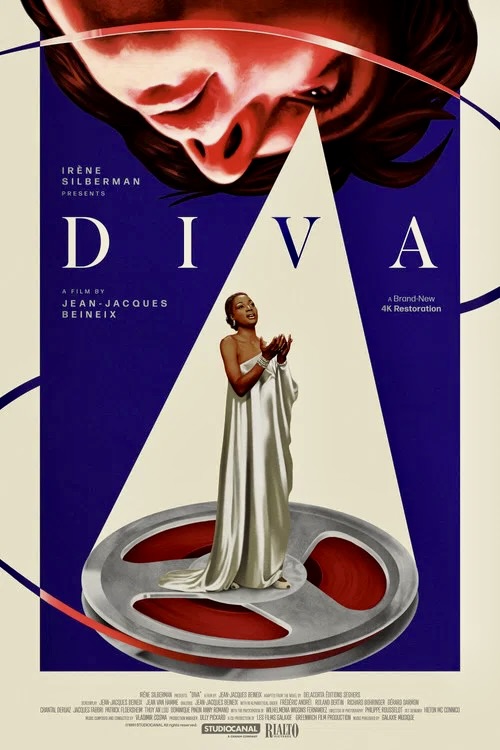
1981 was the year that a French film with the title Diva became a surprise box office hit in America. It grossed $6 million dollars, making it the third most profitable French since 1975 to attract both mainstream and art house audiences plus most of the important critics loved it. Roger Ebert of The Chicago Sun-Times called it, “A visual extravaganza. One of the most persistently entertaining, absorbing and scary thrillers I’ve seen in a long time.” Pauline Kael of The New Yorker raved, “Every shot seems to have a shaft of wit. It’s Welles romanticized, gift-wrapped. It’s a mixture of style and chic hanky-panky, but it’s also genuinely sparkling.” And J. Hoberman of The Village Voice stated, “Diva is not only the most purely pleasurable movie to open here this year, but surely one of the finest films to arrive from France in a decade.” Yet the film was a complete flop in France when it opened there with most critics attacking the film for a visual aesthetic they claimed was inspired by commercial advertising. Strangely enough, after Diva became a hit in America and around the world, French critics and audiences changed their minds and it finally became a commercial success in its own country, winning four Cesar Awards (the French equivalent of the Academy Awards) – Best First Work (director Jean-Jacques Beineix’s debut feature), Best Music Score (Vladimir Cosma), Best Cinematography (Philippe Rousselot) and Best Sound (Jean-Pierre Ruh). So how does it hold up today?
Continue readingTag Archives: pulp fiction

Frank Chandler’s Secret Identity

Now that Hollywood has settled into a regular routine of converting comic books and graphic novels into big screen blockbusters, it seems the time is right to revisit some of the earlier superheroes of American pop culture. Take, for example, Chandu the Magician. Based on the popular radio serial by Harry A. Earnshaw and Raymond R. Morgan and broadcast in fifteen minute episodes, the program ran from 1932 to 1936 and then was revived with new talent in 1948 and broadcast until 1950. What makes Chandu unique is the protagonist. Once known as Frank Chandler, he has spent three years among the yogis as a disciple, mastering the art of hypnosis and the occult arts, before being sent out into the world by his mentor to battle the forces of evil under his new identity, Chandu. His nemesis is Roxor, an evil madman intent on dominating the world after hijacking a death ray weapon created by Chandu’s brother-in-law Robert Regent, who is imprisoned by Roxor. When Regent refuses to divulge the secret of activating the death ray, his wife, daughter and son are also captured and threatened with death. Chandu is the only one who can save them.
Continue readingAll in the Family
If you had gone to a movie theater showing Before the Devil Knows You’re Dead in 2007 without knowing anything about it or who directed it, you’d probably think it was the work of a dynamic new director who had talent to burn, someone possibly in his or her late twenties or early thirties. Of course, we know it’s the work of the 83-year-old Lumet but the film is just as fresh, surprising and alive to the harrowing and painful emotions of its tough familial breakdown as Lumet’s best work and that means on a par with 12 Angry Men (1957), Serpico (1973), Dog Day Afternoon (1975) and Network (1976).
Continue readingClothes Make the Man
How much of your identity is reflected in the clothes you wear? For some, fashion is the truest form of self-expression. It is who you are…or who you want to be. Some of the greatest fashion designers of our time have stated as much while offering other reasons for why it is important. Alexander McQueen said, “Fashion should be a form of escapism, and not a form of imprisonment” and Coco Chanel once remarked, “In order to be irreplaceable one must always be different.” This is certainly something to mull over while watching Quentin Dupieux’s dark, twisted fable, Deerskin (French title: Le Daim, 2019), which isn’t really about fashion per se but self-expression, creativity and being different are clearly part of the film’s thematic interests. Continue reading
The Way of All Flesh
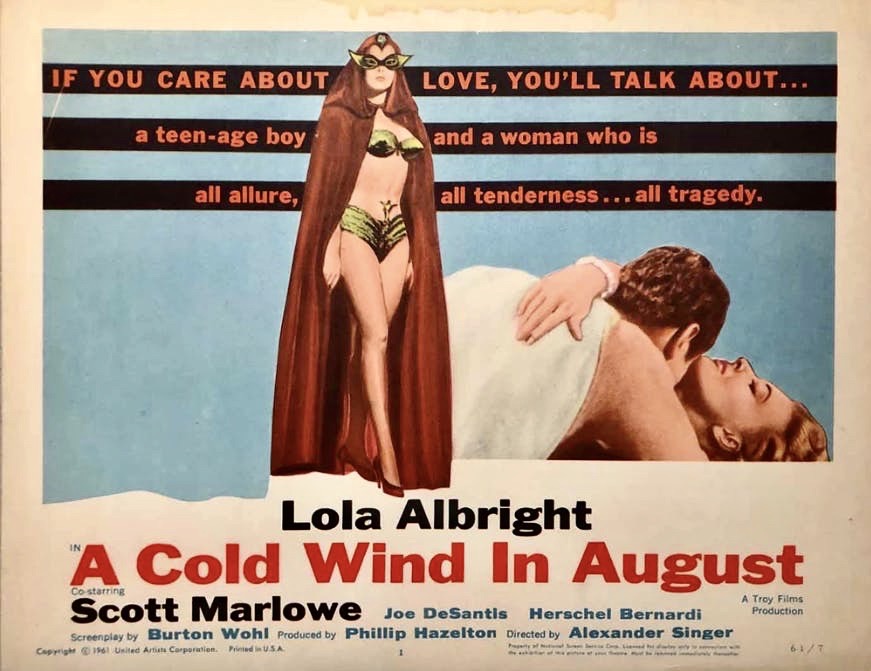
Every once in a while a low-budget independent film with a no-name cast will come along and captivate critics and audiences alike with its audaciousness, honesty and ability to transcend easy categorization. In the film industry, they sometimes call this a “sleeper” and, while this kind of movie rarely becomes a box office hit, it can acquire a cult status or insider buzz that saves it from falling off the radar and vanishing into obscurity. Such is the case with A Cold Wind in August (1961), a steamy little adult drama that was targeted for grindhouses and the drive-in trade with the tagline: “If you care about love, you’ll talk about a teenage boy and a woman who is all allure, all tenderness…all tragedy.” The poster depicted two lovers in a torrid horizontal embrace while the figure of an exotic stripper, dressed in an open cape and eye mask, towers over them, revealing her shapely, half-naked body.
Continue reading
Anita Ekberg is a Screaming Mimi

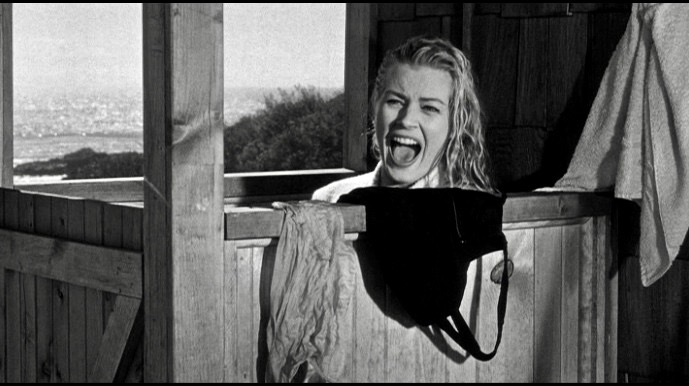
Anita Ekberg screams as a crazed maniac (offscreen) approaches her with a knife as she showers outside in Screaming Mimi (1958), directed by Gerd Oswald.
Every once in a while a psychological thriller comes along that is every bit as delusional and confused as its most disturbed character and that is certainly the case with Screaming Mimi (1958). Whether intentional or not, the movie abandons logic and the intricately plotted pleasure of a good whodunit to run amok in a nocturnal fantasy world populated by bohemians, strippers, sexual deviants and psychopaths. Continue reading