
Diamond Hunting in Siberia

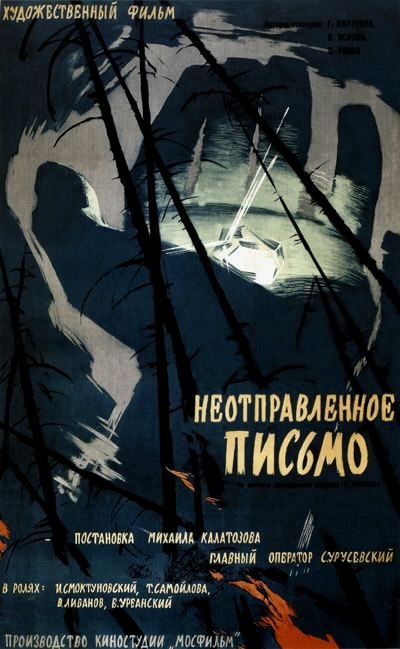
A Russian film poster for the 1960 adventure epic LETTER NEVER SENT.

If international film aficionados are familiar with Russian director Mikhail Kalatozov at all, it is probably due to his 1957 Oscar-winning Best Foreign Film Letyat Zhuravli [English title: The Cranes Are Flying]. But he has also secured a place for himself in cinema history for his 1930 documentary Jim Shvante (Marili Svanets) [English title: Salt for Svanetia] and the visually dazzling, anti-American propaganda epic, presented in four vignettes, as I Am Cuba (1964). Often overlooked or ignored is Neotpravlennoye Pismo [English title: Letter Never Sent, 1960], which was criticized by some Russian critics as unnecessarily arty and underdeveloped in terms of its characters. Yet, seen today, the film works as a stirring, lyrical portrait of man vs. nature where the innovative black and white cinematography of Sergei Urusevsky overwhelms any agitprop messaging. Instead, the viewer is transported to a wild landscape where four explorers fight for their survival against the four unpredictable elements of nature – wind, water, fire and earth.

Continue reading →
Voyage of Doom

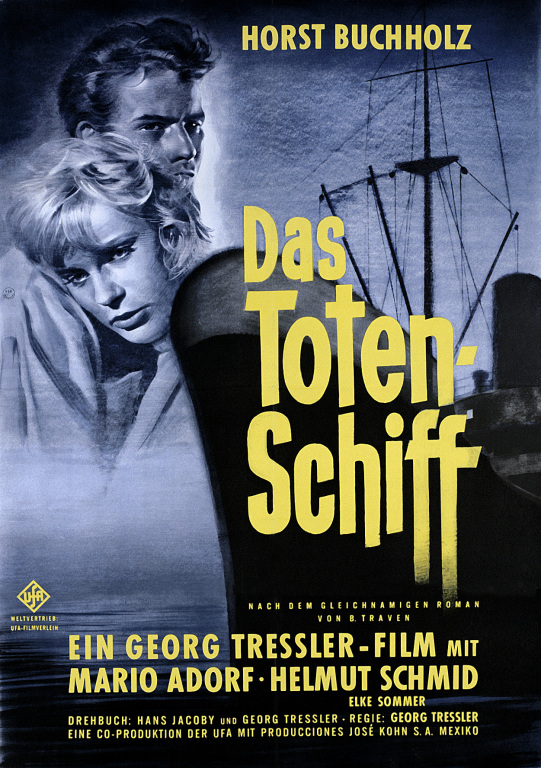
A former actor from Austria turned film director, Georg Tressler is not a name familiar to most American movie fans but for German filmgoers of the fifties he created a sensation with this 1956 feature film debut, Die Halbstarken (released in the U.S. as Teenage Wolfpack). As topical, incendiary and controversial in its day as The Wild One (1953), Rebel Without a Cause (1955) and Blackboard Jungle (1955), Die Halbstarken was a hard-hitting portrait of juvenile delinquency in post-war Germany and featured Horst Buchholz as a manipulative gang leader in a performance possibly inspired by James Dean. It was a huge hit and led Tressler to follow it up with two more youth-oriented films – Noch Minderjahrig (Under 18, 1957) and Endstation Liebe (Two Worlds, 1958). His fourth feature, Das Totenschiff (Ship of the Dead, 1959), was a complete departure from his trilogy in terms of content and was mostly ignored by critics and the public. But timing is everything and today Das Totenschiff looks like a lost classic from the pre-Berlin Wall era. And it may very well be Tressler’s finest achievement.    Continue reading →