
Diamond Hunting in Siberia

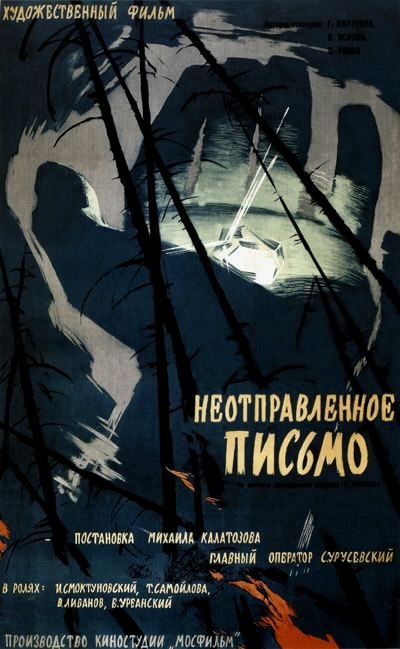
A Russian film poster for the 1960 adventure epic LETTER NEVER SENT.

If international film aficionados are familiar with Russian director Mikhail Kalatozov at all, it is probably due to his 1957 Oscar-winning Best Foreign Film Letyat Zhuravli [English title: The Cranes Are Flying]. But he has also secured a place for himself in cinema history for his 1930 documentary Jim Shvante (Marili Svanets) [English title: Salt for Svanetia] and the visually dazzling, anti-American propaganda epic, presented in four vignettes, as I Am Cuba (1964). Often overlooked or ignored is Neotpravlennoye Pismo [English title: Letter Never Sent, 1960], which was criticized by some Russian critics as unnecessarily arty and underdeveloped in terms of its characters. Yet, seen today, the film works as a stirring, lyrical portrait of man vs. nature where the innovative black and white cinematography of Sergei Urusevsky overwhelms any agitprop messaging. Instead, the viewer is transported to a wild landscape where four explorers fight for their survival against the four unpredictable elements of nature – wind, water, fire and earth.

Continue reading →
Law of the Yukon

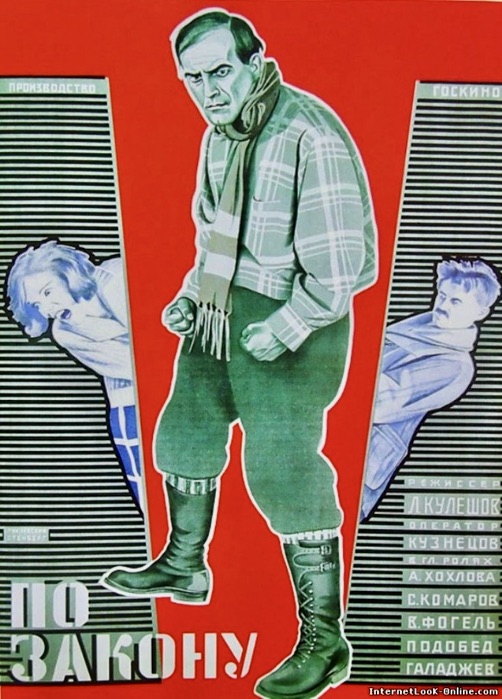
The Russian film poster for BY THE LAW (1926)

It is not a surprise that novelist/journalist Jack London was the most popular writer of the early 20th century and he enjoyed an international readership, especially in Japan, Eastern Europe and Russia. In fact, one of the landmark films of early Soviet cinema is By the Law (Russian title: Po Zakonu, 1926), based on London’s short story The Unexpected, and directed by Lev Kuleshov, a former painter turned set designer who eventually became a film theorist and director who launched the montage movement of the 1920s (Sergei Eisenstein [The Battleship Potemkin, 1925] was one of his students).

Continue reading →

Georgia on My Mind

Images from the 1930 film SALT FOR SVANETIA, filmed in the Republic of Georgia.

Svaneti is not a planet in the solar system or some alternate universe out of a science fiction fantasy but it might as well be. In truth, it is a remote region located in the northwestern part of the Republic of Georgia on the southern slopes of the Caucasus Mountain range. For centuries the area was cut off from civilization due to its inaccessible location in the mountains plus the extreme weather, that usually included eight straight months of snowfall, also made it unwelcoming. After Georgia was invaded and annexed by the Soviet Union in 1922, the region was subjected to Stalin’s five-year plan (1928-1932), which was created to spawn agriculture collectives across the nation and introduce large-scale industrialization. But Svaneti was so isolated from the rest of the world that it took a while for Soviet workers to reach the area and Jim Shvante (Marili svanets) [English title: Salt for Svanetia (1930)] is a portrait of the lives and traditions of the Ushkul tribe in that inhospitable domain before the Soviets arrived to develop it. The result is not a typical documentary but more of a folk culture microcosm as captured by some wildly creative ethnographic filmmaker. 

Continue reading →