

New Discoveries & Overlooked Treasures: Telluride Film Festival 2012

*This archived article originally appeared on the Turner Classic Movies website in September 2021.

Tis the season for major film festivals and Telluride often exceeds those that follow – Toronto, New York, Chicago – by presenting the North American premieres of major works, a mixture of Cannes award winners receiving their American debut, lesser known surprises (some without distributors yet) and wonderful retrospectives from silent films with live music accompaniment to overlooked treasures like Agnes Varda’s La Pointe Courte (1956), Ermanno Olmi’s Il Posto (1961) and Paul Fejos’ Lonesome, (1928).  Unlike the other film festivals, however, Telluride enjoys a long held tradition of withholding its slate of films until the day before the event begins and attendees are rarely disappointed; in fact, most patrons feel rewarded for making the annual trek deep into the Rockies. The big event premieres of the 2012 event included such heavy hitters as Christian Petzold’s Barbara, Michael Haneke’s Amour and The Attack, Ziad Doueiri’s controversial drama about a suicide bombing in Tel Aviv. Yet, it was the unexpected additions of such films as the French documentary Journal de France, Michael Winterbottom’s Everyday, I Knew Her Well (1965) from Italian director Antonio Pietrangeli, and a revival of Something Wild (1961) that made it such an unforgettable year.

Continue reading
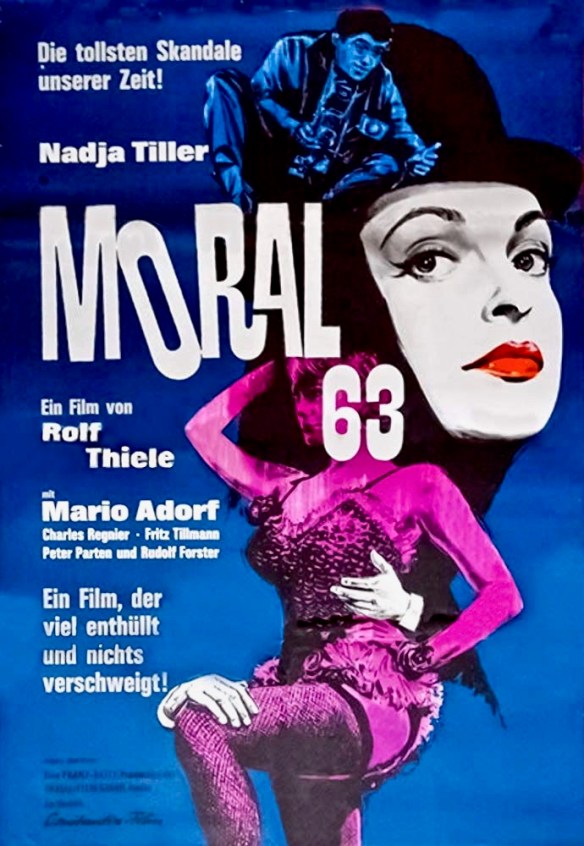
A West German Fable by Rolf Thiele

Why does it often seem like the accumulation of great wealth and power by individuals does not necessarily come with an equal respect for ethics and morality? For Marion (Nadja Tiller), the heroine of Rolf Thiele’s Moral 63, the path to unbridled success is merely an escalating series of business transactions with rich and influential men who reward her for being beautiful, accommodating and discreet. Who cares about honor or virtue in a society where those attributes have no monetary value? Continue reading

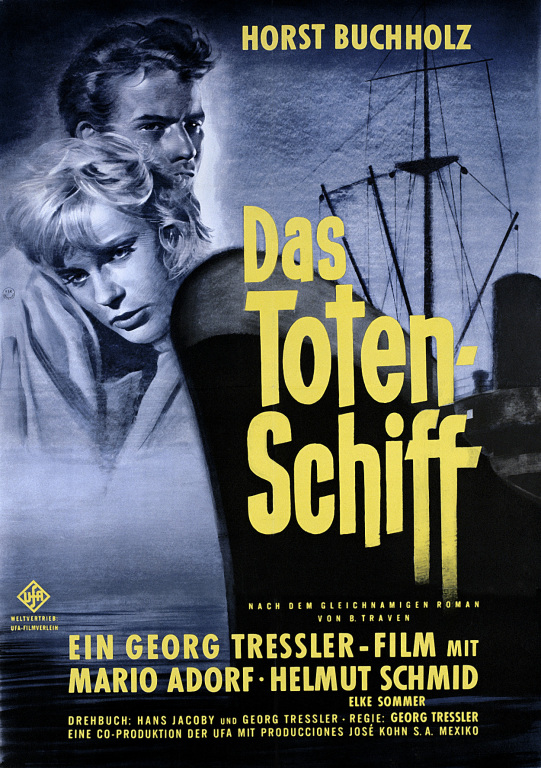
Voyage of Doom

A former actor from Austria turned film director, Georg Tressler is not a name familiar to most American movie fans but for German filmgoers of the fifties he created a sensation with this 1956 feature film debut, Die Halbstarken (released in the U.S. as Teenage Wolfpack). As topical, incendiary and controversial in its day as The Wild One (1953), Rebel Without a Cause (1955) and Blackboard Jungle (1955), Die Halbstarken was a hard-hitting portrait of juvenile delinquency in post-war Germany and featured Horst Buchholz as a manipulative gang leader in a performance possibly inspired by James Dean. It was a huge hit and led Tressler to follow it up with two more youth-oriented films – Noch Minderjahrig (Under 18, 1957) and Endstation Liebe (Two Worlds, 1958). His fourth feature, Das Totenschiff (Ship of the Dead, 1959), was a complete departure from his trilogy in terms of content and was mostly ignored by critics and the public. But timing is everything and today Das Totenschiff looks like a lost classic from the pre-Berlin Wall era. And it may very well be Tressler’s finest achievement.    Continue reading