I am a writer for The Travel Channel, ArtsATL.com, Burnaway.org and other publications. I am also a film researcher for Turner Classic Movies and a member of the Atlanta Film Critics Circle. This blog is dedicated to overlooked, obscure or underrated movies and other cinema topics that I want to share.
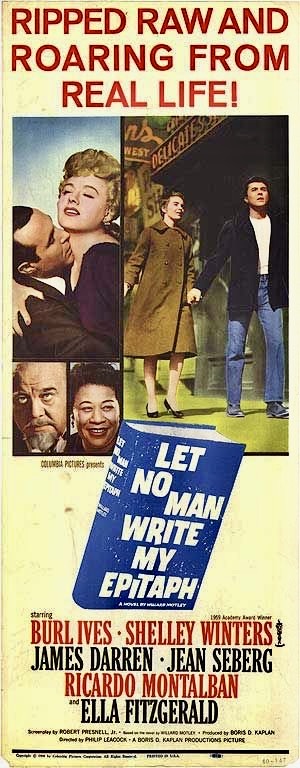
At the end of the 1949 Nicholas Ray film, Knock on Any Door, juvenile delinquent Nick Romano, played by John Derek, is sentenced to die in the electric chair for killing a cop, despite the attempts of his attorney, Andrew Morton (Humphrey Bogart), to save him. The story didn’t end there, however, and African-American novelist Willard Motley wrote a sequel to his original 1947 bestseller in 1958 entitled Let No Man Write My Epitaph. It was adapted to the screen under that same title in 1960 and focused more on the ghetto drug problem than urban gang violence although the latter is still an omnipresent concern.
Most people who work for a company, regardless of its size, have probably attended an office party for the employees at a certain point. For some, the idea of socializing with co-workers outside of work is something to avoid if possible. For others, it is an opportunity to score points with the boss and maybe advance your career. Then there are employees who simply enjoy social gatherings where an open bar and free food is theirs for the taking. All of these personality types and more – the gossip, the prude, the party animal, etc. – are on display in The Invitation (French title: L’invitation, 1973), a comedy of manners by Swiss director Claude Goretta, in which the employees of a small firm gather at a country estate for an office party given by one of the most unlikely employees to host a soiree.
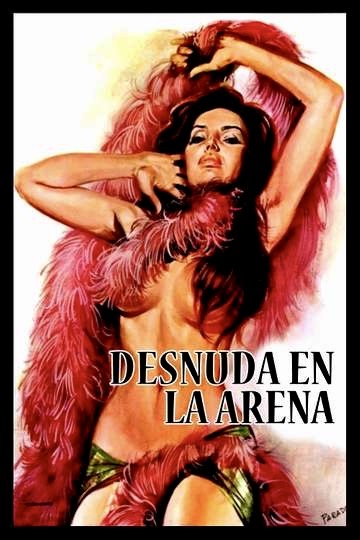
Argentinian sexpot Isabel Sarli stars in the 1969 drama that was also known as NUDE IN THE SAND and ALONE ON THE BEACH.
Nude in the Sand sounds like one of those sex-themed cocktails with names like Between the Sheets, Strip and Run Naked and Sex on the Beach that are offered at trendy under 30 bars but no. It is the English language title of Furia Sexual: Desnuda en la Arena (1969), which is also known as Alone on the Beach, and stars Argentinian sexpot Isabel Sarli. If you know the name, it is probably because cult director John Waters is a big admirer of Sarli’s films and has regularly screened Fuego (1969), probably her most infamous and delightfully campy opus, to stunned audiences over the years. Nude in the Sand may not top the delirious highs and lows of Fuego but it is an enjoyably trashy introduction to the voluptuous Sarli for novices as well as a must-see for fans of Fuego.
The atom bomb and its devastating after effects have served as the basis for some of the science fiction genre’s most popular and successful films and it’s no surprise that many of them hail from Japan where Gojira (1954, U.S. title: Godzilla) became the first in a long line of radioactive monsters bent on stomping Tokyo. Whether intended as metaphorical retribution for the A-bomb destruction of Hiroshima and Nagasaki in 1945 or cautionary tales about the dangers of nuclear power, these sci-fi fantasies became Toho’s studios’ most profitable exports during the late fifties and early sixties and eventually spawned subgenres of their own, one of which was the “mutant” series. The masterminds behind Gojira and most of the Toho sci-fi releases were director Ishiro Honda and special effects technician Eiji Tsuburaya and their first effort in the “mutant” series – Bijo to Ekitainingen (1958) – still stands as one of their most unusual and distinctive films.
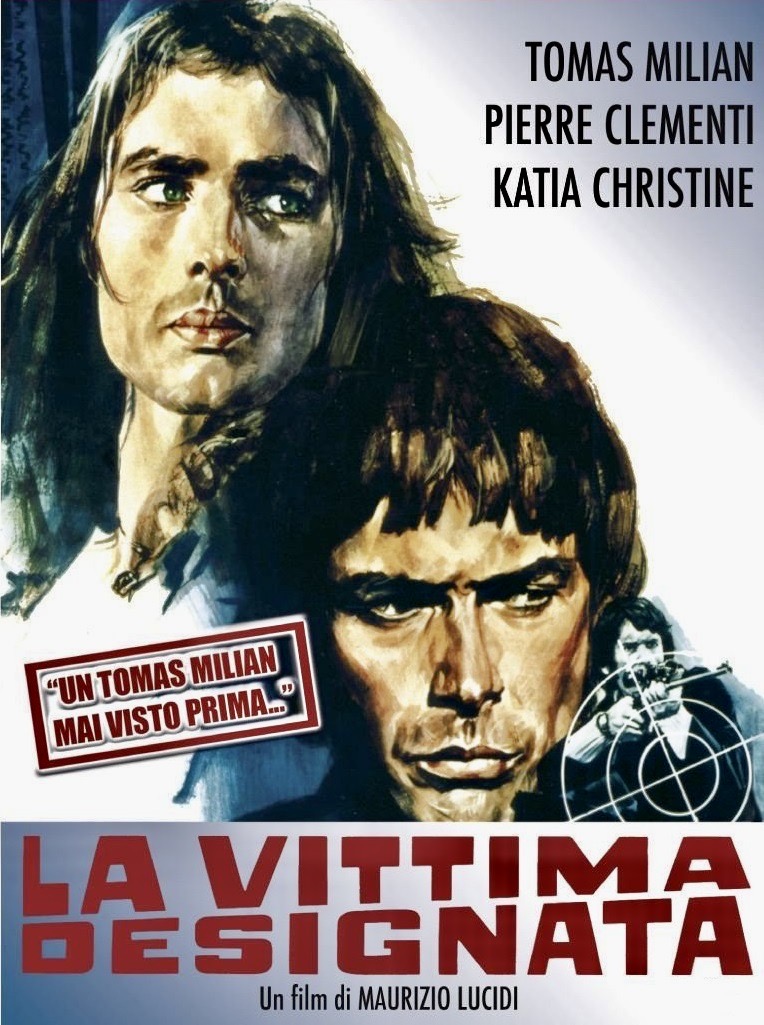
The Italian film poster for THE DESIGNATED VICTIM (1971).
The first Patricia Highsmith novel to be adapted to film was the author’s first book, published in 1950, Strangers on a Train, which Alfred Hitchcock made into a movie the next year. Yet, with the exception of U.S. television which adapted some of Highsmith’s stories for the small screen (The Talented Mr. Ripley for Studio One in Hollywood in 1956, The Perfect Alibi for Jane Wyman Presents The Fireside Theatre in 1957, Annabel for The Alfred Hitchcock Hour in 1962), no American film director would attempt another Highsmith screen adaptation for many years. European filmmakers, however, have returned again and again to her perversely fascinating thrillers which are marked by their disturbing psychological detail and macabre humor. Among these are René Clément’s visually stunning Purple Noon (1960), an adaptation of The Talented Mr. Ripley, Claude Autant-Lara’s Enough Rope (1963), based on the novel The Blunderer, Wim Wenders’ hallucinatory noir The American Friend (1977), adapted from Ripley’s Game, This Sweet Sickness (1977) by French director Claude Miller, and most famously Anthony Minghella’s The Talented Mr. Ripley (1999). Yet, one of the least known – and uncredited – adaptations is La Vittima Designata (English title: The Designated Victim, 1971), which is a very loose, revisionist version of Strangers on a Train with colorful Italian location shooting in Venice, Milan and Lake Como.
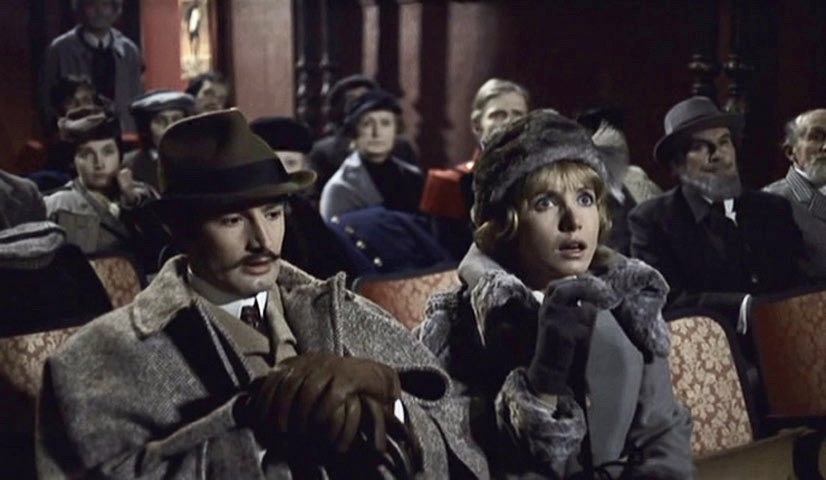
Odile (Bulle Ogier) is quite enthralled with the ingenious exploits of master criminal Fantomas on the screen but her companion Jacques (Roger Van Hool) is clearly annoyed by the whole thing in APPOINTMENT IN BRAY (1971), a French film by Belgium director Andre Delvaux.
Have you ever woken up from a dream that was almost ordinary in the way it unfolded yet it left you with a feeling that it had taken place in some ethereal twilight zone? That is the best way that I can describe the experience of watching Appointment in Bray aka Rendez-vous a Bray (1971), Andre Delvaux’s artful adaptation of the Julien Gracq short story, Le Roi Cophetua. On the surface, the film has the structure of a traditional character study but is actually much closer in tone and atmosphere to a cinematic haiku, one that offers meditative reflections on memory, friendship and the debilitating effects of war.
Mara Corday is Vera, the mastermind behind a gang of female bandits, in GIRLS ON THE LOOSE (1958), directed by Paul Henreid.
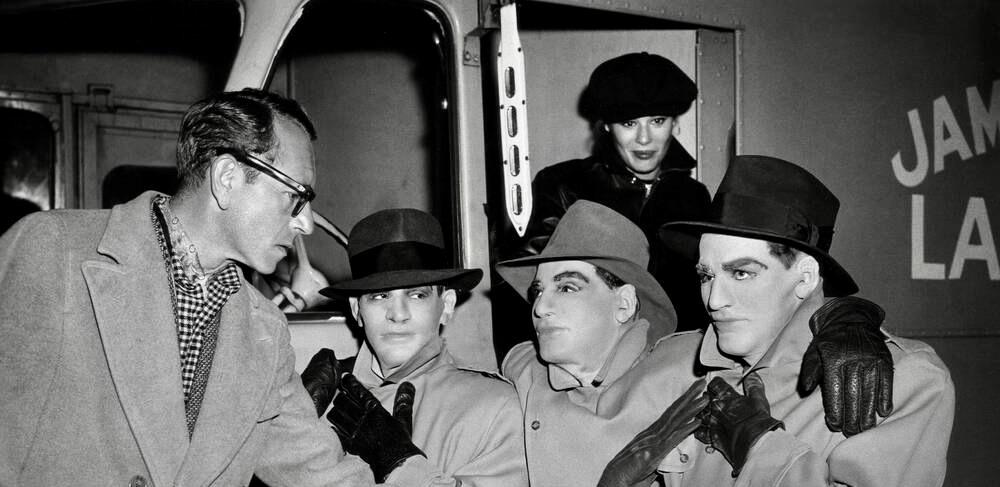
Juvenile delinquent films in the 1950s were so plentiful that they became a major B-movie subgenre and the surprisingly thing about that was the number of movies featuring female hooligans. Among some of the more famous titles are Reform School Girl (1957), Runaway Daughters (1956) and Teenage Devil Dolls aka One Way Ticket to Hell (1955) but Girls on the Loose stands out from the pack as a little known and ingenious B-movie delight. For one thing, these aren’t gum-chewing high school delinquents but a quartet of hardened professionals and damaged goods. Equally surprising is the tough, no nonsense story arc which makes the most of its low budget sets and noir lighting schemes in a compact 77-minute programmer directed by Paul Henreid. Yes, THAT Paul Henreid, the former Warner Bros. heartthrob from Austria-Hungary who performed that romantic cigarette seduction of Bette Davis in Now, Voyager (1942). Here he is below, directing his incognito cast of Girls on the Loose.
GIRLS ON THE LOOSE, director Paul Henreid on set with masked robbery gang Mara Corday, Joyce Barker, Lita Milan and getaway driver Abby Dalton at rear, 1958 Courtesy Everett Collection.
The cover of the souvenir program to the 1926 MGM film TELL IT TO THE MARINES.
Most classic movie fans know that silent film star Lon Chaney was often associated with Tod Browning, who directed him in ten movies starting with The Wicked Darling (1919) and ending with Where East is East (1929). Among their most famous collaborations are the silent version of The Unholy Three (1925), The Unknown (1927) and London After Midnight (1927), which is now considered a lost film. Yet, two of Chaney’s most legendary roles were helmed by different directors. The Hunchback of Notre Dame (1923) was directed by Wallace Worsley and The Phantom of the Opera (1925) is credited to Rupert Julian; both films helped establish Chaney’s reputation for playing monstruous and tortured characters. What tends to be overlooked in his filmography is the fact that Chaney wasn’t always typecast as some kind of grotesque individual and Tell It to the Marines (1926), one of his biggest box-office hits for M-G-M, presents him as a gruff but patriotic Marine sergeant in a stirring romantic drama by director George W. Hill.
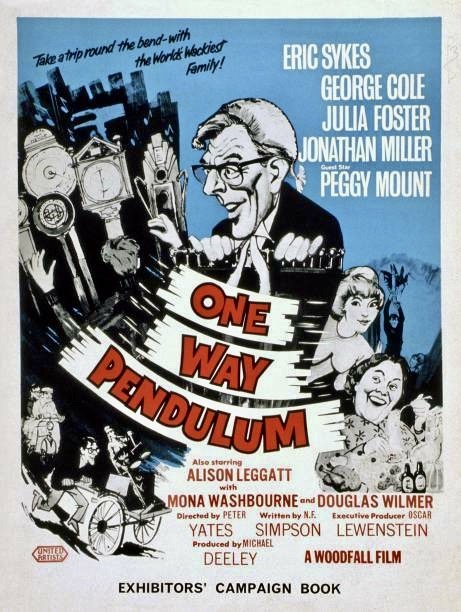
When you think of British film comedies, titles like Whiskey Galore (1949), The Titfield Thunderbolt (1953), and other popular Ealing releases, many with Alec Guinness, probably spring to mind. Or maybe something starring Peter Sellers or any comedies featuring graduates of the Goon Show, Beyond the Fringe or Monty Python TV shows that mix black comedy with Theatre of the Absurd antics. But few people, outside of the U.K., are unlikely to recall One Way Pendulum (1964) with fondness and there are obvious reasons for that. It is the sort of surreal farce that is so deeply rooted in its own culture, setting and time – the sixties – that audiences of today might not get the jokes at all. Even the average Englishman might have sat dumbfounded at the film before him in 1964.
An alternate release poster for the Roberto Rossellini film ERA NOTTE A ROMA (1960)
Available for years in inferior public domain prints and poor video transfers, Robert Rossellini’s influential WW2 trilogy [Rome Open City (1945), Paisan (1946) and German Year Zero (1949)], which firmly established him as the “father of Neorealism”, finally received 4K high-definition digital transfers from The Criterion Collection in 2017. Linked thematically to this trilogy, however, is a later Rossellini film, Era Notte a Roma [English title, Escape by Night aka Blackout in Rome,1960), which, unfortunately, has never enjoyed the reputation or respect of this seminal trilogy. I first saw a 16mm print of the film from Films Inc. years ago when it still licensed titles from The Audio Brandon Collection. I had a chance to revisit Era Notte a Roma again recently on DVD and am still baffled by the movie’s low profile since its original release.







 Cinema Sojourns