
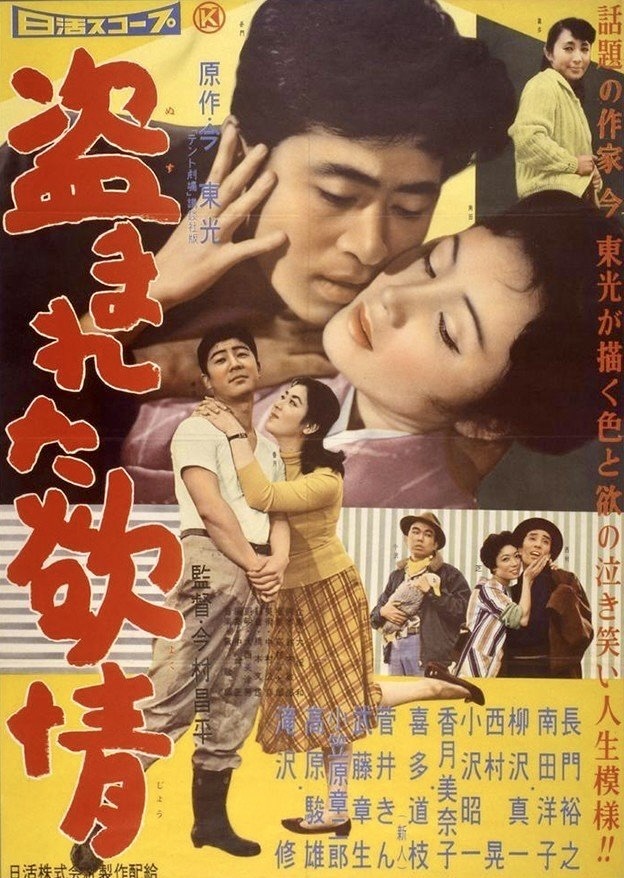
During the post-war years in Japan, a new generation of filmmakers began to address the changing social and political changes in their country which earned them the label of the Nuberu Bagu. Emerging around the same time as the French New Wave in the late 1950s/early 1960s, Masahiro Shinoda, Nagisa Oshima, Yoshishige Yoshida and Shohei Imamura were among the most famous directors in this radical new movement. Imamura, in particular, is an intriguing figure because he worked as an assistant director for Yasujiro Ozu on three of his films – Early Summer [1951], The Flavor of Green Tea Over Rice [1952], and Tokyo Story [1953]. Despite his respect for Ozu, Imamura became frustrated with the director’s rigid and idealized view of Japanese life and broke away to make his own kind of movies which dealt with the lower rung of society, especially outcasts, prostitutes and criminals – the kind of people Imamura lived among and empathized with during the late 1940s. None of this was blatantly obvious with the first films Imamura made for Nikkatsu Studios but you can still perceive a fondness and admiration for disenfranchised people in his feature film debut, Nusumareta Yokujo (English title: Stolen Desire, 1958). An episodic and picaresque tale of a ragtag theater troupe, the movie is an earthy, sensual comedy-drama and surprisingly upbeat in tone compared to Imamura’s later work.
Continue readingTag Archives: Yoshishige Yoshida
Kiju Yoshida’s Escape from Japan
The Japanese New Wave of the late 1950s/early 1960s introduced the world to a number of rising directors who are now icons of cinema like Nagisa Oshima, Hiroshi Teshigahara, Shohei Imamura and Masahiro Shinoda but it has only been in recent years that Yoshishige Yoshida aka Kiju Yoshida has started to receive the belated acclaim he deserves. His 220-minute masterpiece Eros + Massacre (1969), which told the parallel stories of two student activists and Sakae Osugi, an anarchist and free love advocate, startled critics with its radical take on sex and politics, not to mention a fragmented narrative approach with unusual camera compositions of widescreen black and white imagery. Long before that, Yoshida learned his trade at Shochiku Studio at a time when the company began making films about the disaffected post-war generation such as Oshima’s Cruel Story of Youth (Seishun Zankoku Monogatari, 1960) and Good-for-Nothing (Rokudenashi, 1960), Yoshida’s debut film about an aimless youth and his attraction to the secretary of a rich friend’s father. The director would eventually part ways with Shochiku over creative differences and start his own production company in 1964 but his final movie for the studio, Escape from Japan (Nihon Dasshutsu, 1964), shows Yoshida imposing his own aesthetic and stylistic approach to what is essentially a B-movie melodrama.
Continue reading

