
How to Bungle a Heist

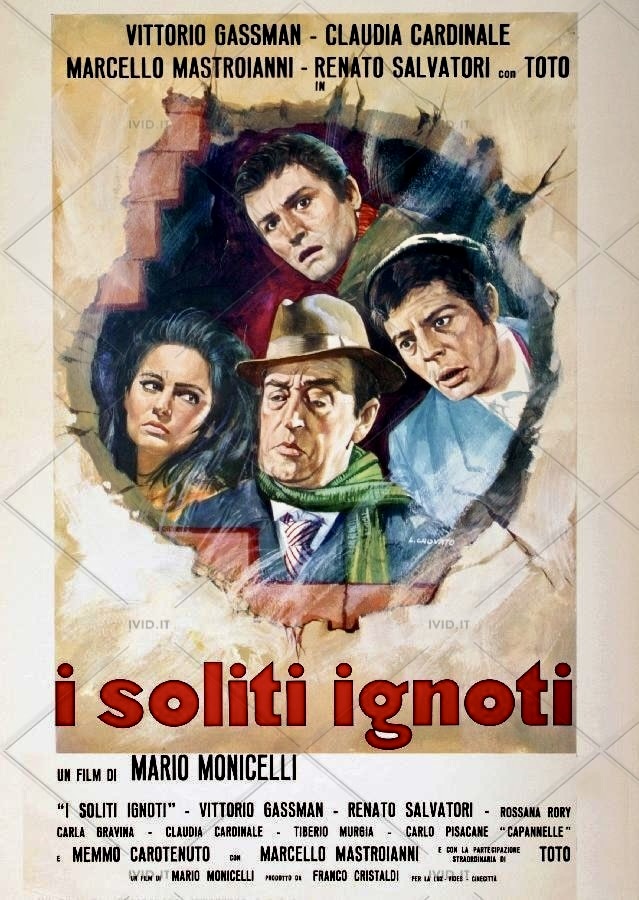
An Italian film poster for the 1958 crime caper comedy BIG DEAL ON MADONNA STREET, directed by Mario Monicelli.

While some point to The Asphalt Jungle in 1950 as the film that really marked the emergence of the heist film, the genre had actually been in existence since the silent era with The Great Train Robbery (1903) a prime example on up through the forties with such influential efforts as High Sierra (1941). It is true, however, that the heist film became an international phenomenon in the fifties thanks to the worldwide success of Jules Dassin’s Rififi (1955) which set the standard for subsequent films such as Stanley Kubrick’s The Killing (1956) and Jean-Pierre Melville’s Bob Le Flambeur (1956). It was inevitable that some filmmaker would eventually poke fun at the then-current craze but nobody expected it to come from Italy in what is now regarded as possibly the finest heist parody of all time – Big Deal on Madonna Street (1958). Directed by Mario Monicelli, the film was known in Italy as I Soliti Ignoti and was also released under the alternate title of Persons Unknown.

Continue reading

Salvatore Samperi’s Cuore di Mamma

The late sixties were a time of social and political upheaval on an almost global scale but Italy, in particular, seemed to be coming apart at the seams. Bloody clashes between the police and student demonstrators, bombings and factory worker strikes were on the rise as rival political parties like the DC (Christian Democrats), PRI (Republican party) and PCI (communist party) vied for power. This turbulent time was reflected in some of the edgier, more troubling movies of that period by such major filmmakers as Gillo Pontecorvo (The Battle of Algiers, 1966), Bernardo Bertolucci (Partner, 1968), Pier Paolo Pasolini (Teorema [1968], Porcile [1969]), and Michelangelo Antonioni (Zabriskie Point, 1970). Even more polarizing but less well-known is Cuore di Mamma (Mother’s Heart, 1969) by director Salvatore Samperi, which is much more of an avant-garde provocation than anything else. It was based on a story by Samperi and Sergio Bazzini (Dillinger is Dead) and fashioned into a screenplay by Dacia Maraini (The Future is Woman).

Continue reading