I Married a Communist

Propaganda masquerading as popular entertainment has rarely fooled the ticket-buying public. And American audiences in particular have rarely turned out in large numbers for politically themed movies with the rare exception of a surprise hit such as Michael Moore’s Fahrenheit 9/11. Yet despite the dismal box office potential of most movies with a political agenda, that didn’t stop some studios or filmmakers from taking an ideological stand in the guise of a genre film. Take Howard Hughes for instance. When he assumed control of RKO studios in 1948, he was already a well-known eccentric with a paranoid fear of communist infiltrators in the industry. He immediately fired almost three-fourths of the RKO work force and had the remaining staff members investigated for their political affiliations. Some of the films produced under his reign also reflected his obsession with the “Red Menace” such as The Whip Hand (1951) and Jet Pilot (1957). The most notorious Hughes concoction, however, was The Woman on Pier 13 (1949) which was originally released as I Married a Communist, prior to Senator McCarthy’s investigation of communist activity within the U.S. army, and later, the entertainment industry.

Continue reading
The Dark Side of Robert Young

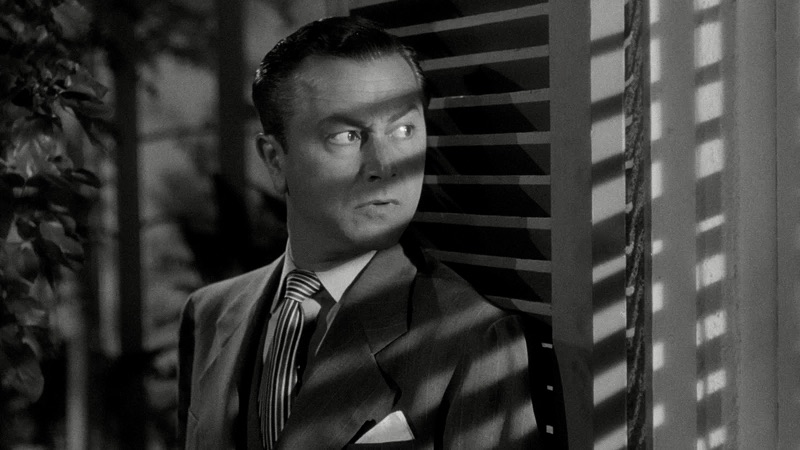
Robert Young plays an embezzler and a womanizer whose luck runs out in THEY WON’T BELIEVE ME (1947), an underrated film noir.

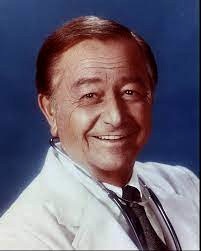
When most baby boomers think of actor Robert Young, they probably recall his popular TV medical series Marcus Welby, M.D. (1969-1976) where he was the epitome of the kind, compassionate doctor or they remember Jim Anderson, the perfect dad in the all-American family sitcom Father Knows Best (1954-1960). He was also typecast as “Mr. Nice Guy” in most of his Hollywood films, playing cheerful romantic leads or the leading man’s best friend or some other debonair, noble or well-intentioned character who rarely made a strong impression compared to more assertive male leads like Clark Gable, Gary Cooper or Spencer Tracy. But there were several occasions when Young discarded his good guy image by playing shadowy characters, outright villains, or damaged human beings.  Among these atypical casting choices, Young is most memorable in Alfred Hitchcock’s Secret Agent (1936) as an undercover spy, a budding fascist in The Mortal Storm (1940), a shellshocked and physically maimed war veteran in The Enchanted Cottage (1945), a complete cad and accused murderer in the underrated film noir They Won’t Believe Me (1947), directed by Irving Pichel, and an architect who is suspected of being a dangerous criminal in The Second Woman (1950).

Robert Young as the star of the popular TV series, MARCUS WELBY, M.D. (1969-1976).
Continue reading

Irene Dunne in a Sinclair Lewis World

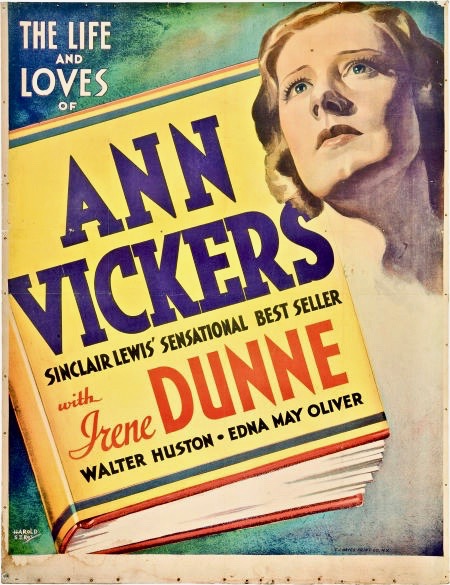
Among the many film adaptations of Sinclair Lewis novels over the years, Ann Vickers (1933) is probably the least known of them all, and, it wasn’t among the most popular or critically acclaimed of Lewis’s novels either. Those would be Main Street (1920), Babbitt (1922), Arrowsmith (1925), Elmer Gantry (1927) and Dodsworth (1929). Yet, Ann Vickers is probably Lewis’s most fully developed female protagonist and the 1933 film version starring Irene Dunne and Walter Huston is a flawed but fascinating movie that provides an apt example of how the work of a great American writer can be completely altered, distorted or softened by Hollywood and the Production Code officials.   Continue reading