Propaganda masquerading as popular entertainment has rarely fooled the ticket-buying public. And American audiences in particular have rarely turned out in large numbers for politically themed movies with the rare exception of a surprise hit such as Michael Moore’s Fahrenheit 9/11. Yet despite the dismal box office potential of most movies with a political agenda, that didn’t stop some studios or filmmakers from taking an ideological stand in the guise of a genre film. Take Howard Hughes for instance. When he assumed control of RKO studios in 1948, he was already a well-known eccentric with a paranoid fear of communist infiltrators in the industry. He immediately fired almost three-fourths of the RKO work force and had the remaining staff members investigated for their political affiliations. Some of the films produced under his reign also reflected his obsession with the “Red Menace” such as The Whip Hand (1951) and Jet Pilot (1957). The most notorious Hughes concoction, however, was The Woman on Pier 13 (1949) which was originally released as I Married a Communist, prior to Senator McCarthy’s investigation of communist activity within the U.S. army, and later, the entertainment industry.
Continue readingTag Archives: Nicholas Ray
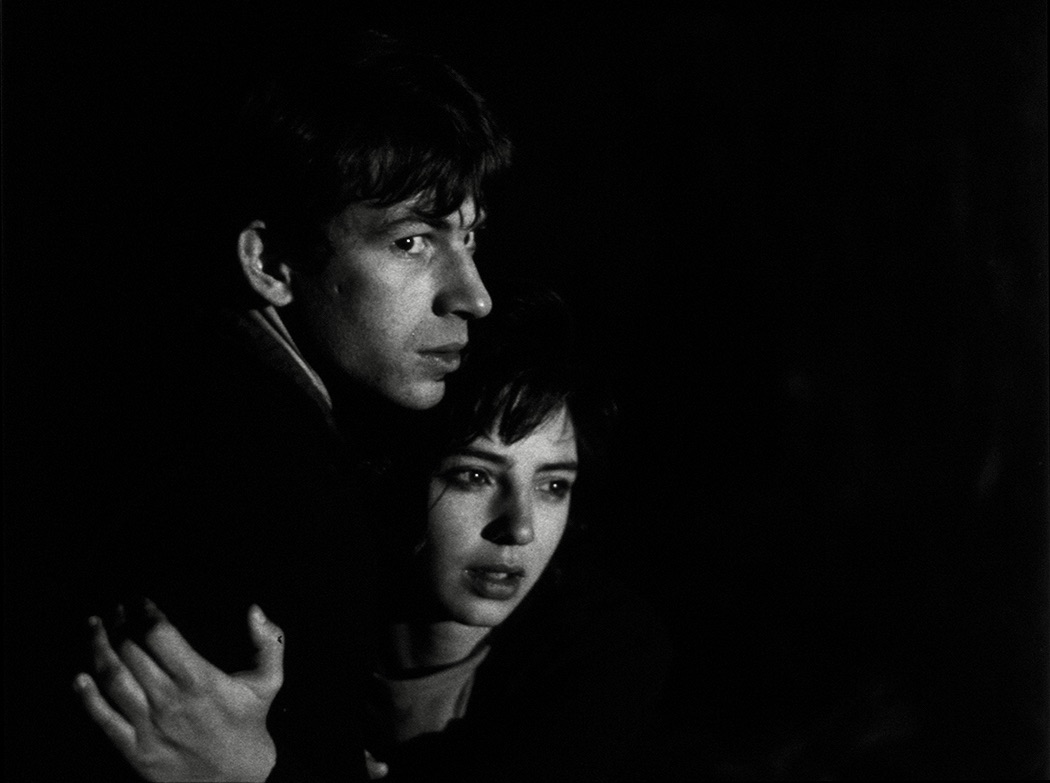
Pedro Costa’s O Sangre

Most film aficionados known that the Cinema Novo movement of the 1960s in Brazil was influenced by both Neorealism and New Wave filmmakers but became an identifiable style of its own. Portugal also had their own Cinema Novo movement in the sixties but it transitioned into a different aesthetic approach in the 1980s known as “The School of Reis,” named after Antonio Reis, a filmmaker and professor at the Lisbon Theater and Film School. Reis influenced a new generation of filmmakers that includes Manuela Viegas, Joaquim Sapinho, Joao Pedro Rodgrigues and Pedro Costa to name a few. Among this group Costa is probably the best known in the U.S. due to his work being exhibited at film festivals and art houses as well as a trilogy of his films known as Letters from Fontainhas being distributed on DVD and Blu-ray by The Criterion Collection. Less known is his 1989 debut feature, O Sangre aka Blood, which Michelle Carey of Senses of Cinema called, “Undoubtedly one of the most remarkable film debuts of the last 20 years.”
Continue readingThe Dirty Little Coward Roadshow

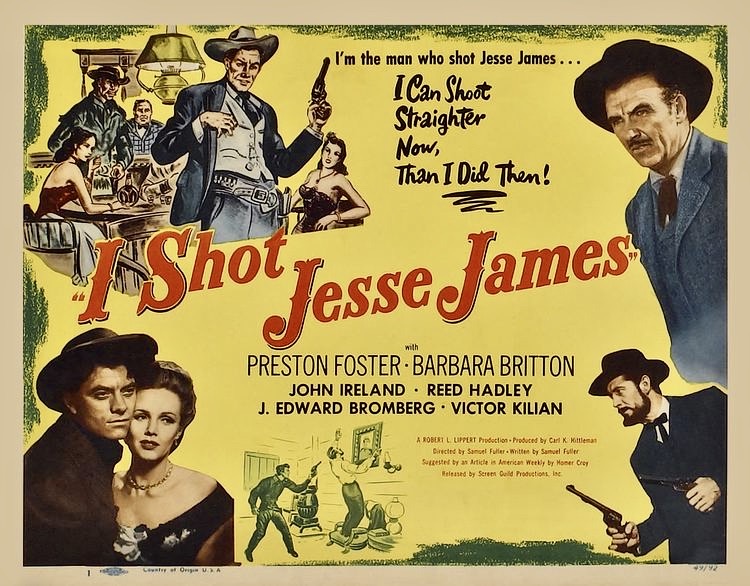
After recently rewatching I Shot Jesse James on DVD from Criterion’s Eclipse label, I couldn’t get a certain scene out of my head. As you may know, this 1949 film is Samuel Fuller’s directorial debut about Robert Ford, the “dirty little coward” who assassinated the frontier legend in 1882 and the scene that pops out occurs not long after Jesse (played by Reed Hadley) is dead and buried. Ford (John Ireland) begins performing re-enactments of the event on stages for money as he travels around capitalizing on his notoriety. At first, I thought this was just a fantasy from Fuller’s fevered, pulp fiction imagination but after doing some research it appears to be true. Robert Ford really did take his act on the road, billing it as “Outlaws of Missouri,” and, night after night before paying audiences, he would act out that fateful day when he shot Jesse James.
Continue readingNicholas Ray’s Gender Bender Western
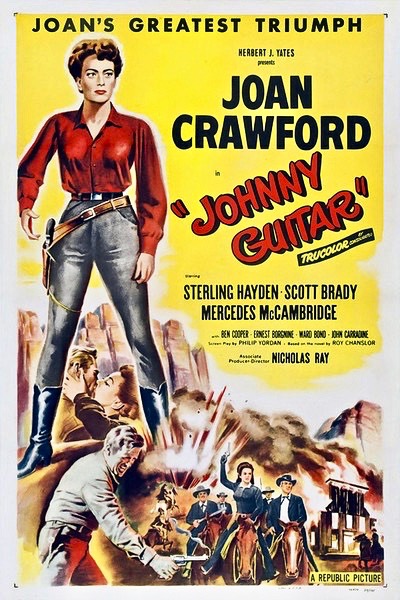
In the fifties, the Western genre experienced a revitalization that saw new approaches to the form – everything from a film noir interpretation like The Furies (1950) to a psychological thriller like High Noon (1952) to a promotional gimmick like the 3-D Western, Hondo (1953). However, it’s safe to say that Johnny Guitar (1954), Nicholas Ray’s bold experiment with color, role reversal, stylized sets, and operatic emotions is a one of a kind masterpiece that will never be repeated. Continue reading