Resistance Begins at Home

In 1940 after France had fallen to the German army, journalist Jean Bruller and his wife, who lived outside Paris, were forced to share their home with a Nazi officer for an extended period of time. That experience inspired Bruller to write the novella Le Silence de la Mer (The Silence of the Sea) under the pseudonym Vercors. The book was secretly published in late 1941 and became known as “the first underground book of the occupation.” It also became an inspiration to the French Resistance in its depiction of using silence as a weapon against the enemy when no other option was possible. It might seem like an unusual choice for French director Jean-Pierre Melville’s feature film debut when you consider that he is mostly famous for his crime and gangster thrillers like Bob le Flambeur (1956), Le Deuxieme Souffle (aka Second Wind, 1966) and Le Samourai (1967). Then again, many consider Melville’s 1969 WW2 drama L’armee des Ombres (aka Army of Shadows) about French underground fighters in Nazi-occupied Paris his masterpiece. Add to this the fact that Melville was also an active member of the French Resistance and The Silence of the Sea makes perfect sense as his feature debut.

Continue reading

Deciphering a French Film Icon

In 1969 French actor Jean-Louis Trintignant had three films in competition at the Cannes Film Festival, Costa-Garvas’s Z, Giuseppe Patroni Griffi’s Metti, Una Sera a Cena (Love Circle) and Eric Rohmer’s My Night at Maud’s, with the actor garnering critical praise for his performance in all three movies. When asked by an interviewer how it felt to be a potential prize recipient, Trintignant replied, “I’m not an award winner. I don’t have that affect to win Best Actor. You need a mad scene or a drunken scene or something like that. And in the films selected I don’t have any like that. All these roles are rather underwhelming. They’re ambiguous. They are complex but not remarkable. I’m not remarkable.” Typical of Trintignant, his response was self-deprecating but also shrewdly self-aware. The irony is that he did win Best Actor at Cannes for Z that year for playing the steadfast, non-partisan investigator of a highly political case. In fact, he built a career playing characters who were often hard to read, repressed or quietly self-possessed, and he made them endlessly fascinating for the viewer. This is just one of many insights shared by director Lucie Caries in Trintignant by Trintignant, an intimate documentary portrait of the actor that was made for French television in 2021, the year before he died. Even though the documentary is barely an hour in length, it pulls from more than 70 years of archival material, photos, interviews, TV and film clips and comments by fellow actors and directors to help dissect the enigma that is Jean-Louis Trintignant.

Continue reading

Expect the Unexpected

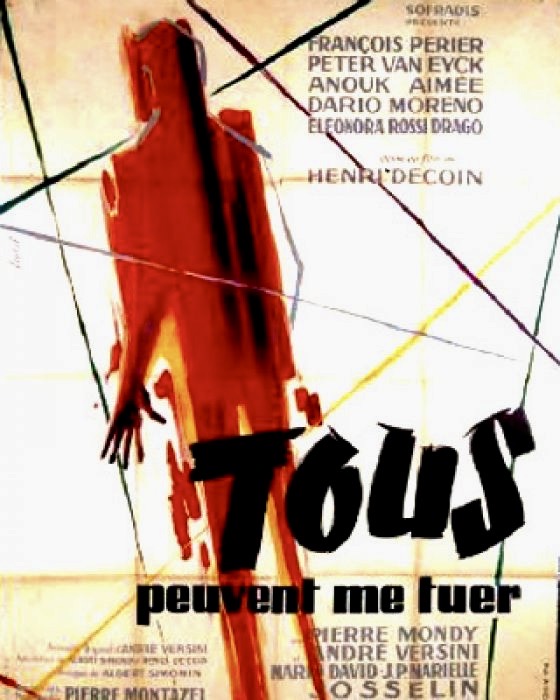
The French film poster for EVERYONE WANTS TO KILL ME (1957), directed by Henri Decoin.

When a movie refuses to fit snugly into a specific genre, that could be a sign that the filmmakers were either unable to capture the desired approach and tone or that the story/screenplay dictated a less conventional approach to the narrative. I suspect that the latter reason is why Tous Peuvent Me Tuer (English title, Everyone Wants to Kill Me, 1957), directed by Henri Decoin, is hard to place into any specific film category. If you were to watch the movie with the sound turned off, you would probably classify it as a brooding French noir. Yet, if you add in the music score and the animated performances, it comes across as an almost lighthearted crime caper flick. Add to this a segue into prison melodrama which soon becomes a whodunit murder mystery. And just to keep things off balance, stir in a romance, some comic relief and a wrap-up that positions the entire affair as a morality play. 

Continue reading

Lily in Wonderland

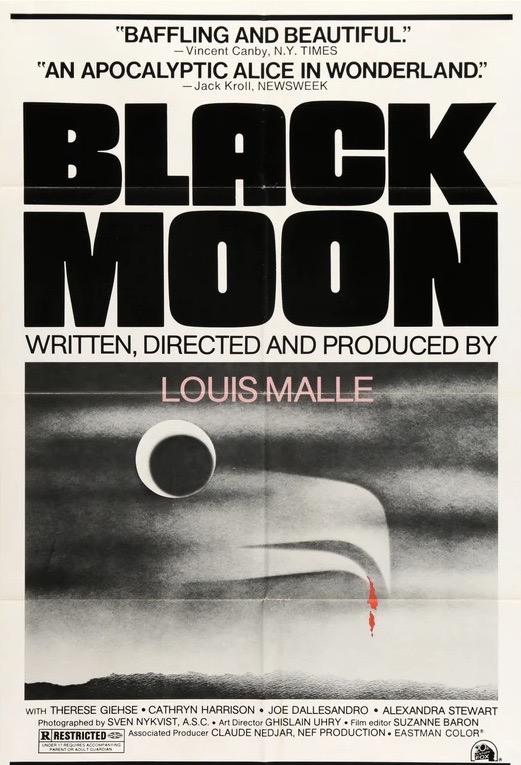
Lily (Cathryn Harrison) flees a global conflict and finds refuge in a mysterious country estate in the 1975 fantasy BLACK MOON, which is partly inspired by Lewis Carroll’s ALICE IN WONDERLAND.

Louis Malle has never been the sort of filmmaker critics could easily pigeonhole in terms of his style and interests. He’s worked in practically every film genre (thriller, social satire, melodrama, documentary, etc.) and his restless curiosity has led him to explore a vast array of subjects from underwater life (The Silent World, 1956) to sexual liberation (The Lovers, 1958) to life under the Nazi occupation (Au Revoir, Les Enfants, 1987). Yet, for even an iconoclast like Malle, his 1975 film Black Moon is unlike anything he’s ever done before or since. “Opaque, sometimes clumsy, it is the most intimate of my films,” he once said. “I see it as a strange voyage to the limits of the medium, or maybe my own limits.” 

Continue reading

Beneath the Mediterranean, the Red Sea and the Indian Ocean

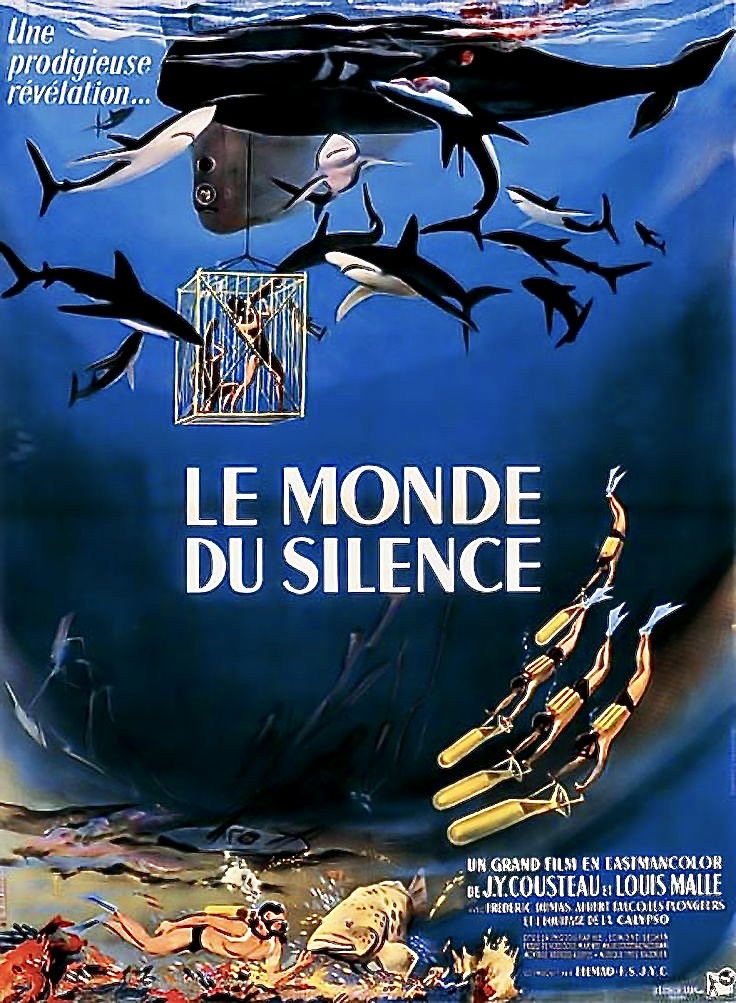
The French film poster for THE SILENT WORLD (1956), Jacques Cousteau’s first feature length documentary.

Jacques-Yves Cousteau was undoubtedly one of the greatest explorers of the 20th century but what he discovered was a world most people had never seen before and it was hiding in plain sight under the ocean. His scientific innovations to deep sea diving and his never-before-seen underwater cinematography introduced most people to marine life, behavior and landscapes that were just as strange, beautiful and mysterious as life on another planet. Although he had made numerous short documentaries on the sea throughout the forties starting with Par Dix-huit Metres de Fond in 1943, it was feature length non-fiction film debut, The Silent Sea (Le Monde du Silence, 1956), co-directed with Louis Malle, that first attracted international attention and inspired school kids to want to become explorers, photographers and oceanographers. Seen today, the film is still a fascinating introduction to Cousteau’s world but, like some nature documentaries, it presents images of unearthly beauty mixed with cruelty and violence that wouldn’t be out of place in a Mondo Cane-like exploitation expose. It also presents a more pristine world under the sea before oil spills, global warming and overfishing helped reduce marine life as well as eradicating entire species of fish. 

Continue reading

Georges Franju & Jean Cocteau: Thomas the Impostor

World War I has been the subject of some of the most powerful and prestigious films in cinema from King Vidor’s The Big Parade (1925) and Lewis Milestone’s All Quiet on the Western Front (1930) to Stanley Kubrick’s Paths of Glory (1957) and more recently, Sam Mendes’ 1917 (2019), nominated for ten Oscars including Best Picture. All of those films captured the grim horrors of the battlefield, the demoralization and death toll of the troops and the often reckless or unnecessary military strategies of commanding officers. Going against the grain is Thomas l’imposteur (Thomas the Impostor), based on Jean Cocteau’s 1923 novel which was inspired by his own experiences during WW1 as an ambulance driver for the Red Cross. Directed by Georges Franju from a screenplay by himself, Cocteau and Michel Worms, the 1965 film views war through the experiences of two idealistic dreamers, one an aristocrat, the Princess de Bormes (Emmanuelle Riva), the other an orphan (Fabrice Rouleau), who lies about his age and invents a fake backstory for himself so he can enlist. The result is a unique take on the Great War which combines the ambiance of a dark fairy tale with a realistic but emotionally detached approach to the events as they affect the two main protagonists.

Continue reading

Lee Marvin in Canicule

As a big Lee Marvin fan, I have seen a large amount of his work on TV and the screen, even many of the early roles in the fifties when he was an unbilled bit player or an extra in such films as the war drama Teresa (1951) or the suspense thriller Diplomatic Courier (1952). As he moved into larger supporting roles, usually playing the heavy, he often became the most electrifying presence in the film, whether it was a noir (The Big Heat, 1953), western (Gun Fury, 1953) or drama (The Wild One, 1953). But he really hit his stride in the early sixties starting with his fearsome gunslinger in John Ford’s The Man Who Shot Liberty Valance (1962) and moving into starring roles with a string of iconic performances in The Killers (1962), Cat Ballou (1965), a dual role which won him the Best Actor Oscar, Ship of Fools (1965), The Professionals (1966), The Dirty Dozen (1967) and the cult favorite Point Blank (1967). Nobody, however, even Marvin himself, could have predicted that one of his final movies would be made in France with an international cast and the result – Canicule (English title: Dog Day, 1984) – is certainly one of the oddest films of his career, if not the most eccentric.

Continue reading

Under Surveillance

Raphael (Jean-Louis Trintignant) is a secret operative who is monitoring the daily life of a suspected Nazi war criminal in UN HOMME A ABATTRE (A Man to Kill, 1967).

We will probably never know the exact number of Nazi war criminals who escaped from Germany in the aftermath of WW2 and made their way to South America but some of the more infamous ones are Adolf Eichmann, who was later captured in Buenos Aires, brought to trial in Israel and executed in 1962, and Josef Schwammberger, who was arrested in Argentina and returned to West Germany for a trial in 1992 (he was sentenced to life in prison and died there). At the same time, there have been reports that as many as 9,000 Nazi officers and collaborators found a safe haven in countries like Brazil and Paraguay under new identities and were never arrested for their war crimes. This unsettling realization inspires the narrative of Philippe Condroyer’s A Man to Kill (French title: Un Homme a abattre, 1967), a fictional espionage thriller that focuses on a suspected concentration camp officer who resurfaces in Barcelona years later as a low profile German architect.

Continue reading

Deadpan Lunacy

Amid the avalanche of overproduced and overmarketed films that flooded movie theaters in the summer of 2006 (Poseidon, Miami Vice, Lady in the Water and Snakes on a Plane to name a few), a gallic import flew in under the radar and delighted any moviegoer willing to give in to its droll sense of humor and fond appreciation of the spy thriller genre of the sixties. OSS 117: Cairo, Nest of Spies was a huge box-office hit in France and Europe but it barely lasted a week in many of its U.S. playdates.

Continue reading

Robert Bresson’s Parisian Reverie

The French film poster for FOUR NIGHTS OF A DREAMER (1971), directed by Robert Bresson.

One wouldn’t normally associate Robert Bresson with such rapturously romantic, Paris-based films as Ninotchka, An American in Paris, Funny Face, Gigi, and Love in the Afternoon yet Four Nights of a Dream (Quartre Nuits d’un Reveur, 1971) is probably the closest the French director has ever come to making a film about love, longing and desire. You could even say it is almost a musical since strolling street musicians occasionally break into song at unexpected moments in the narrative.

Continue reading