Perfect Pitch

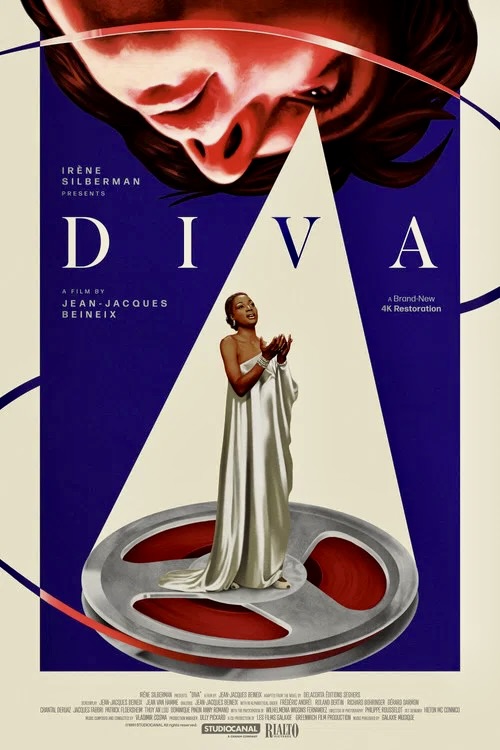
1981 was the year that a French film with the title Diva became a surprise box office hit in America. It grossed $6 million dollars, making it the third most profitable French since 1975 to attract both mainstream and art house audiences plus most of the important critics loved it. Roger Ebert of The Chicago Sun-Times called it, “A visual extravaganza. One of the most persistently entertaining, absorbing and scary thrillers I’ve seen in a long time.” Pauline Kael of The New Yorker raved, “Every shot seems to have a shaft of wit. It’s Welles romanticized, gift-wrapped. It’s a mixture of style and chic hanky-panky, but it’s also genuinely sparkling.” And J. Hoberman of The Village Voice stated, “Diva is not only the most purely pleasurable movie to open here this year, but surely one of the finest films to arrive from France in a decade.” Yet the film was a complete flop in France when it opened there with most critics attacking the film for a visual aesthetic they claimed was inspired by commercial advertising. Strangely enough, after Diva became a hit in America and around the world, French critics and audiences changed their minds and it finally became a commercial success in its own country, winning four Cesar Awards (the French equivalent of the Academy Awards) – Best First Work (director Jean-Jacques Beineix’s debut feature), Best Music Score (Vladimir Cosma), Best Cinematography (Philippe Rousselot) and Best Sound (Jean-Pierre Ruh). So how does it hold up today?

Continue reading

Deciphering a French Film Icon

In 1969 French actor Jean-Louis Trintignant had three films in competition at the Cannes Film Festival, Costa-Garvas’s Z, Giuseppe Patroni Griffi’s Metti, Una Sera a Cena (Love Circle) and Eric Rohmer’s My Night at Maud’s, with the actor garnering critical praise for his performance in all three movies. When asked by an interviewer how it felt to be a potential prize recipient, Trintignant replied, “I’m not an award winner. I don’t have that affect to win Best Actor. You need a mad scene or a drunken scene or something like that. And in the films selected I don’t have any like that. All these roles are rather underwhelming. They’re ambiguous. They are complex but not remarkable. I’m not remarkable.” Typical of Trintignant, his response was self-deprecating but also shrewdly self-aware. The irony is that he did win Best Actor at Cannes for Z that year for playing the steadfast, non-partisan investigator of a highly political case. In fact, he built a career playing characters who were often hard to read, repressed or quietly self-possessed, and he made them endlessly fascinating for the viewer. This is just one of many insights shared by director Lucie Caries in Trintignant by Trintignant, an intimate documentary portrait of the actor that was made for French television in 2021, the year before he died. Even though the documentary is barely an hour in length, it pulls from more than 70 years of archival material, photos, interviews, TV and film clips and comments by fellow actors and directors to help dissect the enigma that is Jean-Louis Trintignant.

Continue reading