
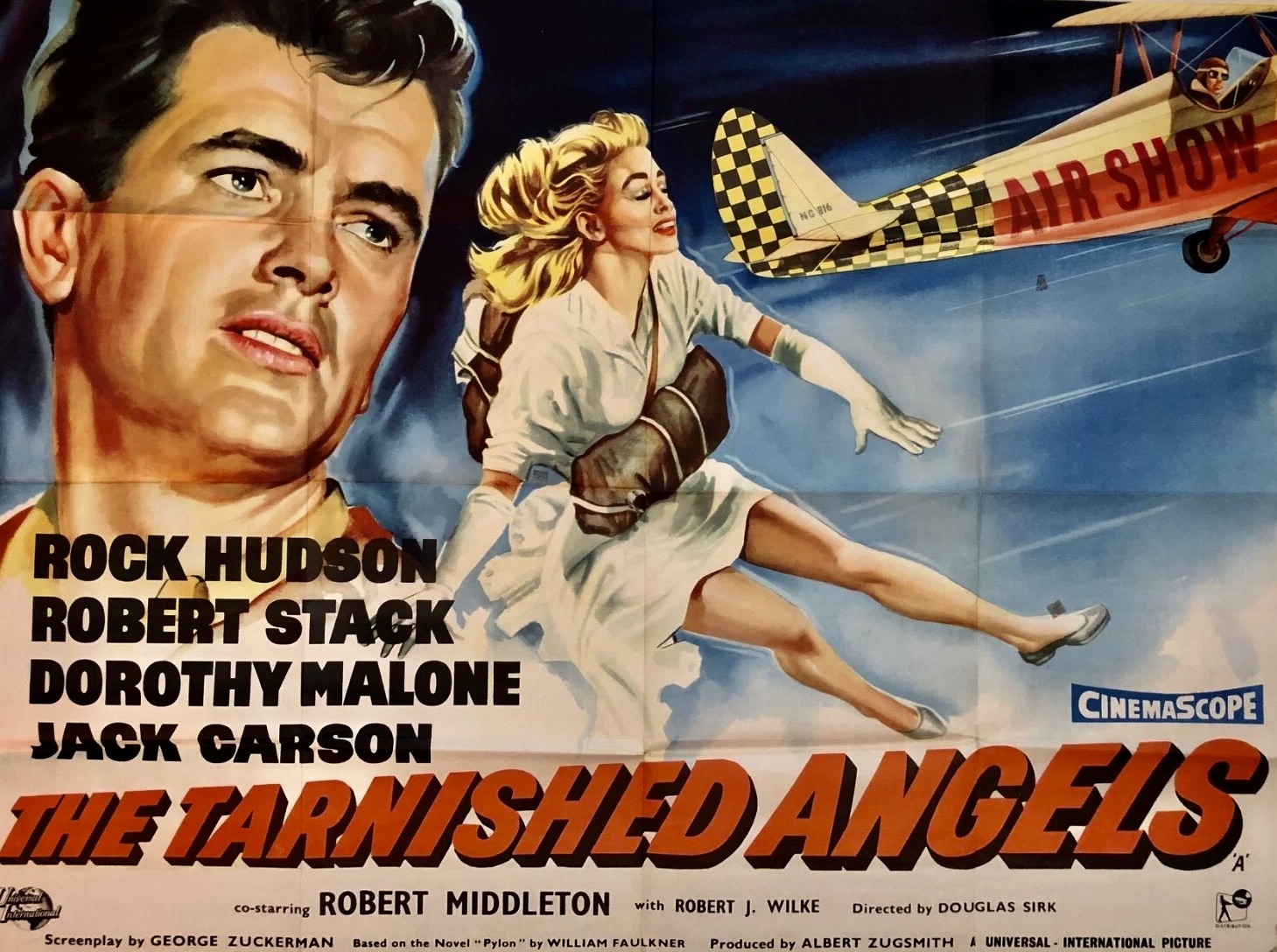
Aerial Daredevils

Among the many novels of William Faulkner, Pylon is less well known today than some of the author’s more critically acclaimed works such as The Sound and the Fury, Intruder in the Dust and The Reivers (a 1962 Pulitzer Prize winner). Yet, the novel, dismissed by most critics of its era as a tawdry melodrama, is a deeply personal work, reflecting Faulkner’s keen interest in flying while including autobiographical details from his own life. The 1957 film adaptation of Pylon entitled The Tarnished Angels and directed by Douglas Sirk was also unfairly dismissed by critics at the time with one reviewer calling it “…cheaply written…abominably played…and absurd” while another panned it as “mostly colorless…and lacking in punch.” Most surprisingly, The Tarnished Angels reunited three of the main actors from Sirk’s Academy Award nominated Written on the Wind from the previous year – Rock Hudson, Robert Stack and Dorothy Malone (who won the Best Supporting Actress Oscar) – but it was completely ignored by the Academy even though the movie is much more highly regarded now.

Continue reading

Lee Marvin in Canicule

As a big Lee Marvin fan, I have seen a large amount of his work on TV and the screen, even many of the early roles in the fifties when he was an unbilled bit player or an extra in such films as the war drama Teresa (1951) or the suspense thriller Diplomatic Courier (1952). As he moved into larger supporting roles, usually playing the heavy, he often became the most electrifying presence in the film, whether it was a noir (The Big Heat, 1953), western (Gun Fury, 1953) or drama (The Wild One, 1953). But he really hit his stride in the early sixties starting with his fearsome gunslinger in John Ford’s The Man Who Shot Liberty Valance (1962) and moving into starring roles with a string of iconic performances in The Killers (1962), Cat Ballou (1965), a dual role which won him the Best Actor Oscar, Ship of Fools (1965), The Professionals (1966), The Dirty Dozen (1967) and the cult favorite Point Blank (1967). Nobody, however, even Marvin himself, could have predicted that one of his final movies would be made in France with an international cast and the result – Canicule (English title: Dog Day, 1984) – is certainly one of the oddest films of his career, if not the most eccentric.

Continue reading

Norman Lloyd: Hollywood’s Long Distance Runner, Part 1

Norman Lloyd hangs on for dear life in Alfred Hitchcock’s Saboteur (1942).

On November 8, 2017 Norman Lloyd will be 203 and he shows no signs of slowing down. In recent years, he has become the go-to historian for the American film industry’s golden era due to his friendship and working relationships with such cinema legends as Charlie Chaplin, Jean Renoir, Orson Welles, Alfred Hitchcock, John Garfield, Bernard Herrmann, John Houseman, Joseph Losey and others. Lloyd also continues to take acting roles (he has a nice cameo in the 2015 Judd Apatow comedy Trainwreck starring Amy Schumer) and appear as an interviewee in documentaries such as Marsha Hunt’s Sweet Adversity (2015) and Broadway: Beyond the Golden Age, which is currently in post-production.

*This is a revised and updated version of the original interview which was recorded in March 2010 just prior to Lloyd’s appearance at the first Turner Classic Movies Classic Film Festival.   Continue reading