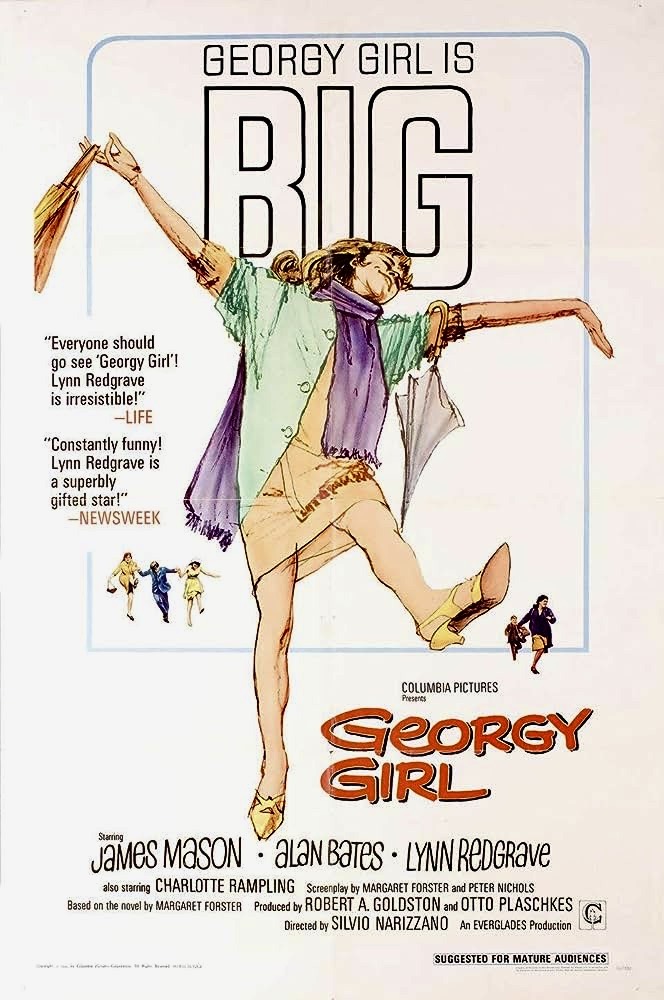
Swinging Down the Street So Fancy Free

A frumpy woman in her early twenties dreams of being loved but despite her continual attempts to have a romance finds herself observing life from the sidelines, barely noticed by those around her. Reduced to a one sentence description, Georgy Girl (1966) sounds dreary and depressing but on-screen this tale of a desperately lonely woman unfolds as a madcap, often irreverent farce which at times is cruelly indifferent to the sad-sack characters it parades before us. This is a film where tone is everything and Georgy Girl, directed by Silvio Narizzano, is distinctively different in this respect, standing out from countless other cinematic tearjerkers about ugly ducklings and lonely spinsters. The film also captures London at the height of the Swingin’ Sixties when everything seemed like a put-on or a come-on.

Continue reading

Saboteur, Pawn or Hero?

Orzechowski (Kaimierz Opalinski), a retired railroad employee, tries to prevent an impending disaster in the 1957 Polish drama Czlowiek na Torze (English title: MAN ON THE TRACKS), directed by Andrzej Munk.

A train rushes through the night somewhere in Poland and the engineer receives an all-clear signal from the local lineman as it moves full speed ahead through a rural crossing. Suddenly a man appears in the train headlights and seems to be warning the engineer of some impending danger but is struck down before the train can be stopped. The victim is Wladyslaw Orzechowski, a former railroad employee who was recently goaded into retirement. Czlowiek na Torze (English title: Man on the Tracks, 1957) is, in some ways, a mystery except that we know the identity of the victim and how he died. The big question is why and Polish director Andrzej Munk presents the facts of the case in the form of a crime procedural crossed with a flashback structure seemingly influenced by the 1950 Japanese film Rashomon. Four people, including three witnesses, give their versions of the event, and each one adds another level of insight and complexity to the tragedy.

Continue reading

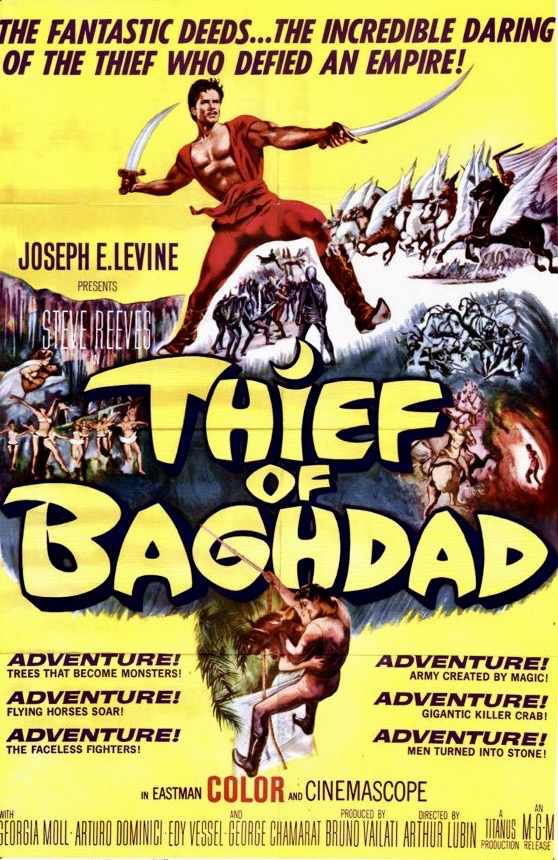
Steve Reeves as The Thief of Baghdad

One Thousand and One Nights also known as the Arabian Nights is a collection of stories from the Middle East and India that can be traced back to the 9th century although the author or authors of the tales are anonymous. What is known is that the stories introduced such famous fictional characters as Sinbad, Aladdin, Ali Baba and others, all of whom have inspired numerous film versions of their exploits. One of my favorite Arabian Nights fables is The Thief of Bagdad but the first movie version I encountered was the 1961 Italian fantasy-adventure Il Ladro di Bagdad (released in an English dubbed version as The Thief of Baghdad in the U.S.) starring Steve Reeves. First seen at a kiddie matinee during its original release, it made a strong impression on me as a ten-year-old, even if it is not the best known, most lavish or critically respected of the many film versions. 

Continue reading

True Love Transcends Everything

Marina (Hildegard Knef) and Alexander (Gustav Frohlich) make a final toast to their eternal love for each other in Die Sunderin (English title: THE SINNER, 1951), a West German romantic tragedy directed by Willi Forst.

Sometimes an offscreen scandal can kill or severely hamper a career (Fatty Arbuckle, Ingrid Bergman, Rose McGowan, etc.) or help bolster it as in the case of Mary Astor, Hedy LaMarr or Elizabeth Taylor. But what if the scandal is the film itself as in The Moon is Blue (1953), Baby Doll (1956) or Last Tango in Paris (1972)? That kind of notoriety can play out in different ways affecting the careers of the featured stars in a negative or positive way. A famous example of the latter is Die Sunderin (English title: The Sinner, 1951), a West German melodrama from Viennese director Willi Forst in which two social outcasts embark on a love affair which brings them true happiness and spiritual redemption after years of misery. The film created a public outcry in Germany due to a nude scene featuring the popular female star, Hildegard Knef. It might seem much ado about nothing today but at the time the typically conservative German moviegoer was offended. More importantly, it didn’t hurt Ms. Knef’s career at all and may have helped launch her international career. She was invited back to Hollywood the same year (where she had previously been under contract), made a few high profile films, and then returned to Germany where she not only resumed her film career but also became a renowned chanson-singer in the style of Marlene Dietrich, a mentor and friend.

Continue reading

The Vampire Moth

The Japanese film poster for Kyuketsu-ga (English title: THE VAMPIRE MOTH, 1956).

There are a number of classic Japanese horror/fantasy films from the fifties and sixties that genre fans in the U.S. have read about but never seen due to their unavailability on DVD or Blu-ray. In recent years a few of these have appeared in domestic release versions such as Nobuo Nakagawa’s 1960 allegorical masterpiece Jigoku (released by The Criterion Collection), in which a hit-and-run driver literally goes to hell, and the director’s 1968 supernatural tale Snake Woman’s Curse (released by Synapse Films). Many of the most famous examples of Japanese fantasy/horror from this period, however, still remain elusive for American viewers unless you own an all-region DVD/Blu-ray player and are willing to purchase import discs from Japan, often with no English subtitles. It is also true that many of these classic genre efforts were directed by Nakagawa who is famous for supernatural chillers as The Ghosts of Kasane Swamp (1957), Black Cat Mansion (1958), and The Ghost of Yotsuya (1959). But I have to admit that one of the director’s creepiest and least seen films is Kyuketsu-ga (English title: The Vampire Moth, 1956), which combines mystery thriller tropes with grotesque horror elements to achieve a delightfully macabre brew.

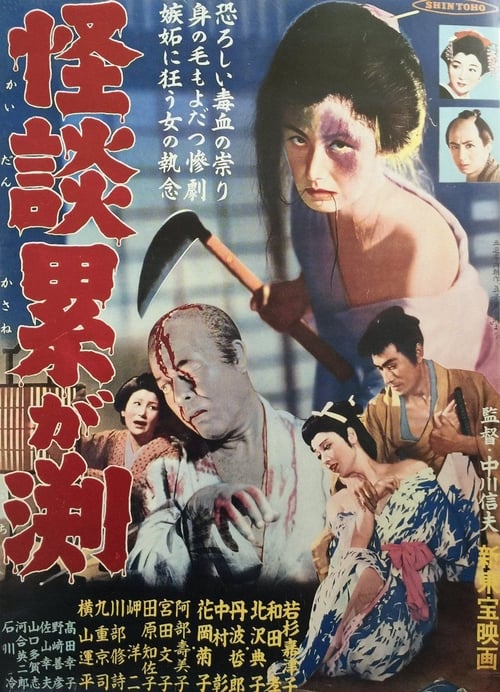
The Japanese poster for Kaidan Kasane-ga-fuchi (English title: THE GHOSTS OF KASANE SWAMP aka THE DEPTHS, 1957).
Continue reading

Cecil B. DeMille’s Seafaring Epic

When fans of classic films from Hollywood’s golden era exclaim “They don’t make ‘em like they used to,” they are usually referring to the kind of lavish, big-budget, audience-pleasing entertainments that were the specialty of Cecil B. DeMille during the silent and sound eras. Often derided by some critics as being corny and bombastic with an exploitable mix of sex, violence and quasi-religious elements, his most popular films were always in sync with what audiences wanted from a movie during his 45-year reign as a major Hollywood director/producer. Three of DeMille’s biblical epics, The Ten Commandments (1923), The King of Kings (1927), and Samson and Delilah (1949), along with Reap the Wild Wind (1942) are still considered some of the biggest box office hits in the history of Hollywood. The latter film, in particular, is an excellent example of his larger-than-life approach to storytelling mixing rival sea captains, a hurricane, and a giant red squid into a torrid romantic saga based on Thelma Strabel’s best selling novel.

Continue reading