
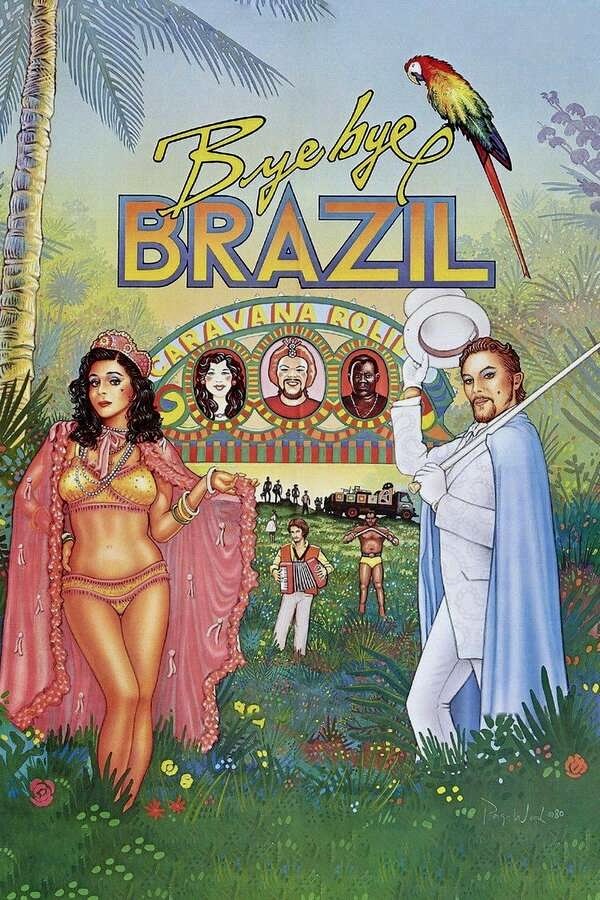
I remember the first time I became aware of Brazilian director Carlos Diegues (1940-2025). It was at the 8th Telluride Film Festival in the Fall of 1981 where he was the focus of a special tribute (the other two were Yugoslavian director Dusan Makavejev and Hollywood character actors featuring Margaret Hamilton, Woody Strode, John Carradine and Elisha Cook Jr.). A mini-retrospective of Diegues’s films were shown with the director in attendance and included Ganga Zumba (1963), A Grande Cidade aka The Big City (1966) and Xica de Silva (1976), an exuberant social comedy about a 18th century black slave who achieves her liberation through political and sexual means. Xica de Silva was the only Diegues movie I saw at the festival but its colorful art direction, playful mix of history and fiction and a music score by Jorge Ben and Roberto Menescal made a strong impression. It was only later in 1981 that I saw Bye Bye Brazil (1980), Diegues’s art house breakthrough hit, and realized what an important figure he was in Brazilian cinema. Prior to this, the only movie from Brazil I had seen was Black Orpheus (1959) and that was an international co-production between France, Brazil and Italy.
Continue readingTag Archives: Pixote
Gloom and Doom in Snowdonia
After winning the Michael Powell Award for Best British Feature at the 2019 Edinburgh International Film Festival and various other accolades in Europe, William McGregor’s debut feature Gwen is opening in selected theaters across the U.S. this August. Some critics have compared it to Robert Eggers’ The Witch (2015), Ben Wheatley’s A Field in England (2013) and other historical dramas with supernatural elements but don’t be misled by those comparisons. The horrors that await Gwen are grounded in reality – sickness, animal deaths, misogyny and grinding poverty. Continue reading
A Tale from the Slums of Rome
In its own way, Pier Paolo Pasolini’s 1961 directorial debut Accattone could be seen as the last gasp of the Italian neo-realism movement. It is also a remarkably self-assured first film that blends the lyrical with the sordid in its depiction of life on the outskirts of Rome where pimps, thieves and petty criminals scrounge for a living with little hope of ever escaping their dead-end existence. Based on Pasolini’s second novel, Una Vita Violenta, Accatone successfully launched Pasolini as a film director but also marked the beginning of an acting career for Franco Citti in the title role. What is most interesting is that Una Vita Violenta was again adapted for the screen under that title the following year but it is hardly ever mentioned or revived. Pasolini had no involvement with the production but it did star Franco Citti in the central role of Tommaso, a character similar to Accattone, and the two films would make a fascinating double feature in terms of their contrasting tones and directorial style. Continue reading
