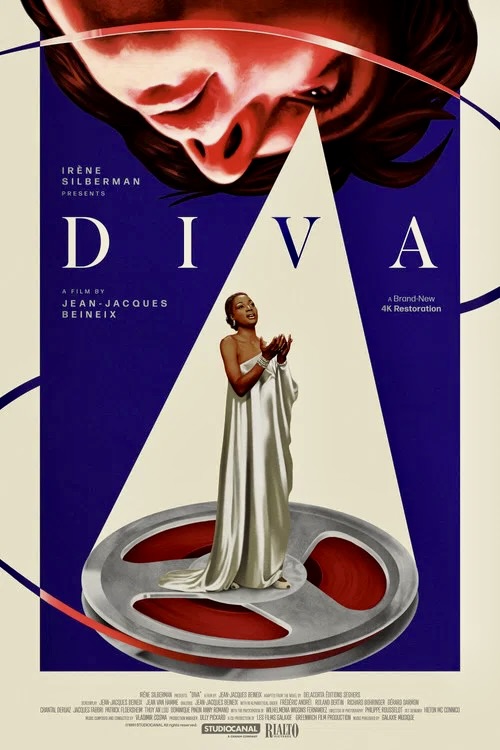
1981 was the year that a French film with the title Diva became a surprise box office hit in America. It grossed $6 million dollars, making it the third most profitable French since 1975 to attract both mainstream and art house audiences plus most of the important critics loved it. Roger Ebert of The Chicago Sun-Times called it, “A visual extravaganza. One of the most persistently entertaining, absorbing and scary thrillers I’ve seen in a long time.” Pauline Kael of The New Yorker raved, “Every shot seems to have a shaft of wit. It’s Welles romanticized, gift-wrapped. It’s a mixture of style and chic hanky-panky, but it’s also genuinely sparkling.” And J. Hoberman of The Village Voice stated, “Diva is not only the most purely pleasurable movie to open here this year, but surely one of the finest films to arrive from France in a decade.” Yet the film was a complete flop in France when it opened there with most critics attacking the film for a visual aesthetic they claimed was inspired by commercial advertising. Strangely enough, after Diva became a hit in America and around the world, French critics and audiences changed their minds and it finally became a commercial success in its own country, winning four Cesar Awards (the French equivalent of the Academy Awards) – Best First Work (director Jean-Jacques Beineix’s debut feature), Best Music Score (Vladimir Cosma), Best Cinematography (Philippe Rousselot) and Best Sound (Jean-Pierre Ruh). So how does it hold up today?
Continue reading