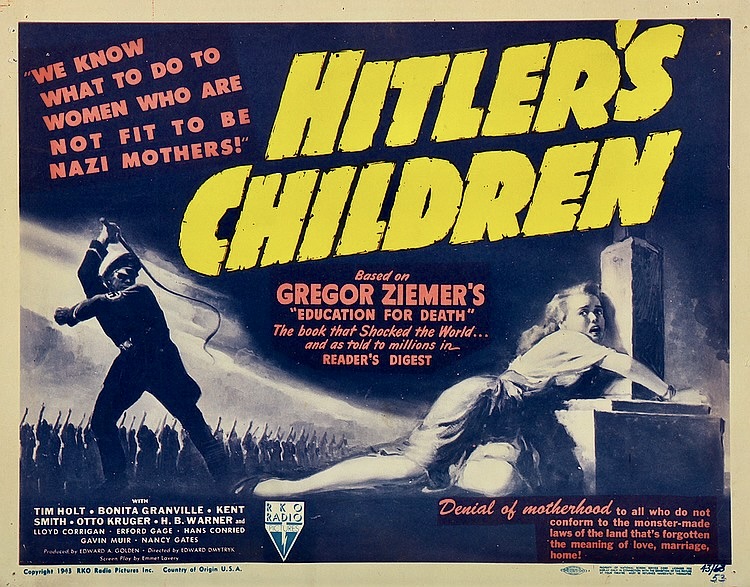
You’d expect a film with a title like Hitler’s Children (1943) to be an exploitation picture, not a prestige production and you wouldn’t be wrong in most respects. But this sensationalistic melodrama about a Nazi youth and his American girlfriend struck a resonant chord with audiences of its era, making it the highest grossing film of all time for RKO Studios, surpassing even the box office receipts of King Kong (1933) and Top Hat (1935).
Marina (Hildegard Knef) and Alexander (Gustav Frohlich) make a final toast to their eternal love for each other in Die Sunderin (English title: THE SINNER, 1951), a West German romantic tragedy directed by Willi Forst.
Sometimes an offscreen scandal can kill or severely hamper a career (Fatty Arbuckle, Ingrid Bergman, Rose McGowan, etc.) or help bolster it as in the case of Mary Astor, Hedy LaMarr or Elizabeth Taylor. But what if the scandal is the film itself as in The Moon is Blue (1953), Baby Doll (1956) or Last Tango in Paris (1972)? That kind of notoriety can play out in different ways affecting the careers of the featured stars in a negative or positive way. A famous example of the latter is Die Sunderin (English title: The Sinner, 1951), a West German melodrama from Viennese director Willi Forst in which two social outcasts embark on a love affair which brings them true happiness and spiritual redemption after years of misery. The film created a public outcry in Germany due to a nude scene featuring the popular female star, Hildegard Knef. It might seem much ado about nothing today but at the time the typically conservative German moviegoer was offended. More importantly, it didn’t hurt Ms. Knef’s career at all and may have helped launch her international career. She was invited back to Hollywood the same year (where she had previously been under contract), made a few high profile films, and then returned to Germany where she not only resumed her film career but also became a renowned chanson-singer in the style of Marlene Dietrich, a mentor and friend.
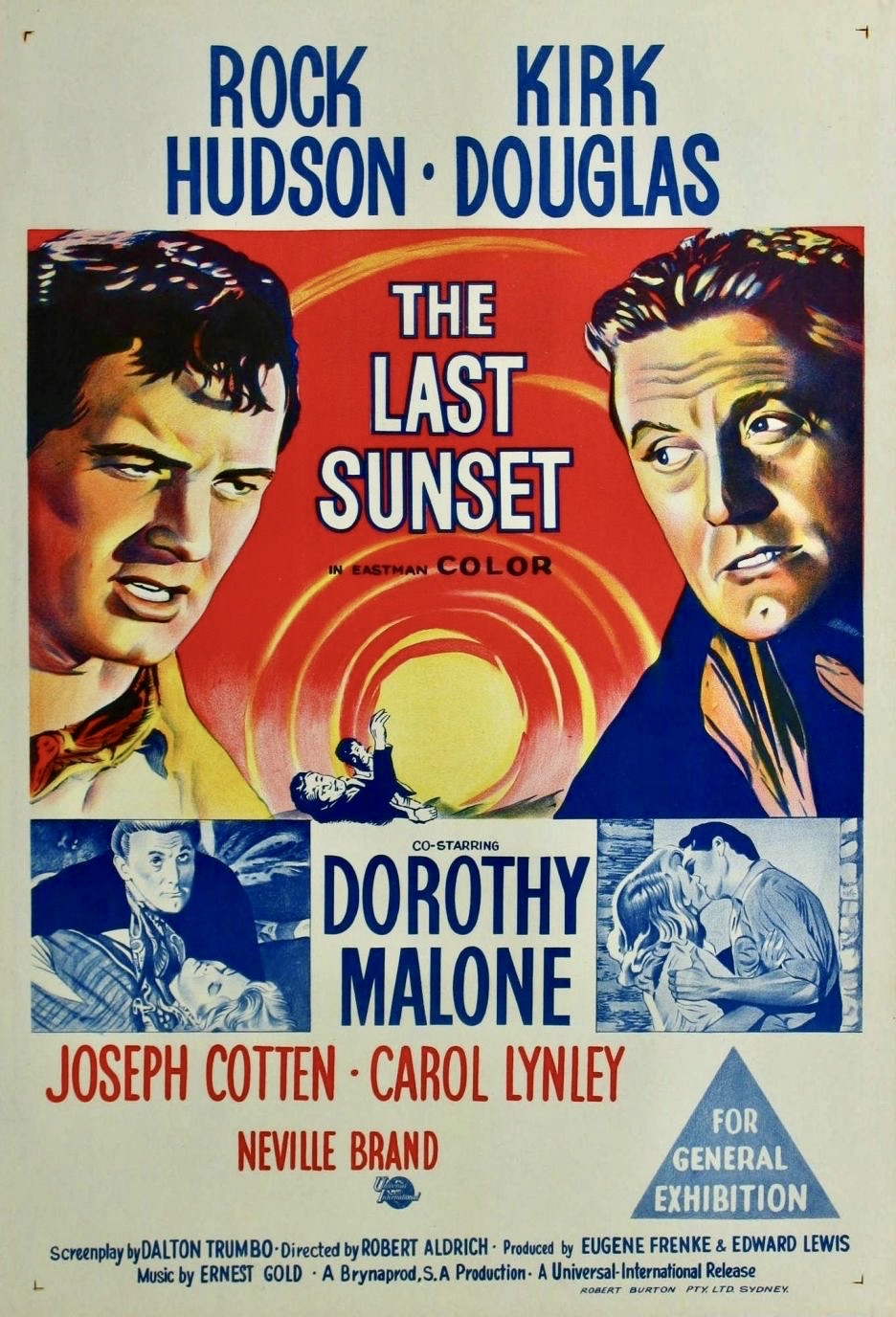
One of the more ambitious and offbeat Westerns of the early sixties, The Last Sunset (1961) is an odd duck that has its admirers and detractors with several participants of the film – director Robert Aldrich, screenwriter Dalton Trumbo and star Kirk Douglas – being the most vocal about its flaws and unrealized potential. For a frontier tale that attempts to emulate a Greek tragedy on the range, there is an abundance of plot twists and varying acting styles to keep you riveted to the sight of this often visually stunning box office failure. Themes of revenge, incest, and cowardice infused with an overarching cod psychology are baked in a heavy casserole that includes dust storms, a cattle stampede, quicksand, trigger-happy rustlers, embittered ex-Confederates in the post-Civil War years, marauding Indians and a natural phenomenon known as St. Elmo’s fire. Even Leonard Maltin in his capsule movie review for his popular guide calls it “Strange on the Range.”
That unlikely combination in the header is just part of the quirky appeal of Lured, a 1947 mystery released by United Artists which is also equal parts comedy and romance. It was a remake of the French film Pieges [1939] by Robert Siodmak and starred Erich von Stroheim, Marie Déa and Maurice Chevalier. Most biographers of Lucille Ball and director Douglas Sirk have routinely dismissed it as an insignificant film in their careers but I think part of the problem was that critics and audiences expected a genuine thriller and got something else entirely. It is an eccentric original and highly recommended for anyone who wants to see Lucille Ball in one of her most underrated and accomplished performances; she plays dance hall hostess hired by the police as an undercover female detective and “bait” for a London serial killer. Continue reading →



 Cinema Sojourns