As 2017 drew to a close, Hollywood studios and independent film distributors raced to release their best movies in order to qualify for Oscar consideration. The documentary category in particular was unusually strong that year with such critically acclaimed contenders as JR & Agnes Varda’s Faces Places, Ai Weiwei’s Human Flow and Errol Morris’s The B-Side: Elsa Dorfman’s Portrait Photography. Mostly overlooked among the many offerings, however, was a remarkably diverse portrait of the artist Joseph Beuys (1921-1986) from Germany entitled Beuys (2017), directed by Andres Veiel.
Maryutkh (Izolda Izvitskaya), a Red Army sharpshooter, prepares to greet some approaching White Army members in the Russian Revolution war drama THE FORTY-FIRST (1956).
After the death of Soviet premier Joseph Stalin in 1953, Russia began to experience a less repressive period in the arts, especially the cinema, which had previously been used for mostly propaganda purposes. During this brief period, which flourished between 1953 and 1967, Russian filmmakers were allowed to explore the artistic possibilities of the medium, resulting in a number of cinematic masterpieces which enjoyed international distribution, even in the U.S. Among the more famous of examples from the “Cinema of the Thaw” (as it came to be called) are Sorok Pervyy (The Forty-First, 1956), Letyat Zhuravli (The Cranes are Flying, 1956), the historical epic, Tikhiy Don (And Quiet Flows the Don (1957), Don Kikhot (Don Quixote, 1957), The Idiot (1958), based on the novel by Fyodor Dostoevsky, and Ballada o Soldate (Ballad of a Soldier, 1959). The latter film, in particular, which won a special award for director Grigori Chukhrai at the Cannes Film Festival, is still considered a high water mark for Soviet cinema in the 50s but it is Chukhrai’s debut film, The Forty-First, which launched the director’s career and is in danger of being forgotten.
*This article originally appeared on Movie Morlocks, Turner Classic Movies’s official blog in May 2011 (The blog was discontinued years ago and is no longer available)
In the event-packed hurly burly of TCM’s second annual Film Festival in Los Angeles from April 28-May 1 of 2011, I didn’t have a chance to blog about all of the films or attending guests that I saw but here are a few that linger in the memory and deserve to be singled out –cinematographer/director Haskell Wexler, who participated in a Q&A with Leonard Maltin before a screening of Who’s Afraid of Virginia Woolf?(1966), Hayley Mills, who appeared after a screening of Whistle Down the Wind (1961) with interviewer/author Cari Beauchamp, a midnight screening of The Mummy (1932) introduced by Boris Karloff fan Ron Perlman, Buster Keaton’s The Cameraman (1928) accompanied by a live orchestra score by Vince Giordano and His Nighthawks, the MoMA restoration print showing of 1933’s Hoopla (Clara Bow’s final film) and the underrated Ernst Lubitsch Pre-Code delight Design for Living (1933).
In 2016 the Cohen Media Group released My Journey Through French Cinema, written and directed by Bertrand Tavernier. It was not a traditional survey of French Cinema but a much more idiosyncratic and personal look at favorite films and directors from France in the eyes of Tavernier. In this way, it seemed inspired by Martin Scorsese’s 1999 documentary on Italian cinema, My Voyage to Italy, which shined a light on forgotten and underrated movies that deserved re-evaluation. Tavernier certainly covered some landmarks of French cinema in his overview but he also devoted time to specific directors like Jacques Becker and Jean-Pierre Melville while including favorite film composers and cinematographers as well. Some of Tavernier’s choice were fascinating obscurities and others were grade-B genre films that were so stylish and well-made that they served as superior examples of their craft such as Edmond T. Greville’s Le Diable Souffle aka Woman of Evil (1947) and Gilles Grangier’s Hi-Jack Highway aka Gas-Oil (1955). I was especially intrigued by film clips from the crime thriller Ca Va Barder (1955), which was directed by blacklisted American director John Berry (it was his first credited feature in France) and starred expatriate American actor Eddie Constantine as two-fisted itinerant adventurer Johnny Jordan. His rough and tumble character is as disruptive as a bull in a china shop.
Some movies are prescient or ahead of their time but audiences and film critics often don’t notice until many years after the original release. Sidney Lumet’s Network (1976), written by Paddy Chayefsky, is one example, but so is The King of Comedy (1983), which unlike Network, was a major box office bomb for director Martin Scorsese and received mixed reviews from the critics. Yet, it seems more relevant than ever about the cult of celebrity and the public’s obsession with the rich and famous. Although The King of Comedy was promoted as a comedy, some critics and moviegoers found the film too dark and disturbing and felt Rupert Pupkin, the title character, was just as delusional and dangerous in his own way as Travis Bickle, the anti-hero of Scorsese’s Taxi Driver (1976).
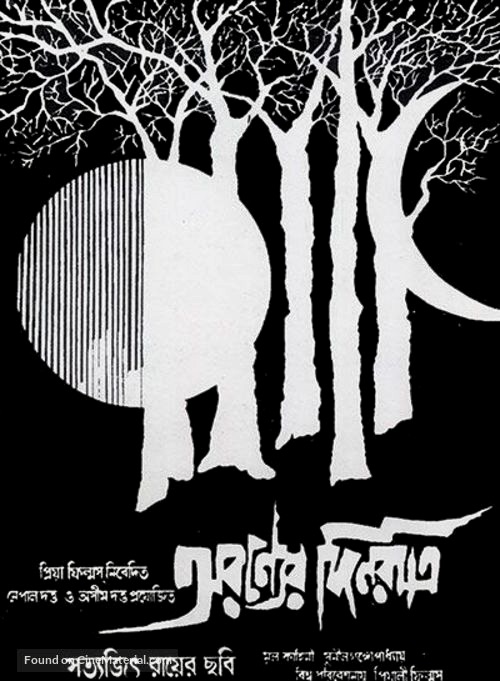
The film poster for DAYS AND NIGHTS IN THE FOREST (1970) from India.
Four carefree middle class bachelors from Calcutta journey deep into the bucolic countryside for a break from city life and to enjoy drinking and partying with the local native women. What they end up experiencing in this unfamiliar locale is both a reflection of their own ignorance and colonialist attitudes inherited from their former British occupiers about the lives of people in rural India. This is the basic premise of Ananyer Din Ratri (English title: Days and Nights in the Forest, 1970), which many film scholars and critics consider a mid-career masterpiece from director Satyajit Ray. Admirers of the movie also cite the plays of Anton Chekhov and the films of Jean Renoir, especially his 1946 short Partie de Campagne (English title, A Day in the Country) as distinct influences on this social comedy with its amusing and sometimes harsh observations about human foibles and cultural differences.


 Cinema Sojourns