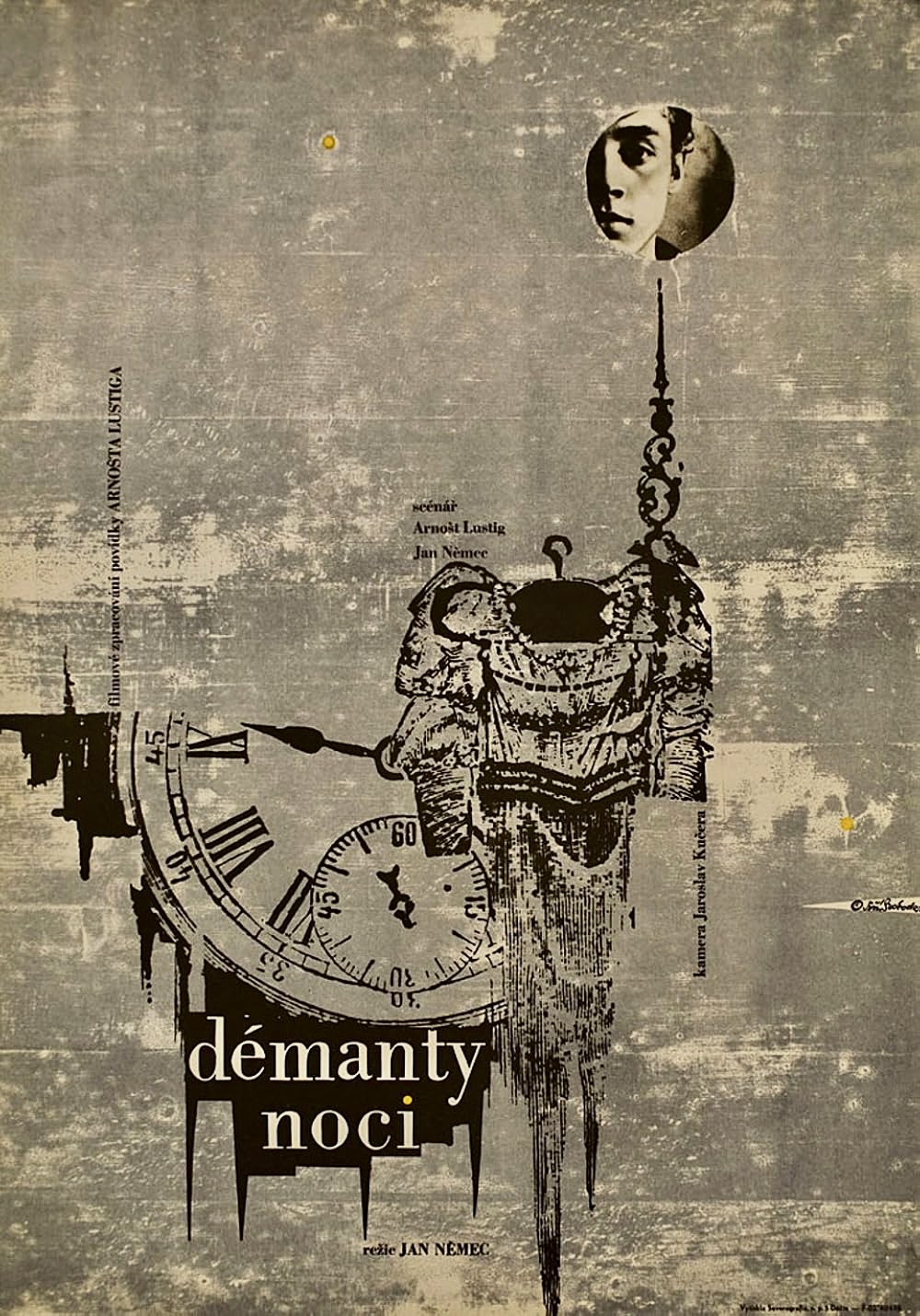
Jan Nemec’s Diamonds of the Night

The Czech film poster for DIAMONDS OF THE NIGHT (1964), directed by Jan Nemec

In what must be one of the most astonishing opening scenes in a movie, two young men jump off a moving train and flee into the surrounding woodlands, racing up a ravine, over mud, rocks and uneven ground. And the cameramen follow them both in their lunging, zigzag movements from the front, side and behind as they race deeper into the darkness accompanied by sounds of their heavy breathing, gun shots, cries of “Halt!” and a steam engine train chugging slowly into the distance. The viewer is immediately pulled into a grim tale of survival and human endurance which alternates between stark realism and dreamlike imaginings. Flashbacks from the escapees’ past life also interrupt the narrative to create a haunting and ambiguous portrait of two men on the run during the Nazi occupation of Czechoslovakia during WW2. Demanty Noci (English title, Diamonds of the Night, 1964) was the feature film debut of Jan Nemec and it remains one of the defining masterpieces of Czech New Wave cinema in the 1960s.

Continue reading
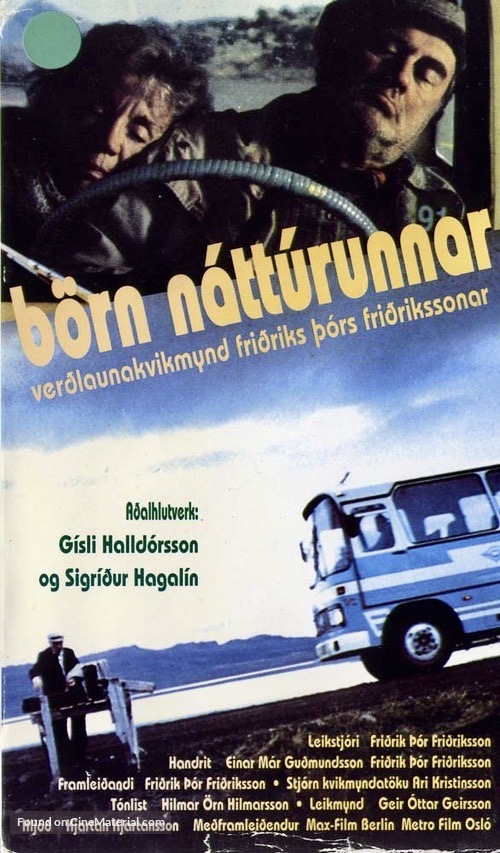
Homeward Bound

The original film poster for Children of Nature (1991), an Oscar nominee from Iceland.

Films about aging and the elderly are not that prevalent in Hollywood’s yearly production schedule of new films for obvious reasons. It is not a subject that most moviegoers seeking escapism, especially younger viewers, want to contemplate. It is also a risky commercial proposition unless the film is a heartwarming drama with broad appeal (Driving Miss Daisy, 1989) or a feel-good comedy like Harold and Maude (1970), which was a box office flop on its initial release before it went on to become a profitable cult hit. Of course, some of the undisputed masterpieces of 20th century cinema have focused on senior citizens like Vittorio De Sica’s Umberto D (1952), Yasujiro Ozu’s Tokyo Story (1953), and Ingmar Bergman’s Wild Strawberries (1957) but these are not mass appeal attractions but the favorites of a niche art house audience. Fridrik Thor Fridriksson’s Children of Paradise aka Born Natturunnar (1991) is certainly a film that belongs in this latter grouping but is distinctly different in tone, combining social realism with deadpan humor and a touch of magical realism.

Continue reading

Off the Grid

The Swedish film poster for The Outlaw and His Wife (1918).

A master of 20th century cinema, the Swedish director and actor Victor Sjöström is best remembered for his moving performance as the elderly physician reflecting on his life in Wild Strawberries (1957). As a director, his highly acclaimed 1921 adaptation of Selma Lagerlöf’s novel The Phantom Carriage convinced MGM mogul Louis B. Mayer to bring him to America where Sjöström directed the prestigious projects He Who Gets Slapped (1924), with Lon Chaney, and two starring Lillian Gish, The Scarlet Letter (1926) and The Wind (1928), arguably the pinnacle of his Hollywood tenure. While The Outlaw and His Wife (1918) is not as well known, it is considered by many film historians to be Sjöström’s silent-era masterpiece and, nearly a century after its release, is enjoying a revival that should elevate its stature in the director’s pantheon.

Continue reading