
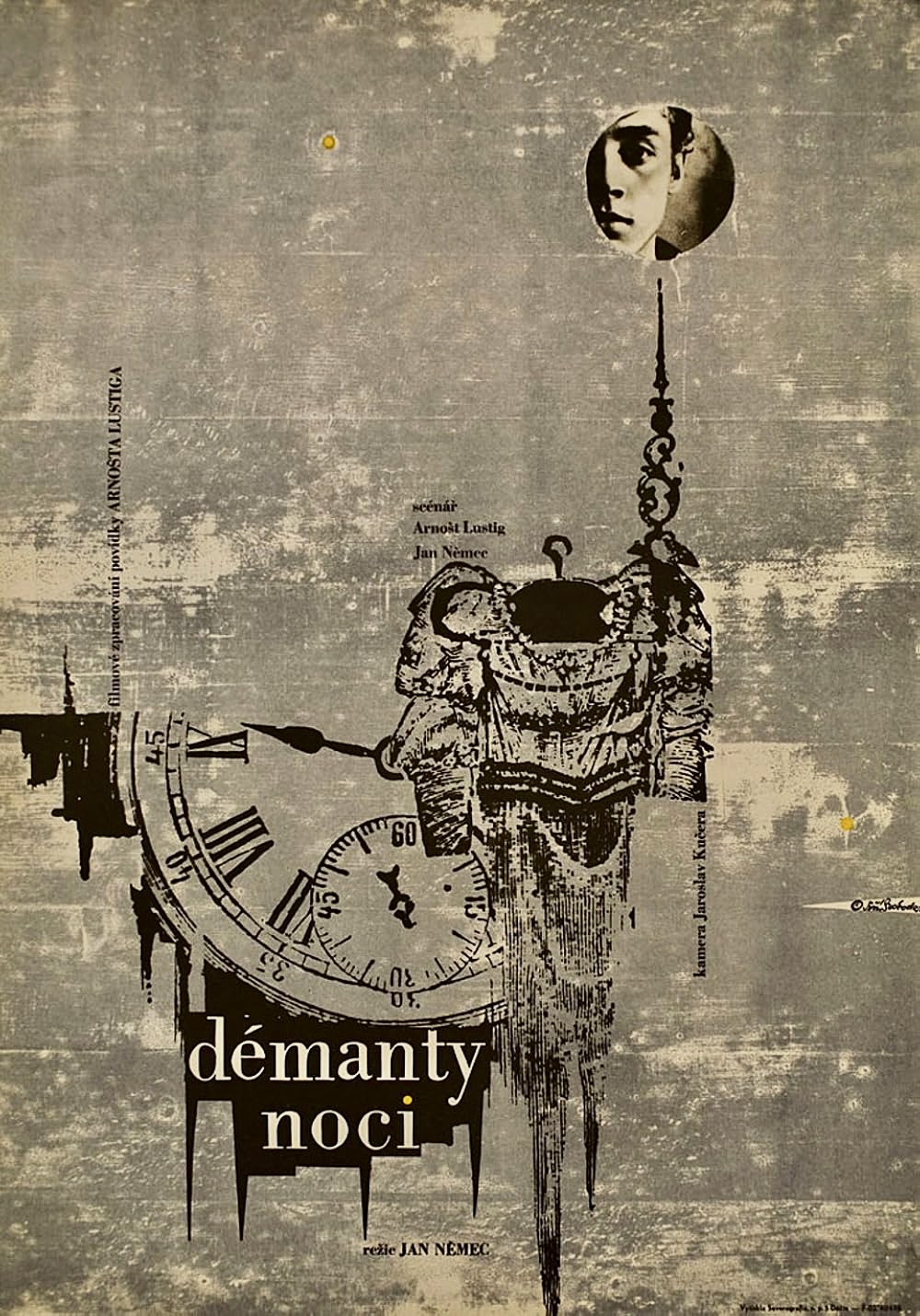
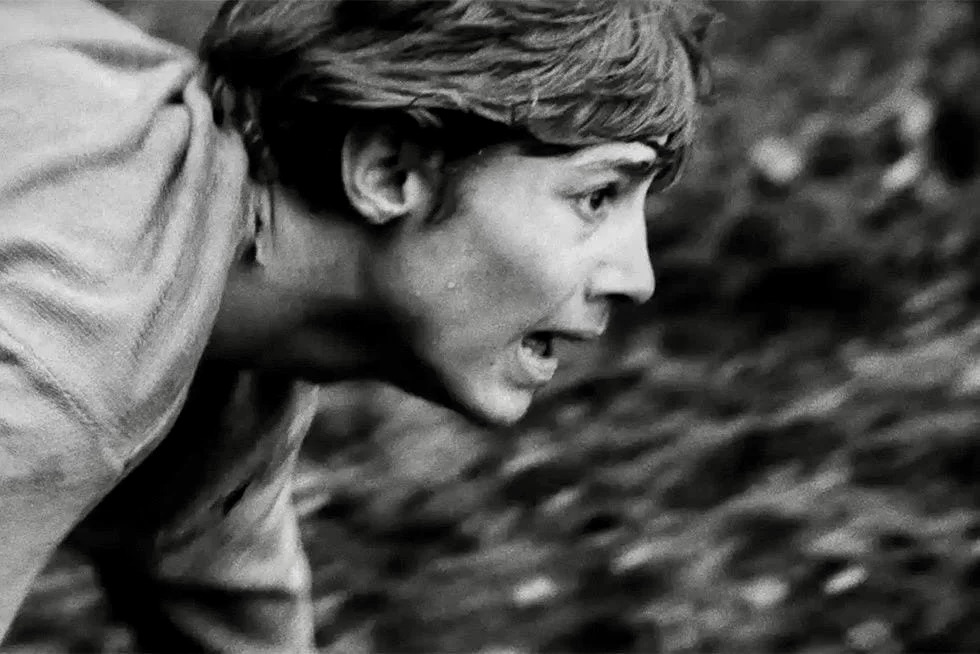
In what must be one of the most astonishing opening scenes in a movie, two young men jump off a moving train and flee into the surrounding woodlands, racing up a ravine, over mud, rocks and uneven ground. And the cameramen follow them both in their lunging, zigzag movements from the front, side and behind as they race deeper into the darkness accompanied by sounds of their heavy breathing, gun shots, cries of “Halt!” and a steam engine train chugging slowly into the distance. The viewer is immediately pulled into a grim tale of survival and human endurance which alternates between stark realism and dreamlike imaginings. Flashbacks from the escapees’ past life also interrupt the narrative to create a haunting and ambiguous portrait of two men on the run during the Nazi occupation of Czechoslovakia during WW2. Demanty Noci (English title, Diamonds of the Night, 1964) was the feature film debut of Jan Nemec and it remains one of the defining masterpieces of Czech New Wave cinema in the 1960s.
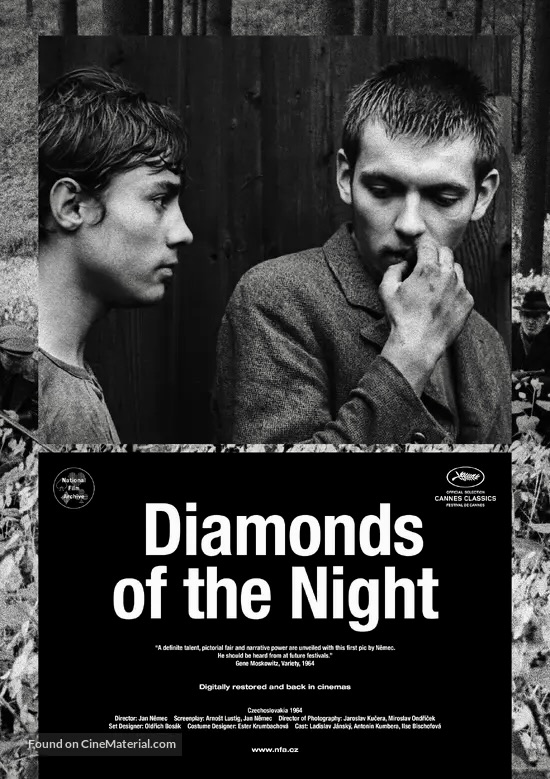
Based on the short story “Darkness Casts No Shadow” by Holocaust author Arnost Lustig, Nemec’s film departs significantly from the original story in two important respects: it never identifies the two young escapees by name and it dispenses with much of the short story’s dialogue, focusing more intently on movement, sound design, and visual effects (fast cut edits, repetition of scenes with slight variations, and actions which could be hallucinations or fever induced paranoia).
The two young men are close in age – one is shorter and possibly a teenager (Antonin Kumbera), the other is taller with an injured foot (Ladislav Jansky) and looks about 20 or 21 years of age. They have escaped from a transport train bound for the concentration camp but we never learn if they are Jewish prisoners or possibly army deserters. All we know is that they are physically and mentally exhausted and desperate to avoid capture.
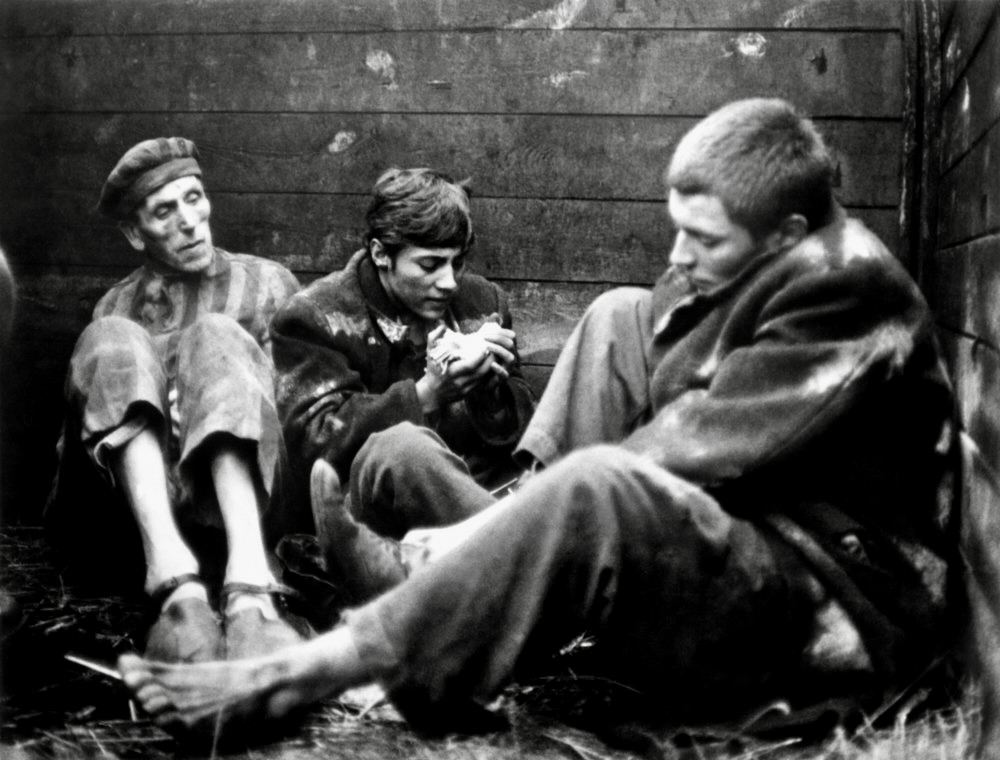
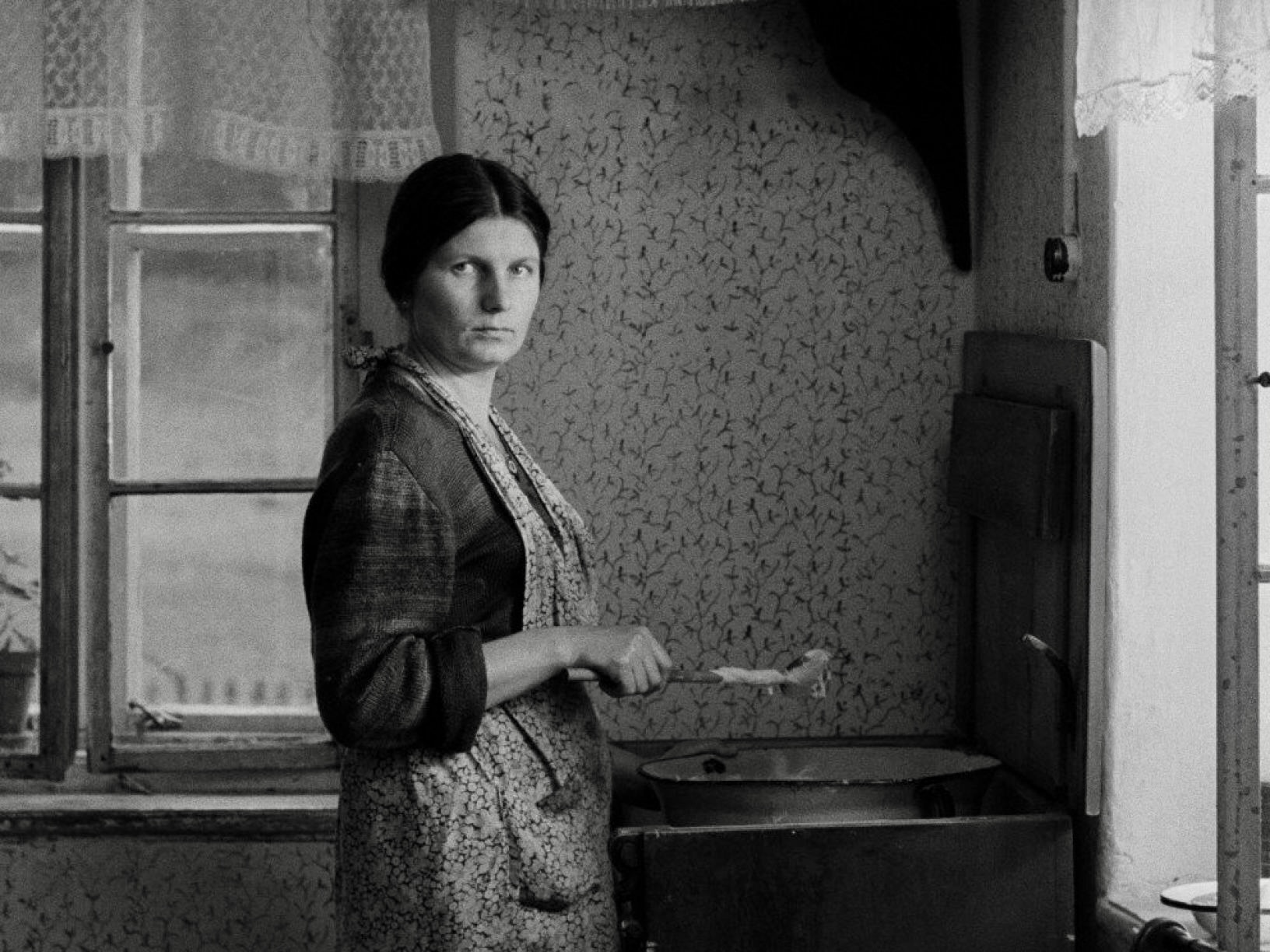
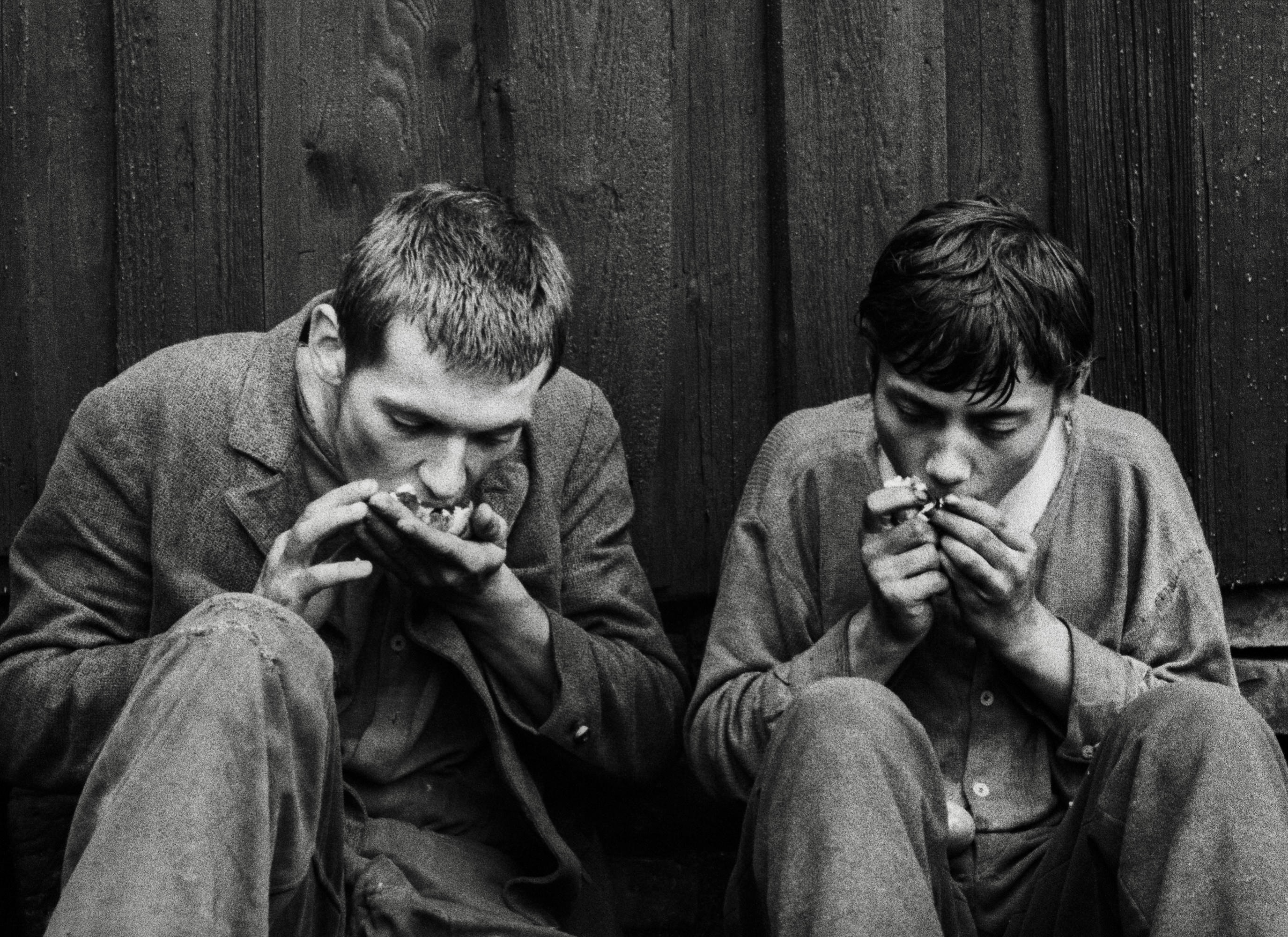
We watch as the two escapees cover themselves with foilage for the night, try to eat pinecones and roots for sustenance, and deal with unpredictable aspects of nature (a rainstorm, swarms of black ants and falling trees – or is that a nightmare?). It is often hard to tell what is real and what is delusional from the point of view of the two protagonists. The most striking example of this is a scene where the two boys hide near a farmhouse after observing the farmer plowing his fields. The younger one enters the farmhouse kitchen and encounters the farmer’s wife (Ilse Bischofova). She appears frightened, cautious, and, in one strange shot, smiling and seductive on her bed. She offers the boy several slices of bread, carving them off with a circular movement of the knife. Then he suddenly assaults her with a large stick and she falls lifelessly to the floor, her hair fanning out on all sides in a Medusa-like pose. Is she dead or did he really attack her? We know this can’t be true since the same boy returns to the kitchen and begs for milk because the two escapees can barely chew their food without their gums bleeding from malnutrition.
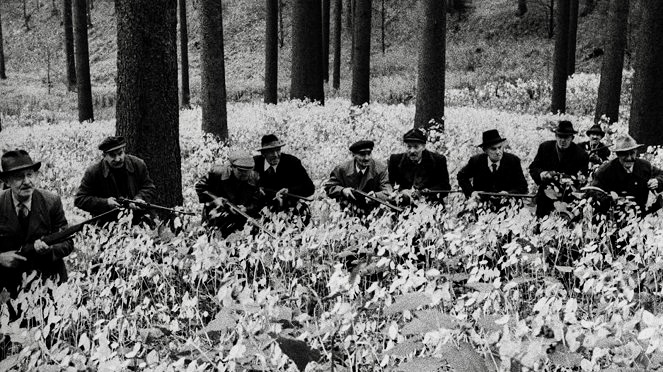
Debate continues to this day on the conclusion to Diamonds of the Night. After the two escaped prisoners are captured by a posse of drunken, elderly hunters, there is a trial of sorts and we hear gunshots and see the bodies of the two young men. Later, however, we see the two men flee into the woods again to hide in its darkness. But even if they did survive, they are stuck in an endless loop of desperation and fear.
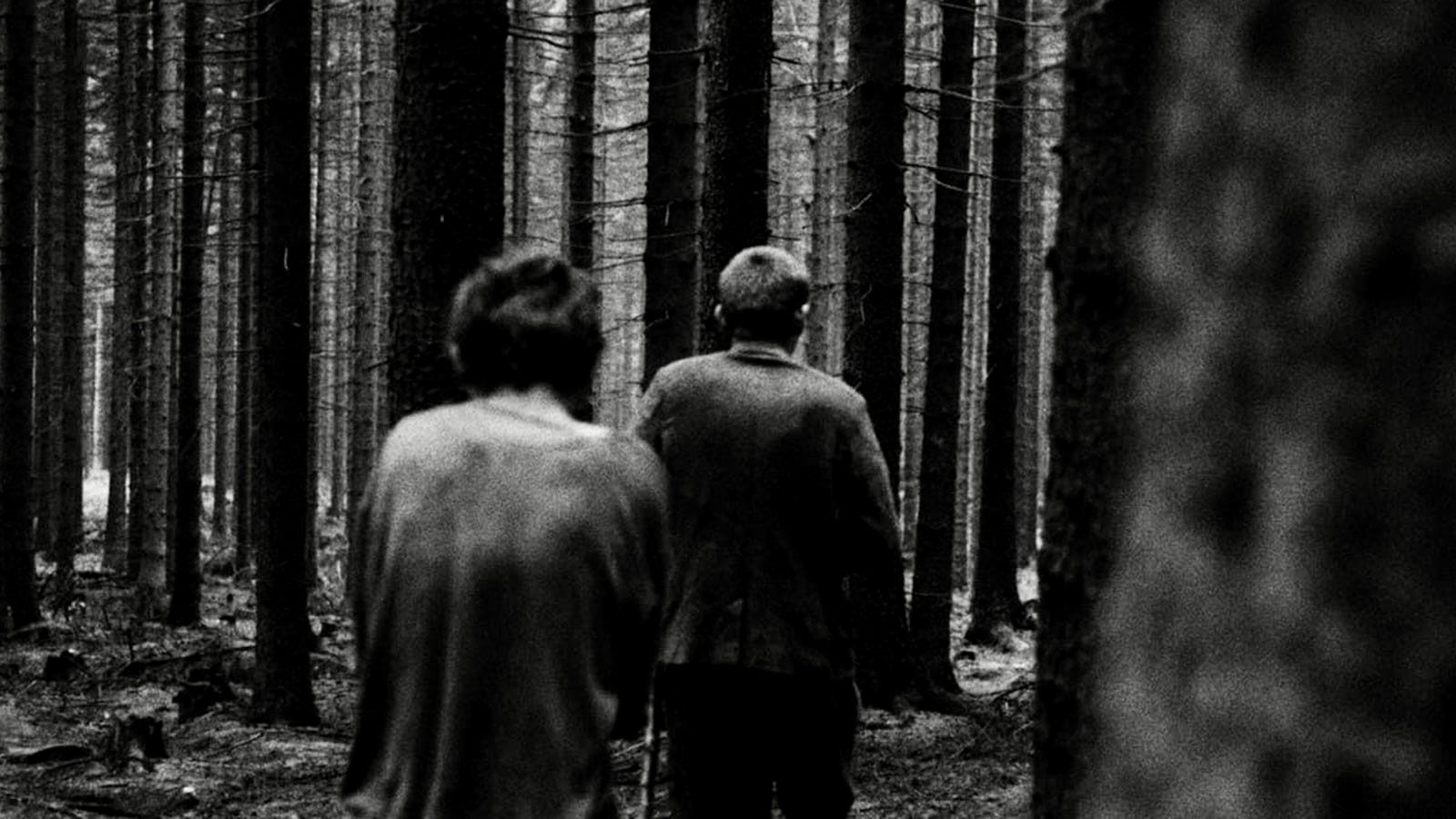
All of the action in Diamonds of the Night unfolds in little more than an hour (the running time is 67 minutes) but it feels as if events have been compressed from several days due to flashbacks to the two boys’ life in Prague, fragments from dreams or nightmares and atmospheric shots of the forbidding forest and countryside. Nemec did not use any professional actors in the movie (all of them could have stepped out of a rural documentary on Czechoslovakia during WW2) and he also had the good luck to collaborate with two of the most creative and accomplished cinematographers from the Czech New Wave – Jaroslav Kucera and Miroslav Hajek. Unfortunately, in the middle of production, Kucera informed Nemec he would not be available for the remainder of the shoot because he was leaving for South America where he was accepting an award at a film festival. Luckily, Hajek made up for his absence with his own innovative ideas and Diamond of the Night ends up being a work of remarkable contrasts – the first half has a gritty documentary realism while the second half is eerily dreamlike.
Kucera would go on to work with some of the most famous Czech directors such as Vojtech Jasny (When the Cat Comes Home aka Cassandra Cat, 1963), Juraj Herz (Morgiana, 1972), Morgiana (1972) for Juraj Herz, Adele Has Not Had Supper Yet, aka Dinner for Adele: Nick Carter in Prague, 1978) and his wife Vera Chytilova (1966’s Daisies, Fruit of Paradise, 1970). Hajek, on the other hand, would work often with Czech director Milos Forman on most of his films, receiving Oscar nominations for his cinematography on Ragtime (1981) and Amadeus (1984). He also left Czechoslovakia to work in the U.K. with Lindsay Anderson (The White Bus, If…, O Lucky Man) and in the U.S. with such directors as George Roy Hill (Slaughterhouse-Five, The World According to Garp), Mike Nichols (Silkwood), and Penny Marshall (Awakenings, A League of Their Own).
What is most surprising about Diamonds of the Night is that the two actors playing the escaped prisoners didn’t go on to work in the film industry. The younger boy Antonin Kumbera, who had previously appeared in Zeleznicari (1963), a documentary short by Evald Schorm, simply disappeared after completing the movie and no one seems to know what happened to him. Ladislav Jansky, the actor playing the escapee with the injured foot, emigrated to the U.S. and went to work as a photographer for Larry Flynt’s adult publication Penthouse.
Nemec had received numerous awards and critical acclaim at European film festivals for his 1960 film short A Loaf of Bread, Diamonds of the Night and A Report on the Party and Guests (1966) and seemed poised to be the most famous of the Czech New Wave directors. Instead the filmmaker was banned by the communist government of Czechoslovakia forever and tried to continue filmmaking in Germany, France and the U.S. for two decades before returning to Prague in 1989 after the Velvet Revolution. At that point, he began to make movies again but his career had suffered from a long hiatus and his final work was compared unfavorably to his early triumphs.
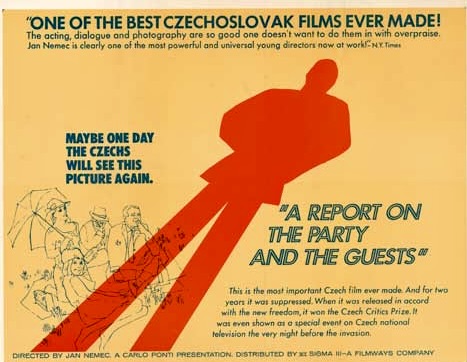
Nemec recalled that Kamil Pixa, the general manager of the production company Kratky film Praha, had come to him after the release of A Report on the Party and Guests and explained why he was being blacklisted. “You know, Nemec,” he said, ”We can’t let you make movies. You are so clever and such a swine. You would learn how to do it better than those who we are allowing to work now, those nontalented cretins. You would build up your position, and when the party and society stopped watching you, you would stab us in the back. You are unreliable. Simply forget about making films again.”
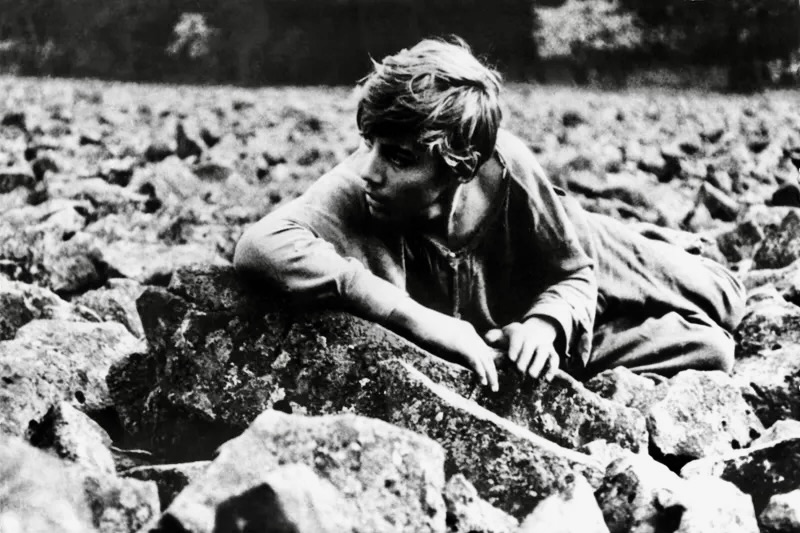
The authorities were probably right to fear Nemec because Diamonds of the Night and A Report on the Party and Guests are damning critiques of government oppression and persecution, though both are markedly different from each other in tone and treatment.

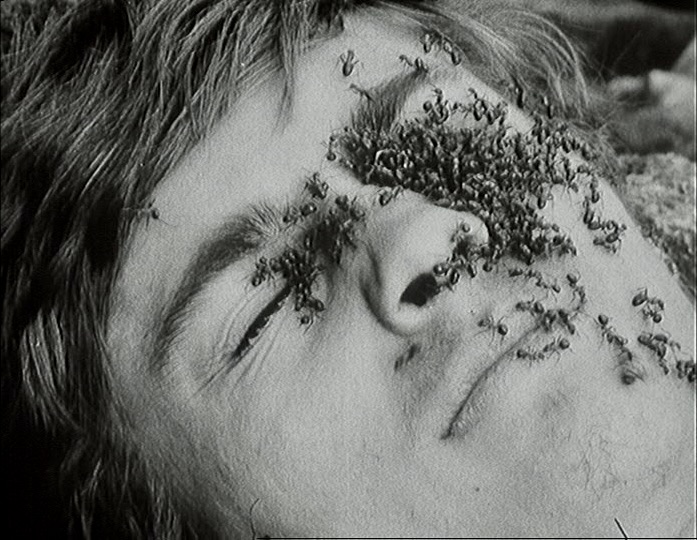
It is also easy to see some of the cinematic influences that molded Nemec as a filmmaker in Diamonds of the Night. The editing and fantasy-tinged sequences recall the work of Alain Resnais, especially Hiroshima, Mon Amour (1959) and Last Year at Marienbad (1960). The use of non-professional actors and an austere visual approach bears comparison with Robert Bresson for his 1956 masterpiece A Man Escaped. There are also nods to Ingmar Bergman’s Wild Strawberries (1957) with imagery involving clocks without hands and allusions to Luis Bunuel & Salvador Dali’s Un Chien Andalou (1929) and L’Age d’Or (1930) with the disturbing footage of black ants crawling over the hands and face of one of the escaped prisoners.
Diamonds of the Night remains one of the essential films to see from the Czech New Wave movement. Peter Cowie describes its importance in his film reference work, 80 Years of Cinema: “The memories are like a stabbing pain; they are literally injected into the spectator’s psyche. At first they are ambivalent and illogical. Then, as they recur, they slowly bloom into tangible recollections and realizations. Kucera’s hand-held camera clings obsessively to the fugitives, registering the slightest change in expression on their faces….Diamonds of the Night is horribly disquieting in its suggestion that the human mind is so much clay, molded by events and contingencies and infinitely impressionable. Nemec is a superb stylist, ordering the soundtrack so that silence becomes as haunting as the mastications of a toothless old man as he tears at a cooked chicken in front of the boys.”
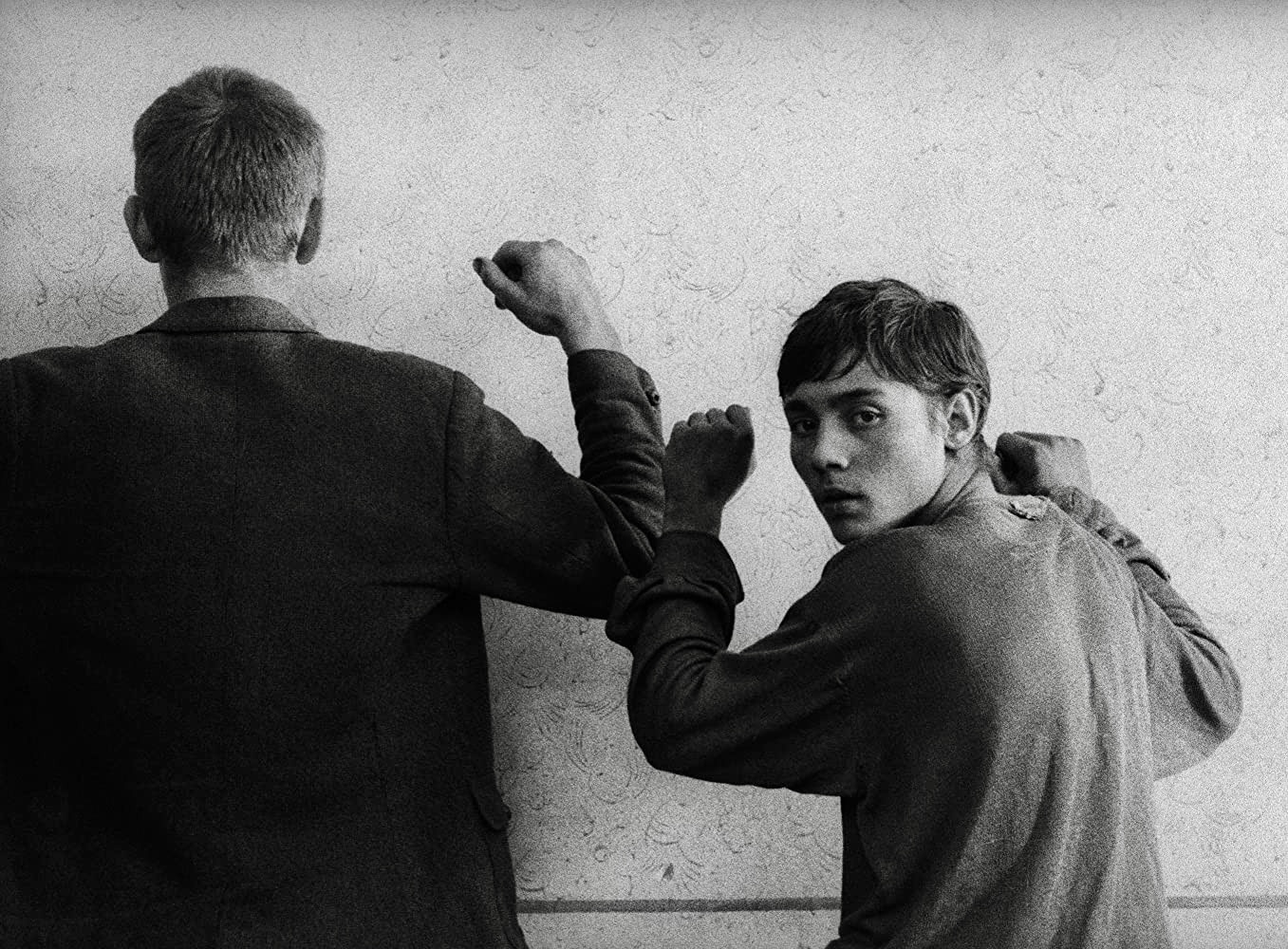
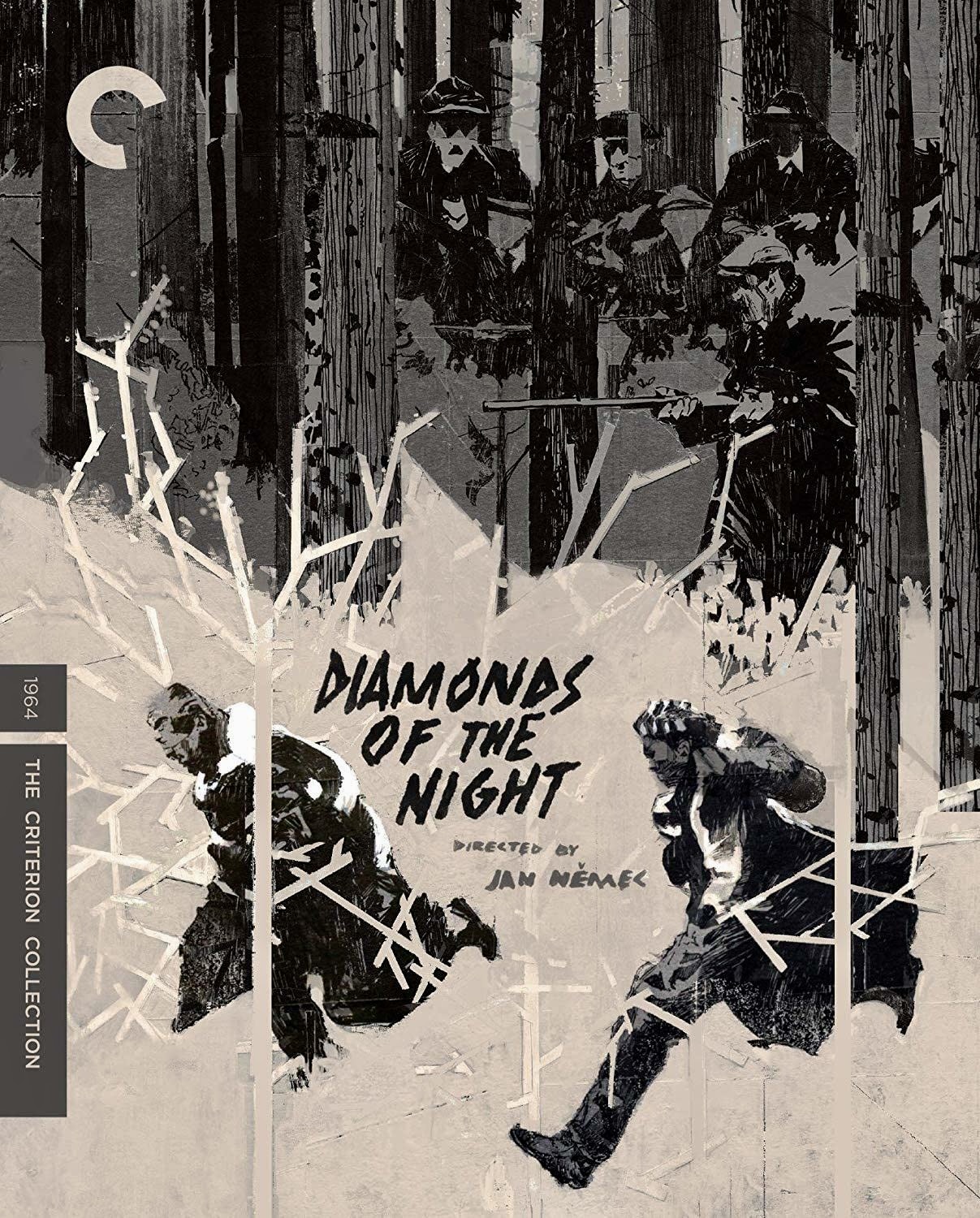
Nemec’s film has appeared in various formats over the years but The Criterion Collection Blu-ray edition from April 2019 is certainly an ideal presentation. The disc includes an interview with Nemec from 2009 plus his short film A Loaf of Bread, a short documentary on Arnost Lustig, a video essay by film scholar James Quandt and more.
Other links of interest:
https://www.bfi.org.uk/sight-and-sound/news/jan-nemec-1936-2016
https://www.filmcenter.cz/en/news/the-mastery-of-jan-nemec-rediscovered
https://www.umass.edu/defa/people/3931
https://english.radio.cz/vojtech-jasny-venerable-film-director-and-font-remarkable-stories-8594461

