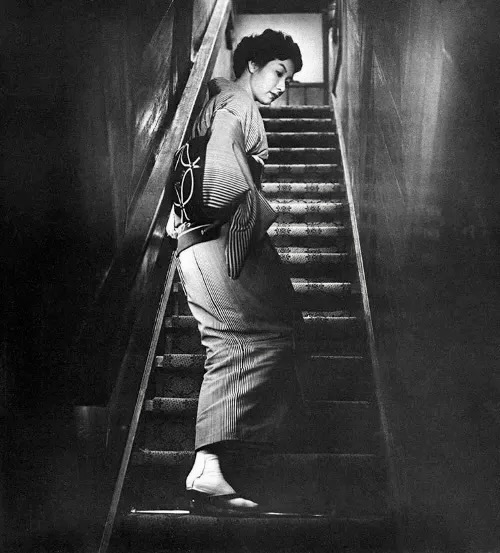
The Bar Hostess of Ginza

Keiko (Hideko Takamine) prepares to go to work at a bar on the second floor of a popular male destination in WHEN A WOMAN ASCENDS THE STAIRS (1960).

Most fans of Japanese cinema know that the Ginza district of Tokyo is often featured as a setting in films with its vibrant nightlife, intimate bars and fashionable shops, particularly in contemporary movies. Although the district dates back to the Edo period in the 16th century, the area has seen major changes over the years including a devastating fire in 1872 and widespread damage from aerial attacks during WWII. Yet, it always seemed to reinvent itself after every major setback and, by the end of the 1950s, it had become a prosperous symbol of Japan’s post-war recovery with its mix of upscale shoppers, modern buildings and cultural hotspots. It is against this colorful backdrop that Mikio Naruse’s Onna ga Kaidan wo Agaru Toki (English title: When a Woman Ascends the Stairs, 1960) takes place and the central focus is Keiko Yashiro (Hideko Takamine), one of the most popular bar hostesses in the Ginza sector.

Continue reading

The Sociopath’s Playbook

The Japanese film poster for THE BEAST SHALL DIE (1959), directed by Eizo Sugawa.

According to the Oxford Dictionary, a sociopath is a person who has a personality disorder which causes them to behave in an aggressive, violent or unpleasant way towards other people. The general opinion among psychiatrists is that sociopaths are not born that way, which is usually the case with psychopaths. Instead, sociopaths are shaped by their environment and experiences. A classic example of this is profiled in Eizo Sugawa’s Yaju Shisubeshi (English title: The Beast Shall Die). The protagonist of this 1959 psychological thriller is Date Kunihiko (Tatsuya Nakadai), a quiet, well-mannered graduate student who is exceptionally gifted as a writer and athlete. Behind his benign façade, however, is a cunning sociopath with a plan that slowly reveals itself as the film unfolds. As portrayed by Nakadai, Date is a truly chilling figure and one of his least known but most potent early performances. It deserves to be included with his more celebrated work in such Japanese masterpieces as Masaki Kobayashi’s The Human Condition (1959-1961), Kihachi Okamoto’s The Sword of Doom (1966) and numerous collaborations with Akira Kurosawa such as Sanjuro (1962), High and Low (1963) and Kagemusha (1980).

Continue reading

Identity Disintegration

A wealthy chemist who was disfigured in an explosion undergoes plastic surgery in the 1966 Japanese film, The Face of Another.

What would happen if you lost the face you recognize as your own and had to replace it with a new one? Would you have an identity crisis or simply become a different person? Japanese director Hiroshi Teshigahara ponders this unusual dilemma in The Face of Another (1966, Japanese title: Tanin no kao). Continue reading

The Age of Assassins (1967)

A paranoid conspiracy thriller delivered in a droll tongue-in-cheek style with generous helpings of black comedy and anti-establishment satire doesn’t really fit neatly into any genre and Kihachi Okamoto’s The Age of Assassins (1967 aka Epoch of Murder Madness; Japanese title: Satsujin Kyojidai) was generally dismissed by critics and avoided by audiences when it was first released in the late sixties. Like many of Okamoto’s films, it didn’t receive theatrical distribution outside of its own country and that’s a shame because the film has the essential goods to become a bona fide cult classic on the order of Seijun Suzuki’s Branded to Kill (1967) or Kinji Fukasaku’s Black Lizard (1968). The Age of Assassins arrived at the tail end of the secret agent craze but it is not really a James Bond parody. Think of it instead as a crazy quilt journey through an off-kilter, pop culture universe where no one is who they appear to be.   Continue reading