
A Nouvelle Vague Musical?

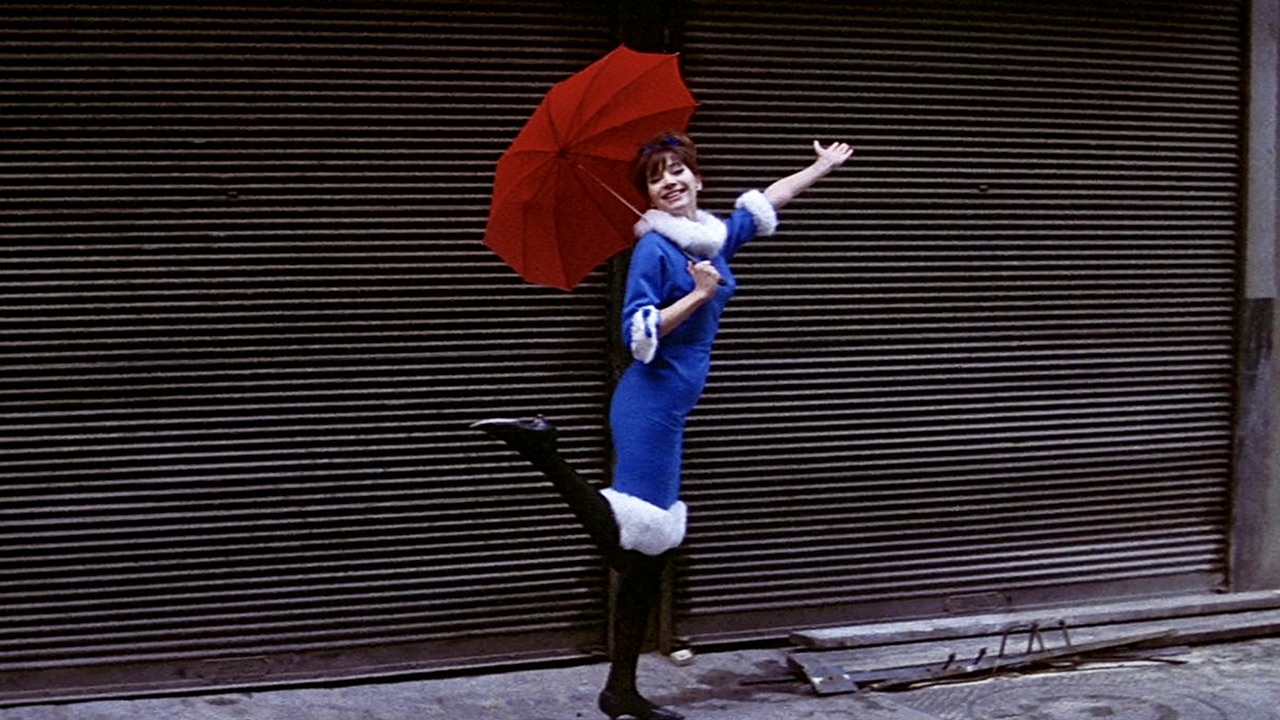
Angela (Anna Karina) imagines she is in a movie musical choreographed by Bob Fosse in A WOMAN IS A WOMAN (1961), directed by Jean-Luc Godard.

Of the more than 120 movies and short films in director Jean-Luc Godard’s oeuvre, there is really nothing like Un Femme est une Femme (English title: A Woman is a Woman, 1961). What other Godard creation could you describe as joyful, lighthearted and consistently playful? A homage to MGM musicals, romantic comedies a la Ernst Lubitsch and Hollywood productions shot in Cinemascope and Eastmancolor, A Woman is a Woman is essentially a valentine to Godard’s muse at the time, Anna Karina. It is also unlike any other musical ever made or even a Nouvelle Vague confection like Jacques Demy’s The Umbrellas of Cherbourg (1964).  Yet, for someone who has never seen a Godard film, it is an accessible entry point to his work and an example of why he was considered so innovative, daring and controversial for his time.

Continue reading
Expect the Unexpected

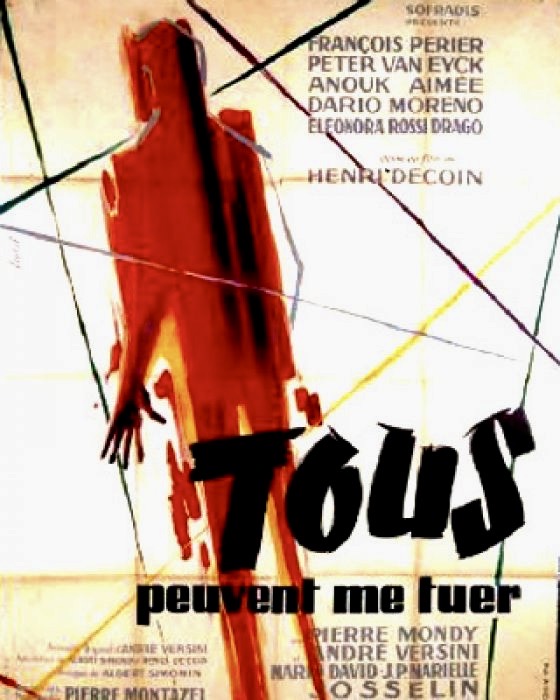
The French film poster for EVERYONE WANTS TO KILL ME (1957), directed by Henri Decoin.

When a movie refuses to fit snugly into a specific genre, that could be a sign that the filmmakers were either unable to capture the desired approach and tone or that the story/screenplay dictated a less conventional approach to the narrative. I suspect that the latter reason is why Tous Peuvent Me Tuer (English title, Everyone Wants to Kill Me, 1957), directed by Henri Decoin, is hard to place into any specific film category. If you were to watch the movie with the sound turned off, you would probably classify it as a brooding French noir. Yet, if you add in the music score and the animated performances, it comes across as an almost lighthearted crime caper flick. Add to this a segue into prison melodrama which soon becomes a whodunit murder mystery. And just to keep things off balance, stir in a romance, some comic relief and a wrap-up that positions the entire affair as a morality play. 

Continue reading

A City or a Labyrinth?

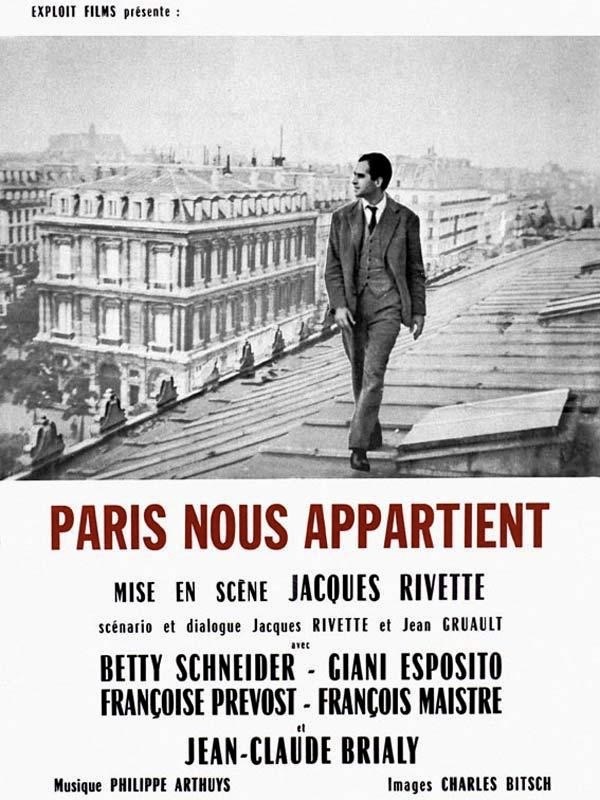
Whether by accident or design, French filmmaker Jacques Rivette is probably the least known member of the influential Nouvelle Vague movement of the late fifties though, like Jean-Luc Godard, Francois Truffaut, Eric Rohmer, and Claude Chabrol, he too was a former writer and film critic for Cashiers du Cinema. He even started production on his first feature length film, Paris Belongs to Us (French title: Paris Nous Appartient), in 1957, before Chabrol, Truffaut and Godard began work on what would become their universally acclaimed debuts of, respectively, Le Beau Serge (1958), The 400 Blows (1959) and Breathless (1960). Yet, despite the artistic and liberating impact the latter three films had on world cinema, Paris Belongs to Us might be the most ambitious, challenging and intellectually provocative film of the whole movement. It is also the darkest, waltzing toward an imagined or possibly real oblivion. The Homeland Security System would give it a code orange classification.       

Continue reading