
Memories of the 2011 TCM Classic Film Festival

*This article originally appeared on Movie Morlocks, Turner Classic Movies’s official blog in May 2011 (The blog was discontinued years ago and is no longer available)

In the event-packed hurly burly of TCM’s second annual Film Festival in Los Angeles from April 28-May 1 of 2011, I didn’t have a chance to blog about all of the films or attending guests that I saw but here are a few that linger in the memory and deserve to be singled out –cinematographer/director Haskell Wexler, who participated in a Q&A with Leonard Maltin before a screening of Who’s Afraid of Virginia Woolf?(1966), Hayley Mills, who appeared after a screening of Whistle Down the Wind (1961) with interviewer/author Cari Beauchamp, a midnight screening of The Mummy (1932) introduced by Boris Karloff fan Ron Perlman, Buster Keaton’s The Cameraman (1928) accompanied by a live orchestra score by Vince Giordano and His Nighthawks, the MoMA restoration print showing of 1933’s Hoopla (Clara Bow’s final film) and the underrated Ernst Lubitsch Pre-Code delight Design for Living (1933).

Continue reading
Home Alone

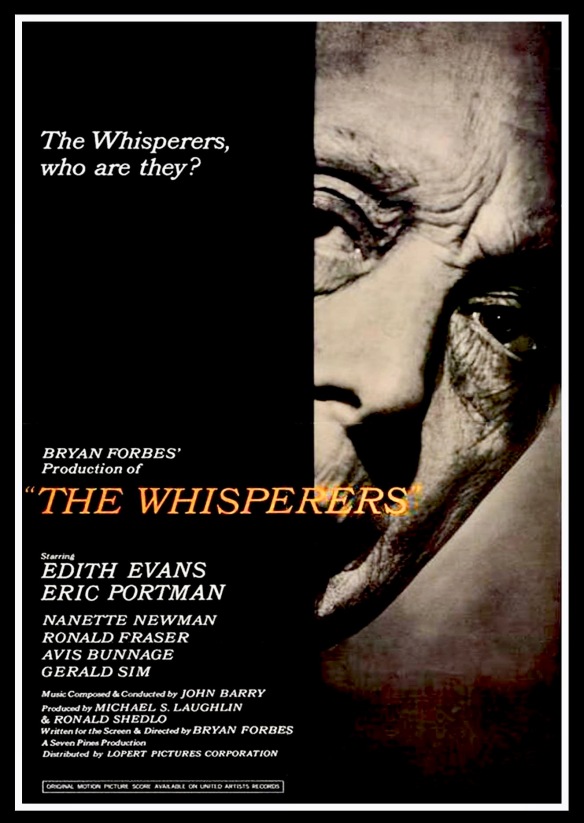
No one wants to think about growing old, becoming infirm and having to rely on others for assistance, particularly after a life of relative independence. While some are lucky enough to have family and friends to help out, many elderly people have no one for support and are left to fend for themselves among strangers. The situation becomes even more desperate without savings or financial assistance. Certainly this isn’t a topic that the commercial cinema has often explored for obvious reasons and great films on this subject are rare indeed but occasionally a masterpiece has emerged. Vittorio De Sica’s Umberto D. [1952], Akira Kurosawa’s Ikiru [1952], and Yasujiro Ozu’s Tokyo Story [1953] are prime examples while a handful of other films remain memorable for the performances alone – Victor Moore and Beulah Bondi in Make Way for Tomorrow [1937], Art Carney in Harry and Tonto [1974] and Edith Evans in The Whisperers [1967], Bryan Forbes’s often overlooked and forgotten adaptation of Robert Nicolson’s novel, Mrs. Ross.    Continue reading

Labor Pains

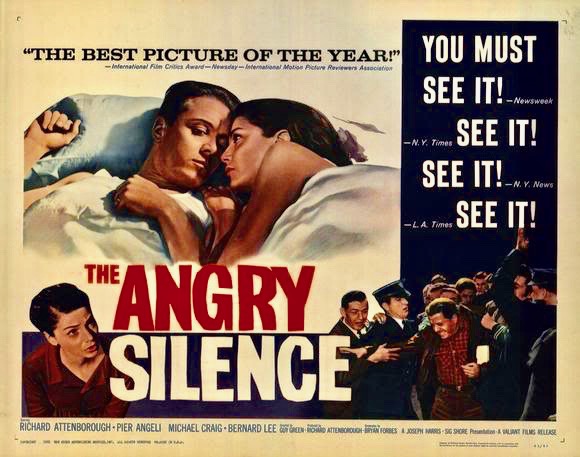
When cinema buffs talk about their favorite movies from that brief period known as the “angry young man” phase of the British New Wave movement, one title is usually overlooked – The Angry Silence (1960) – and that might be due to the film’s more overt focus on labor unions, working conditions and corruption. Directed by Guy Green, The Angry Silence (1960) shares many similarities with others of its ilk with its harshly realistic depiction of a specific working class milieu, all of it captured in a gritty, documentary-like approach that was partially shot on location (Ipswich, Suffolk) using local nonprofessionals and real actors.  Continue reading