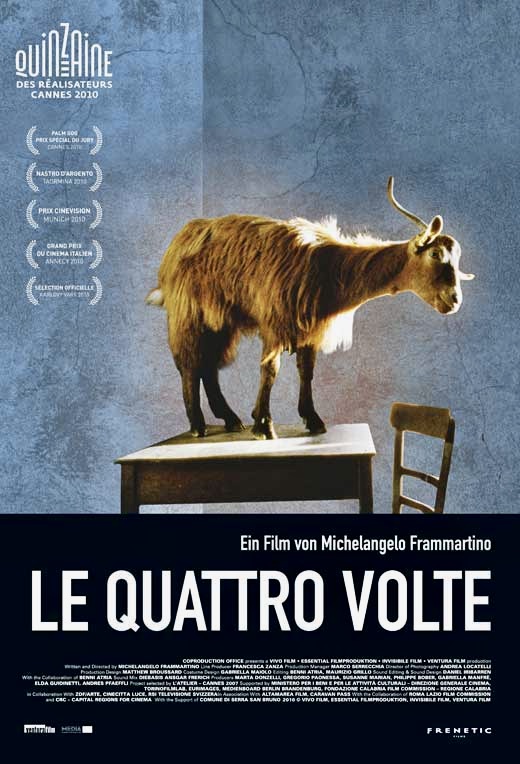
Life in Transition

Smoke fills the screen and drifts toward the sky. We see black earth that is steaming and could be cooling lava. Then we notice small holes punched into the dark topography where smoke is being released. A wide shot reveals that we are looking at a mound of charred material that is being raked by a worker at the top of the heap. Where are we and what are we looking at? Michelangelo Frammartino’s Le Quattro Volte (2010), which roughly translates as The Four Times, is an immersive but often disorienting portrait of life in the village of Caulonia, Italy, which often requires the viewer to make sense of a visual detail or local ritual without a frame of reference. This is not detrimental, however, to the film’s exploratory narrative but one which is enriched by a sense of mystery and wonder.

Continue reading
Robert Bresson’s Parisian Reverie

The French film poster for FOUR NIGHTS OF A DREAMER (1971), directed by Robert Bresson.

One wouldn’t normally associate Robert Bresson with such rapturously romantic, Paris-based films as Ninotchka, An American in Paris, Funny Face, Gigi, and Love in the Afternoon yet Four Nights of a Dream (Quartre Nuits d’un Reveur, 1971) is probably the closest the French director has ever come to making a film about love, longing and desire. You could even say it is almost a musical since strolling street musicians occasionally break into song at unexpected moments in the narrative.

Continue reading

The Holy Bray

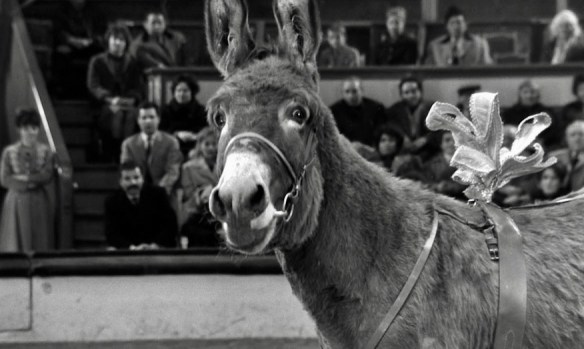
The title character of Robert Bresson’s Au Hasard Balthazar (1966) is a donkey who goes through a series of owners in his sad life as a beast of burden.

Films about animals or featuring them as the main protagonists are usually the province of Walt Disney and other family friendly productions such as Benji (1974) and March of the Penguins (2005). Other than the horror genre, though, there have been relatively few departures from the usual formulaic approach to this type of movie with Jerome Bolvin’s dark satire Baxter (1989) and the ethnographic Story of the Weeping Camel (2003) being two of the rare exceptions. Yet nothing can really compare with Au Hasard Balthazar (1966), directed by French filmmaker Robert Bresson, which stands alone as a profound and singular achievement in this category.   Continue reading