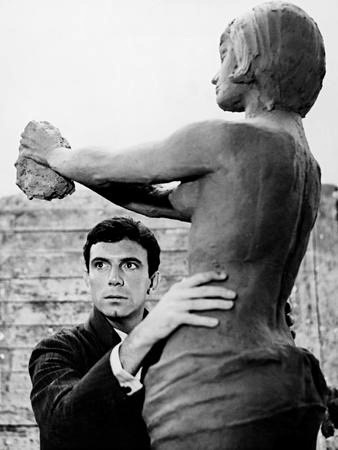
Senilità aka Careless (1962)

Anthony Franciosa plays a frustrated office worker pushing forty who develops an obsessive love for a young woman in SENILITA (1962), directed by Mauro Bolognini.

Italian novelist Italo Svevo was the pseudonym for Ettore Schmitz, a novelist and short story writer who was born in Trieste in 1861. After publishing two unsuccessful novels, he gave up writing until his English tutor James Joyce encouraged him to continue and he wrote a third novel in 1823, Confessions of Zeno (considered his masterpiece) and several short stories which were not published until after his early death from an automobile accident in 1928. Svevo never received the acclaim he deserved during his own lifetime but now he is considered one of Italy’s most famous authors and a pioneer of the psychoanalytical novel. His novels and some of his short stories were later adapted for film and television productions but the first one to hit the screen was Senelita (aka Careless, 1962), based on his second novel. The story of an insecure, self-absorbed office worker approaching forty who develops an obsessive love for a beautiful working class girl, the film was an impressive early masterwork for director Mauro Bolognini and helped launch Claudia Cardinale as an international star (The following year she appeared in Federico Fellini’s 8 ½, Luchino Visconti’s The Leopard and made her American film debut in The Pink Panther). 

Continue reading
Salvatore Samperi’s Cuore di Mamma

The late sixties were a time of social and political upheaval on an almost global scale but Italy, in particular, seemed to be coming apart at the seams. Bloody clashes between the police and student demonstrators, bombings and factory worker strikes were on the rise as rival political parties like the DC (Christian Democrats), PRI (Republican party) and PCI (communist party) vied for power. This turbulent time was reflected in some of the edgier, more troubling movies of that period by such major filmmakers as Gillo Pontecorvo (The Battle of Algiers, 1966), Bernardo Bertolucci (Partner, 1968), Pier Paolo Pasolini (Teorema [1968], Porcile [1969]), and Michelangelo Antonioni (Zabriskie Point, 1970). Even more polarizing but less well-known is Cuore di Mamma (Mother’s Heart, 1969) by director Salvatore Samperi, which is much more of an avant-garde provocation than anything else. It was based on a story by Samperi and Sergio Bazzini (Dillinger is Dead) and fashioned into a screenplay by Dacia Maraini (The Future is Woman).

Continue reading

Mondo Man

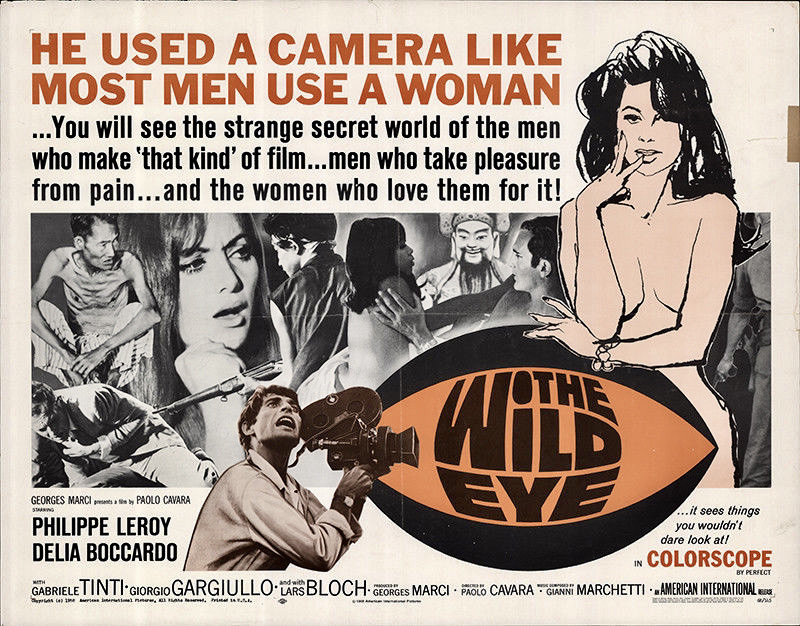
Gualtiero Jacopetti and Franco Prosperi are generally acknowledged as the “Godfathers of Mondo” and took a sensationalist approach to documentaries that revelled in bizarre and shocking cultural practices around the world. Mondo Cane (A Dog’s Life, 1962) was their wildly popular debut film and it spawned a new genre that included their later work Women of the World (1963), Mondo Cane 2 (1963), Africa Addio aka Africa: Blood and Guts (1966) and Goodbye Uncle Tom (1971), a critically reviled and polarizing account of the origins of the American slave trade that was filmed as a you-are-there dramatization. What is usually left out of the Jacopetti-Prosperi backstory are the contributions of Paolo Cavara, who co-directed and co-wrote Mondo Cane and Women of the World with Jacopetti. He broke off his association with the other two filmmakers after their second collaboration and went solo with two more Mondo films (Malamondo [1964], Witchdoctor in Tails [1966]) before turning his camera on a fictionalized version of himself in The Wild Eye (L’occhio Selvaggio, 1967), an unforgiving portrait of a ruthless Mondo filmmaker that should be better known today.

Continue reading