

Roll the Credits

An example of Stephen Frankfurt’s iconic title treatment for the 1962 film TO KILL A MOCKINGBIRD.

In their increasing eagerness to capture a wider viewing audience for their annual awards ceremony, you would think the Academy of Motion Picture Arts & Sciences would create a few more categories that could generate some genuine interest with the average moviegoer. How about Best Title Credits? It’s an art form in its own right. Graphic designer Saul Bass certainly proved that years ago with his innovative opens for the films of Otto Preminger (Carmen Jones, The Man With the Golden Arm, Saint Joan, Bonjour Tristesse, Anatomy of a Murder, Advise and Consent, Exodus, The Cardinal and several more) and Alfred Hitchcock (Vertigo, North by Northwest, Psycho). Other title designers you might recognize are Stephen Frankfurt (To Kill a Mockingbird, Rosemary’s Baby), Pablo Ferro (Dr. Strangelove, Being There) and Maurice Binder (Dr. No, Charade). Even before them, opening title credits were a key component of the film, often setting the tone and even encapsulating the movie’s theme or storyline into a compact visual nugget.

Continue reading
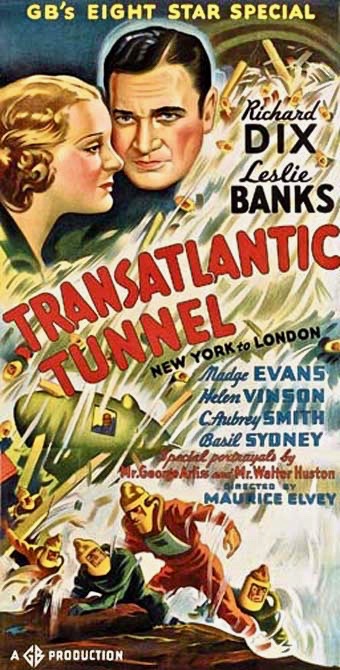
The Next Wonder of the World

Imagine a tunnel under the Atlantic that connected the United States with Europe and provided a high speed form of transportation between the two points. It’s certainly not an unrealistic expectation for the near future when you consider that the undersea rail known as the Channel Tunnel (aka the Chunnel) that currently connects Folkestone, Kent in England to Coquelles, France has been in operation since 1994. But that remarkable feat of engineering is only 50.5 km. compared to the 5,000 km. that would be the more likely distance of an undersea rail that connected New York City with London. Still, proposed plans for under-the-sea travel connectors between countries separated by water continue to surface in news reports and may happen in the near future. What’s most remarkable is the fact that Transatlantic Tunnel (aka The Tunnel), a 1935 British film, envisioned the same thing and some of that movie’s futuristic art direction and design is not that far removed from some of the models you can view on the interest today (just do a search for undersea rail systems).       Continue reading