
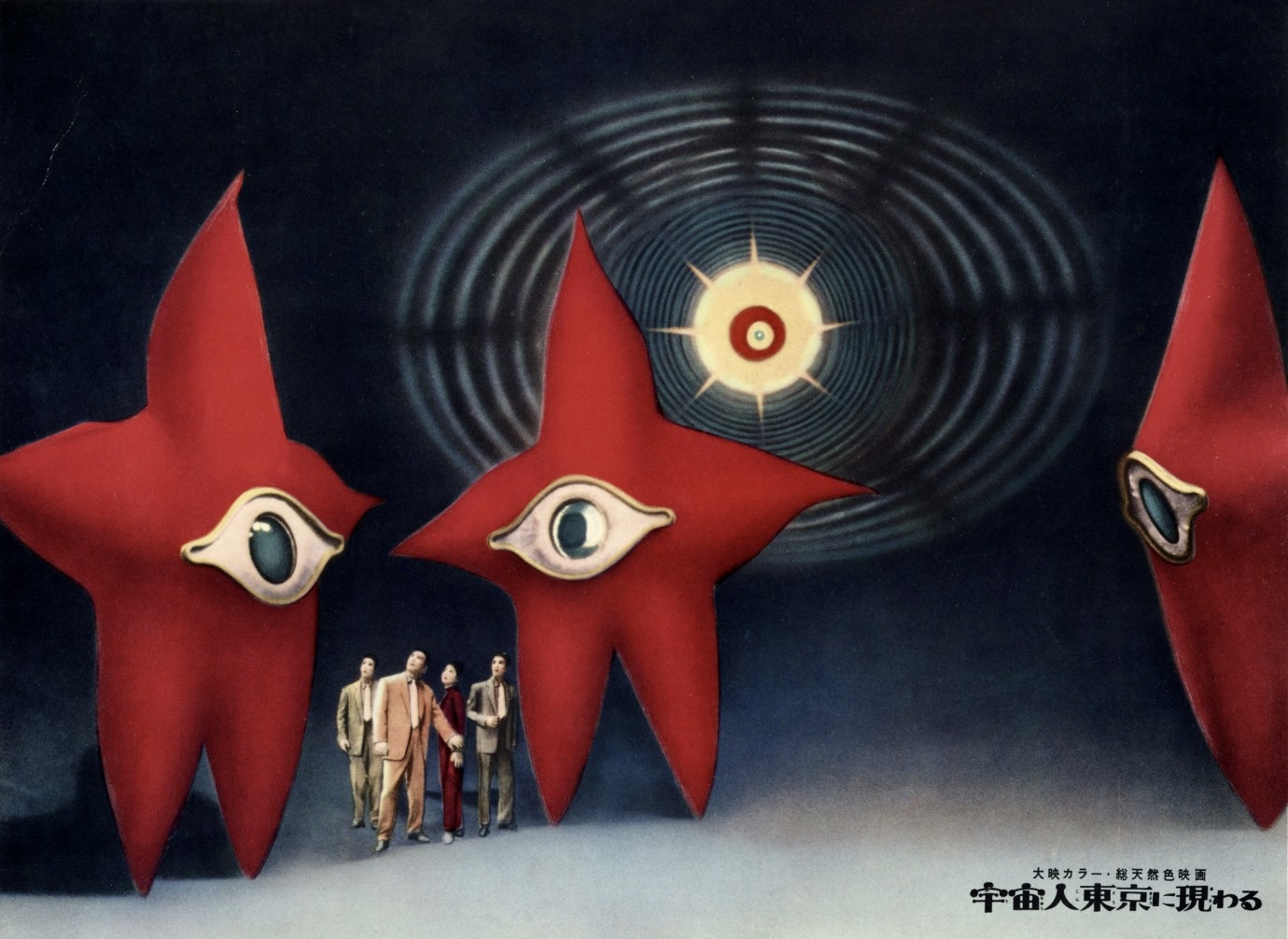
The Pairans Are Among Us

A promotional still from the Japanese science fiction film Uchujin Tokyo ni Arawaru (1956), which was released in the U.S. in 1963 as WARNING FROM SPACE.

The early 1950s is generally regarded as the time when science fiction truly became a popular and profitable film genre thanks to a number of pioneering efforts from Hollywood such as The Day the Earth Stood Still (1951), The Thing from Another World (1951), The Man from Planet X (1951), It Came from Outer Space (1953) and Invaders from Mars (1954). Other countries quickly followed suit producing their own sci-fi entries but Japan was a latecomer in this regard. It wasn’t until 1956 when Daiei Studios released the first Japanese movie to address the subject of UFOs and extraterrestrials – Uchujin Tokyo ni Arawaru aka Spacemen Appear in Tokyo, directed by Koji Shima. The film was a commercial failure and quickly vanished from cinemas before turning up seven years later on American television screens in an English-dubbed version known as Warning from Space. Unfortunately, this altered version for TV syndication with its pan-and-scan format deviating from the original presentation was intended for juvenile audiences. The original 1956 Japanese version, however, is a fascinating and important genre entry in the development of the science fiction film and deserves to be better known today. (When I refer to Warning from Space throughout the following article, I am talking about the Japanese version).

Continue reading
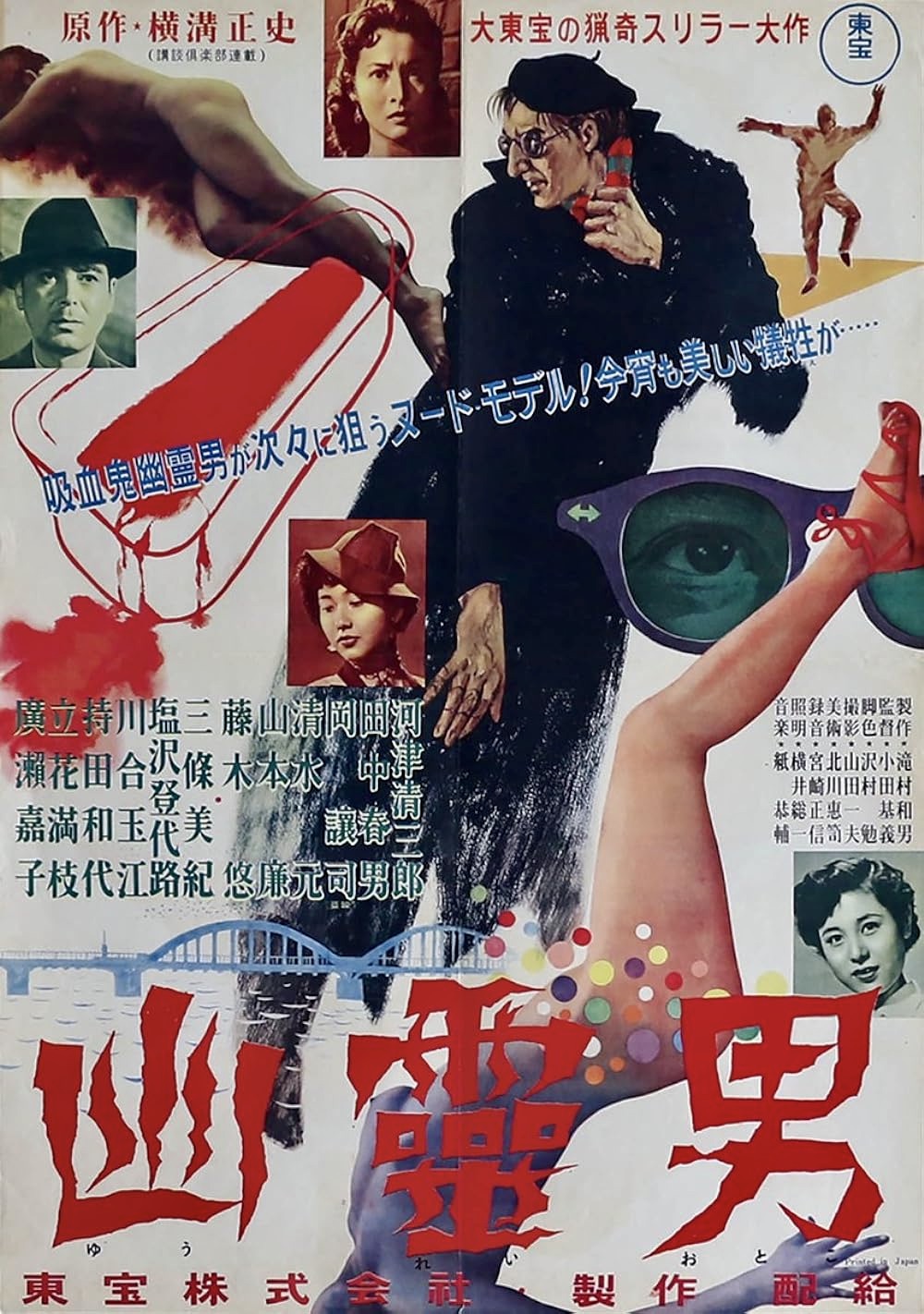
Detective Kindaichi vs. Ghostman Sagawa

The 1954 Japanese film poster for GHOST MAN.

Novelists who specialize in murder mysteries and thrillers with detective heroes are not exclusively British and American but practitioners of a worldwide literary tradition, especially in Japan where Edogawa Ranpo, Soji Shimada and Seishi Yokomizo are considered masters of the form. Yokomizo, for example, was so popular and prolific that he was often called the “Japanese John Dickson Carr,” a writer of American detective fiction who created such famous sleuths as Dr. Gideon Fell and Sir Henry Merrivale in his novels. Yokomizo became popular in the post-WW2 years with a series of “locked room” mystery thrillers that began with The Honjin Murders in 1946 featuring the detective hero Kosuke Kindaichi. Yet it wasn’t until 1954 when the character of Kindaichi was first portrayed on the screen by actor Seizaburo Kawazu in the murder mystery Yurei Otoko (English title: Ghost Man). It was the first of several Kosuke Kindaichi film adaptations but, for its era, it was also extremely racy for its female nudity as well as its disturbing narrative which follows the crimes of a cunning serial killer who preys on models.

Continue reading

Kuan Tai Chen in Action

Several years before the martial arts film craze erupted in the U.S. in the early seventies, Chinese action films classified as wuxia, a combination of sword fighting and martial arts in a period setting featuring noble anti-heroes, were already dominating the Hong Kong film industry. The masterminds behind this new trend were Runme and Runde Shaw, who had initially founded the Tianyi Film Company in Shanghai with their brother Runje in 1925. Once they opened their Hong Kong movie studio in 1958, the two Shaw Brothers begin to produce box-office hits like the 1962 historical drama The Magnificent Concubine. Then, the unexpected success of The One-Armed Swordsman in 1967 launched a new action genre for the studio and the floodgates were open. One of the best of these latter efforts is The Boxer from Shantung (1972), which was a major hit in China but is not as well known here. Starring martial arts expert Kuan Tai Chen, the film is a spectacular showcase for the charismatic athlete/performer and a wonderful introduction to martial arts movies produced by the Shaw Brothers.

Continue reading

Life is a Carnival

The Japanese film poster for THE WIND-OF-YOUTH GROUP CROSSES THE MOUNTAIN PASS (1961).

Most Japanese film fans and cult movie buffs are certainly familiar with maverick director Seijun Suzuki for his ultra-stylish and unconventional yakuza thrillers Tokyo Drifter (1966) and Branded to Kill (1967). Not as well known are the numerous genre films he was assigned by his studio Nikkatsu in the late fifties/early sixties. One of his most atypical efforts is The Wind-of-Youth Group Crosses the Mountain Pass (Japanese title: Toge o wataru wakai kaze, 1961), which is like a more adult variation on James Otis Kaler’s Toby Tyler or Ten Weeks with a Circus except, in this case, the protagonist is not a kid but a college student majoring in economics. There is also no circus, just a traveling carnival troupe with an uncertain future. Yet, the tone is surprisingly upbeat and cheerful with moments of slapstick comedy, musical interludes, dramatic incidents and a subplot involving competitive yakuza gangs, who are closer to bumbling schoolyard bullies than menacing gangsters.

A massive lantern float lights up the nightime sky in THE WIND-OF-YOUTH GROUP CROSSES THE MOUNTAIN PASS (1961), a Japanese film about a traveling carnival troupe.
Continue reading

…And You Thought Donald Pleasence Was Creepy?

Angela Pleasence stars in the 1974 psychodrama SYMPTOMS, directed by Jose Ramon Larraz.

Angela Pleasence, like her father, has a face made for the cinema though not in the realm of conventional leading ladies. Even as a young actress appearing in bit parts in movies like Here We Go Around the Mulberry Bush (1968) and The Love Ban (1973), she was never a winsome ingénue or the lovable girl next store. Her uniquely peculiar beauty – especially those hungry eyes that bore holes right through you – must have somehow hindered her movie career because her film roles have been few and far between. She is mostly remembered for her television work, particularly her role as Catherine Howard in the 1970 TV mini-series The Six Wives of Henry VIII, but she should have had the film career her father had on the basis of Symptoms (1974) alone.  

Continue reading