The Rashomon Moment: Bob Dylan at the 1965 Newport Folk Festival

Bob Dylan performs for the crowd in Murray Lerner’s excellent 2007 documentary on the musician at the Newport Jazz Festival – THE OTHER SIDE OF THE MIRROR: BOB DYLAN AT THE NEWPORT JAZZ FESTIVAL, 1963-1965.

In the winter of 2007 moviegoers were given a choice to see numerous impersonations of the artist known as Bob Dylan in a semi-experimental biopic or experience the living legend in concert at the Newport Folk Festival circa 1963. The former was Todd Haynes’s I’m Not There featuring several faux-Dylans portrayed by Heath Ledger, Christian Bale, Cate Blanchett, Richard Gere and others in a dramatic attempt to capture the many phases and contradictions in the musician’s life. The latter was Murray Lerner’s riveting time capsule, The Other Side of the Mirror: Bob Dylan Live at the Newport Folk Festival, 1963-1965. The strange thing is that Lerner’s documentary featuring the real deal vanished after a brief theatrical run while Haynes’s film continues to enjoy wide exposure thanks to its release on DVD. I don’t know if this meant that the younger movie-going audience is more interested in popular actors playing Bob Dylan or that they have little interest in the sixties folk music scene that Dylan revitalized with his spectacular entry into it. 

Continue reading
Wolves, Pigs and Men

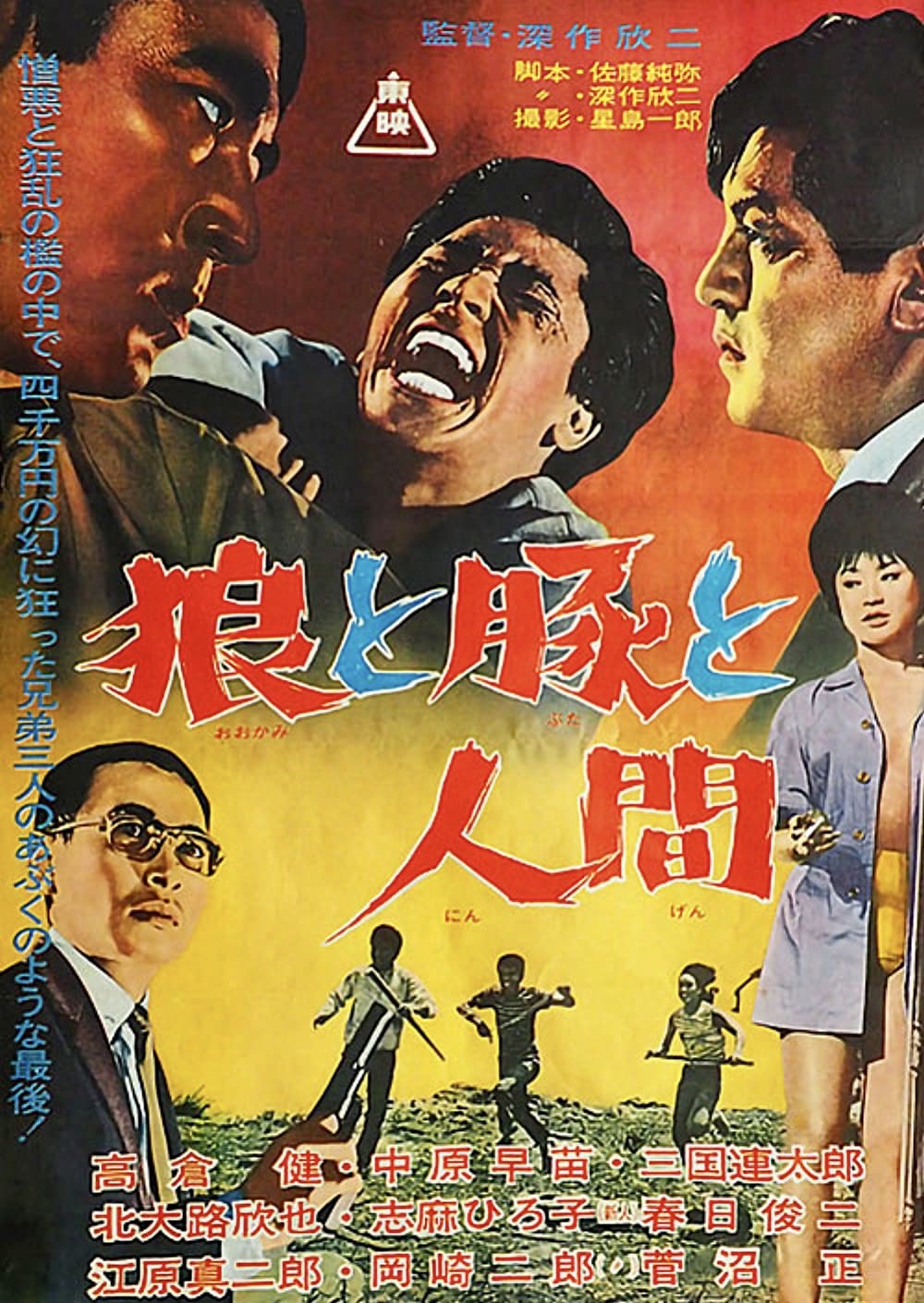
The Japanese film poster for WOLVES, PIGS AND MEN (1964).

Among the many post-WW2 Japanese filmmakers who emerged in the 1960s and hit their stride in the seventies, Kinji Fukasaku was one of the most prominent and critically acclaimed directors in his own country but didn’t start to acquire a growing fan base in the U.S. until after 2000 when some of his masterworks began to appear on DVD such as the yakuza epic Battles Without Honor and Humanity aka The Yakuza Papers (1973), which launched a five-film franchise, and Battle Royale (2000), a controversial futuristic fable about institutionalized violence against problem teenagers. Over the years, Fukasaku has dabbled in numerous film genres from historical drama (Under the Flag of the Rising Sun, 1972) to sci-fi (Message from Space, 1978) and comedy (Fall Guy, 1982), but he is best known from his crime dramas, especially those which popularized the jitsuroku eiga genre. His documentary-like dramatizations based on real crimes often depicted yakuza figures as ruthless men operating without “honor and humanity” (in the title words of his breakthrough film). Even prior to his trend-setting crime thrillers of the mid-seventies, Fukasaku was turning out edgy, innovative work and Okami to Buta to Ningen (English title: Wolves, Pigs and Men) from 1964 is an explosive, nihilistic tale which qualifies as a rough-hewn, early masterpiece.

Continue reading

Playing the Odds

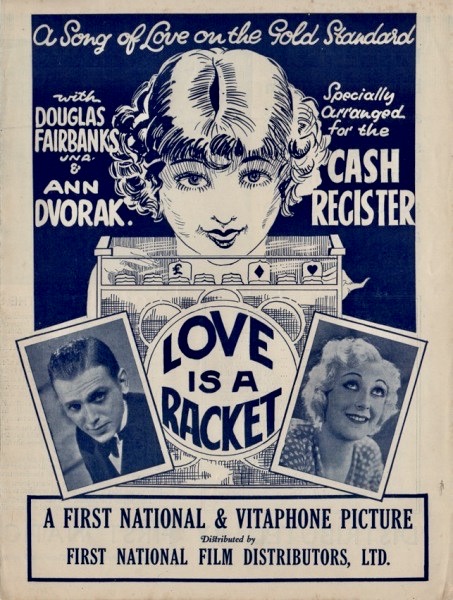
During his years as a contract director at Warner Bros., William Wellman made his mark early with the influential gangster drama The Public Enemy (1931) but didn’t have another major box office success until after he left the studio and directed A Star Is Born (1937), produced by David O. Selznick and distributed by United Artists. Yet, during his tenure with First National Pictures/Warner Bros., Wellman churned out a number of energetic, fast-paced entertainments which are often overlooked by admirers of his work but stand out from the assembly-line programmers they were intended to be. Among the highlights from this early period are Night Nurse (1931) with Barbara Stanwyck, the grim Pre-Code drama Safe in Hell (1931) and Love Is a Racket (1932) starring Douglas Fairbanks, Jr. as a newspaper columnist working the Broadway beat. The latter film is not only a fascinating time capsule of its era, with glimpses of then-popular New York City nightspots such as Sardi’s, but also presents an unapologetic, cynical view of reporters who often resort to any means necessary to score a front-page story.

Continue reading

Break Up the Dance and Other Film Shorts from Poland

Polish film director Roman Polanski during his student years at the Lodz Film School.

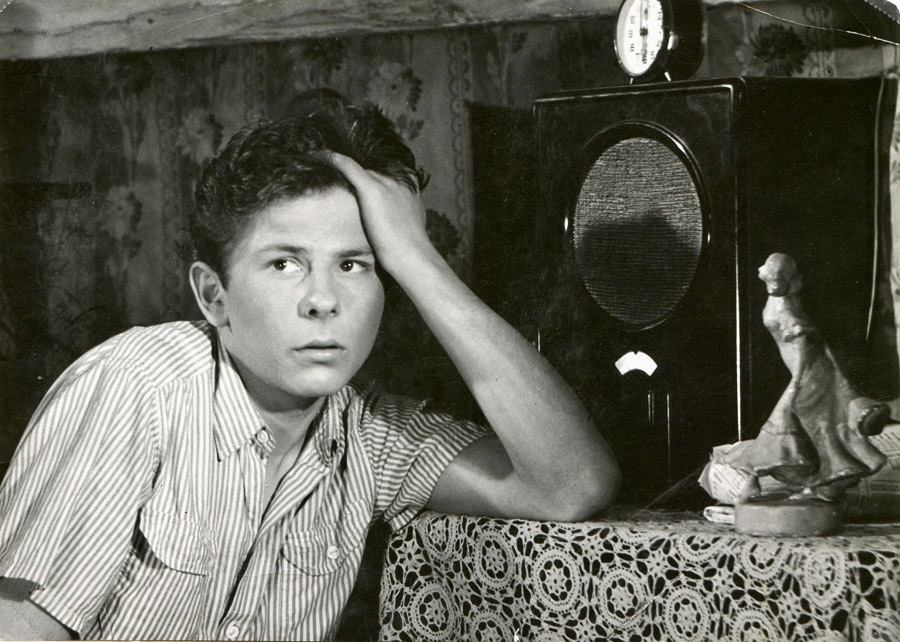
At an early age Roman Polanski began to realize his true ambition to be a filmmaker with a series of short films which were made during his time as a student at Poland’s prestigious National Film School at Lodz. His debut film Morderstwo [English title, Murder aka The Crime, 1957] – a three minute short without dialogue about a senseless murder – and the one that followed it, the three-minute Usmiech Zebiczny [English title: Teeth Smile aka A Toothful Smile, 1957], about a peeping tom, were atmospheric studies in violence and voyeurism that disturbed his fellow filmmakers and raised speculations about the young filmmaker’s dark side. His third short, Rozbijemy Zabawe… [English title: Break Up the Party, 1957], however, aroused considerably more controversy over his directorial methods. 

Continue reading

Expect the Unexpected

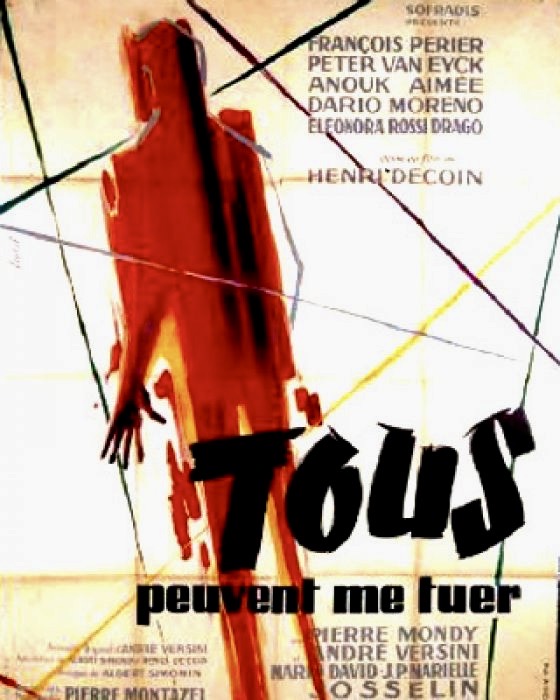
The French film poster for EVERYONE WANTS TO KILL ME (1957), directed by Henri Decoin.

When a movie refuses to fit snugly into a specific genre, that could be a sign that the filmmakers were either unable to capture the desired approach and tone or that the story/screenplay dictated a less conventional approach to the narrative. I suspect that the latter reason is why Tous Peuvent Me Tuer (English title, Everyone Wants to Kill Me, 1957), directed by Henri Decoin, is hard to place into any specific film category. If you were to watch the movie with the sound turned off, you would probably classify it as a brooding French noir. Yet, if you add in the music score and the animated performances, it comes across as an almost lighthearted crime caper flick. Add to this a segue into prison melodrama which soon becomes a whodunit murder mystery. And just to keep things off balance, stir in a romance, some comic relief and a wrap-up that positions the entire affair as a morality play. 

Continue reading

The Education of Miss Blum

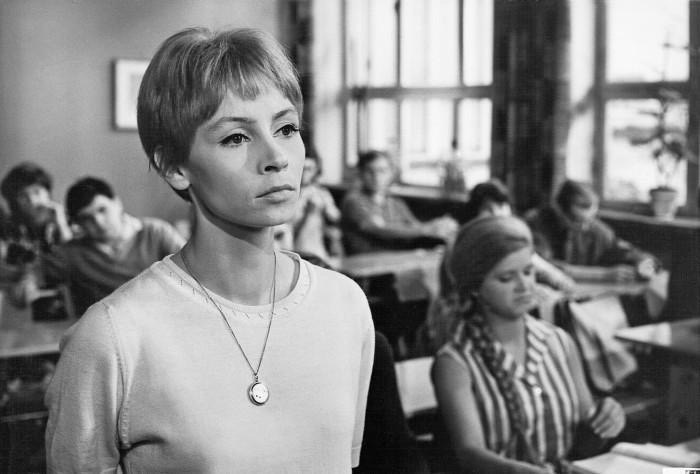
Karla (Jutta Hoffmann) has some doubts about her effectiveness as a teacher in the East Germany drama KARLA (1965), which was banned for many years.

There have been enough movies about teachers facing challenging classroom situations and unsympathetic staff and school board members to comprise a film genre of its own. And it is not limited to just classic flicks from Hollywood like Goodbye, Mr. Chips (1939), Bright Road (1953) The Blackboard Jungle (1955), Up the Down Staircase (1967), To Sir, With Love (1967), Stand and Deliver (1988) and Dead Poets’ Society (1989). Other countries have produced their own cinematic touchstones on the subject such as the U.K. (The Browning Version [1951], If… [1968], The Prime of Miss Jean Brodie [1969]), France (Zero for Conduct [1933], The Class [2008]), Japan (Twenty-Four Eyes [1955] or Russia (Village Teacher [1947]). All of these address numerous issues like juvenile delinquency, racism, illiteracy and the value of mentorship but few, if any, have presented the complex problems facing Karla, the heroine of Herrmann Zschoche’s 1965 East German drama which was extremely controversial in its day.

Continue reading

Monster Mash

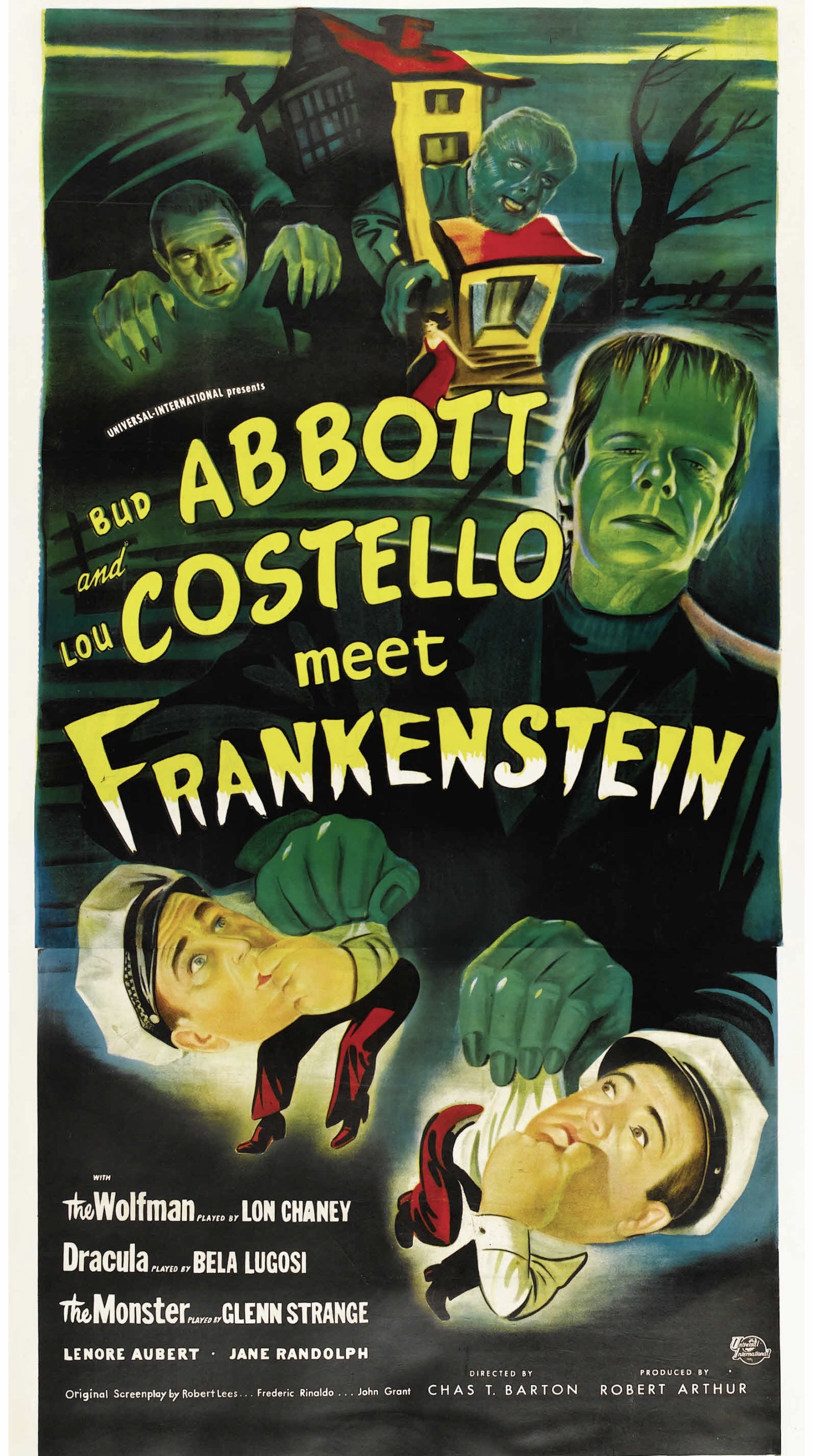
During the 1930’s and early forties, Universal Studios rode the crest of a horror film craze that made them rich and famously established them as the home of Frankenstein, Dracula, the Wolf Man, the Mummy and other screen monsters. But the fear factor was lost over time as their signature creatures were paraded through a series of inferior B-movie sequels. And in the minds of some horror film fans, the genre hit rock bottom with the release of Abbott and Costello Meet Frankenstein in 1948. Once capable of terrifying their audiences, the Universal monsters were now reduced to playing “straight men” to Abbott and Costello’s slapstick antics. Who could ever take them seriously again? Yet, Abbott and Costello Meet Frankenstein is both a first-rate horror-comedy that ranks as one of the comedy team’s finest efforts (and most profitable) and an affectionate homage to the screen horrors who gave us nightmares as kids.  

Continue reading