
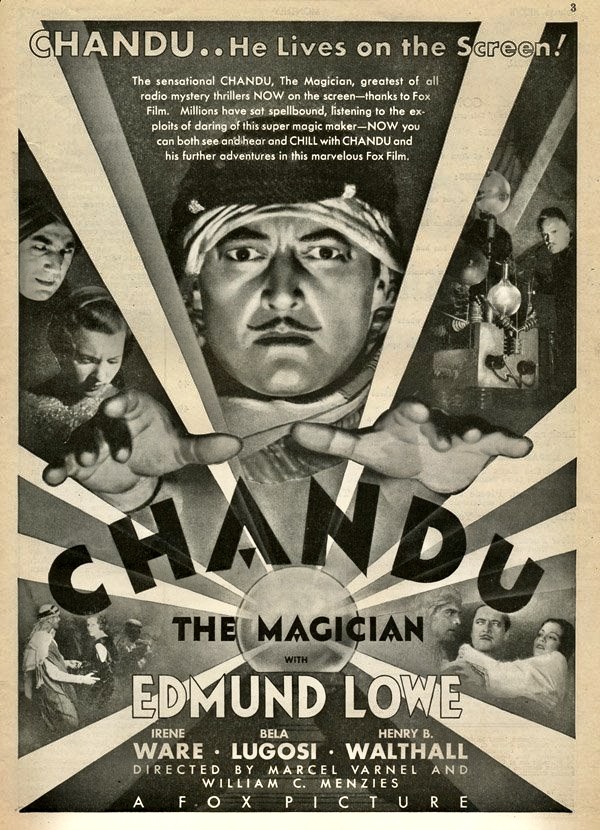
Frank Chandler’s Secret Identity

Now that Hollywood has settled into a regular routine of converting comic books and graphic novels into big screen blockbusters, it seems the time is right to revisit some of the earlier superheroes of American pop culture. Take, for example, Chandu the Magician. Based on the popular radio serial by Harry A. Earnshaw and Raymond R. Morgan and broadcast in fifteen minute episodes, the program ran from 1932 to 1936 and then was revived with new talent in 1948 and broadcast until 1950. What makes Chandu unique is the protagonist. Once known as Frank Chandler, he has spent three years among the yogis as a disciple, mastering the art of hypnosis and the occult arts, before being sent out into the world by his mentor to battle the forces of evil under his new identity, Chandu. His nemesis is Roxor, an evil madman intent on dominating the world after hijacking a death ray weapon created by Chandu’s brother-in-law Robert Regent, who is imprisoned by Roxor. When Regent refuses to divulge the secret of activating the death ray, his wife, daughter and son are also captured and threatened with death. Chandu is the only one who can save them.

Continue reading
A Madcap Chase Across Brazil

On September 6, 2021, France lost one of their biggest cinema icons of the 20th century with the death of Jean-Paul Belmondo at age 88. The actor attained international fame in 1960 for his charismatic performance in Jean-Luc Godard’s Breathless as an amoral car thief on the lam. He was the epitome of bad boy cool in that film and would enhance that screen persona in other crime dramas like Claude Sautet’s Classe Tous Risques (1960) and Jean-Pierre Melville’s Le Doulos (1962). Then, Belmondo reached an even wider international audience with the cross-over commercial hit, That Man from Rio (1964), which was even more accessible to the average moviegoer than Breathless, especially in America.

Continue reading

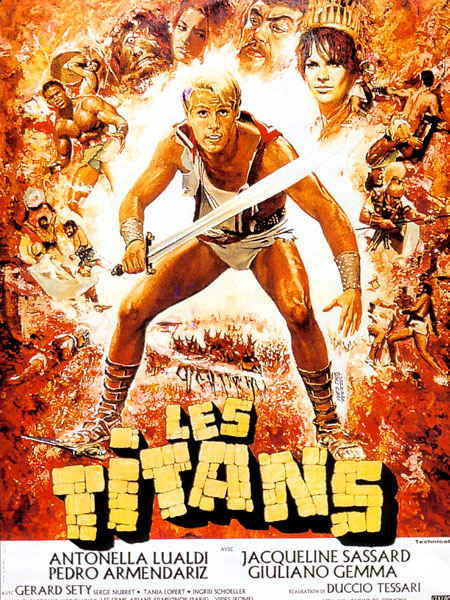
Vintage Peplum

The French film poster for My Son, the Hero (1962)

Remember the Italian sword and sandal films (known as peplum in their native land) that enjoyed a brief period of popularity in the U.S. from around 1958 to 1964? There was never any question about the appeal. What’s not to like about muscle-bound super heroes, beautiful, curvaceous slave girls, princesses and evil queens, despicable, hiss-worthy villains, amazing feats of strength, epic battle scenes, exotic dance sequences, bizarre tortures and stylized sadism, picturesque locations, atmospheric set design, and disaster film calamities (earthquakes, volcanoes, storms)?   Continue reading