Moviegoers often complain about the Hollywood practice of remaking a film that was popular the first time around so why make it again. The answer is obvious. A good story is worth retelling again and again and author Peter B. Kyne is one of those writers whose various novels and stories have been adapted to the screen more than 100 times, especially during the silent and early sound era. Many of these works were also adapted by screenwriters without his consent or any compensation from the studios but most film buffs will recognize his most popular creation, which was a 1913 novella entitled Three Godfathers (It first appeared in The Saturday Evening Post in November 1912). D.W. Griffith made a short silent version of it in 1913 with Harry Carey called The Sheriff’s Baby. There was a Universal silent version in 1916 which also starred Harry Carey, then a remake directed by John Ford in 1920 called Marked Men, and yet another remake by Ford in color and starring John Wayne in 1948 entitled 3 Godfathers. Other adaptations include a made-for-TV version entitled The Godson in 1974 and even a 2003 Japanese anime called Tokyo Godfathers from director Satoshi Kon as a homage to the original story. But one version that is often overlooked is Hell’s Heroes (1929) directed by William Wyler.
Continue readingTag Archives: The New York Times

Metamorphosis of a German Housewife

When German director Alexander Kluge first burst upon the international film scene in 1966 with his debut feature Abschied von Gestern – (Anita G.) aka Yesterday Girl, he was at the forefront of the emerging New German cinema. The movie was proclaimed “Outstanding Feature Film” at the 1967 German Film Awards with Kluge also winning for “Best Direction” and it also won numerous awards at the Venice Film Festival. After such a glorious beginning, Kluge was soon overshadowed by R.W. Fassbinder, Werner Herzog, Wim Wenders and other rising German directors as their work enjoyed wider acclaim and distribution outside Germany. That certainly didn’t discourage Kluge from moviemaking and his filmography to date includes more than 100 shorts, features and TV movies, most of which have been criminally overlooked by the same film critics who embraced his more famous peers. Yesterday Girl earned him the moniker of “The German Godard” and you can see stylistic similarities between the two directors but Kluge forged his own personal brand of cinema and one of his most important and audacious works is Gelegenheitsarbeit einer Sklavin (English title: Part-Time Work of a Domestic Slave, 1973).
Continue readingJack Webb: Drill Instructor
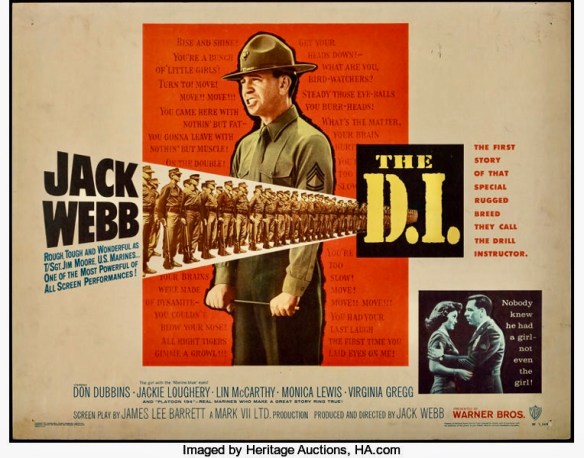
“I AM NOT YOUR MOTHER!” – Sergeant Jim Moore
One of the more popular releases in the Warner Archives Collection, The D.I. (1957) was not a box office smash upon its original release but the cult of Jack Webb has grown considerably since then and The D.I. is undiluted, industrial-strength Webb; the star/director/producer is on the screen almost the entire time during this 106 minute marine training drama. Continue reading
Carole Lombard: Shady Lady
Prior to her breakout role opposite John Barrymore in the screwball comedy Twentieth Century (1934), Carole Lombard was a struggling young contract player at Paramount Pictures where her talent was often squandered in mediocre projects and B-pictures like It Pays to Advertise (1931), No One Man (1932) and Supernatural (1933). There were exceptions, of course, and one of the better examples is Virtue (1932), which confirms Lombard’s promise as an actress in her pre-stardom years. Continue reading
When Seafood Fights Back!
Japanese pop culture can be so crazieeee, especially as filtered through their national cinema! You already know this if you’ve seen any films by Noboru Iguchi (A Larva to Love, 2003; RoboGeisha, 2009), Gen Sekiguchi (Survive Style 5+, 2004), Sion Sono (Exte: Hair Extensions, 2007; Why Don’t You Play in Hell?, 2013), and especially Minoru Kawasaki, who likes plopping animal-suited characters into his genre films in order to mix it up with the humans who, in most cases, might be initially surprised but usually become complacent about the absurdity of the situation.
A good example of this is Kawasaki’s The Calamari Wrestler (2004) which is the sort of movie which will immediate polarize potential viewers into two camps based solely on images or clips from the film, its plot description or even the title alone. It all depends on how you feel about a movie in which a former championship wrestler-turned-squid returns to the ring to reclaim his title, win back his girlfriend who is now the fiancee of the current champion, and battle corrupt promoters and new rivals such as Squilla, the boxing shrimp.
Continue reading