Extraordinary Encounters on the Trans-Siberian Express

Movies that take place on trains constitute a film genre of their own and there have been plenty of great ones over the years – The General (1926), The Lady Vanishes (1938), The Narrow Margin (1952), Snowpiercer (2013) – but I can safely say that Johanna D’Arc of Mongolia (English title: Joan of Arc of Mongolia, 1989), directed by Ulrike Ottinger, is the most unusual one ever made. Although it embraces the idea that travel can be a life-changing experience for everyone, Ottinger puts her own personal spin on this by addressing ideas about gender, history, personal empowerment and cultural traditions through a smash-up of popular genres. These include musical theater, campy soap operas, widescreen epics and ethnographic documentaries. It might sound like either a complete goof or pretentious nonsense (some detractors claim both) but it works as a one-of-a-kind hybrid, informed by Ottinger’s insights into human behavior and her own directorial eccentricities.

Continue reading

Wim Wenders Explores Yasujiro Ozu’s Favorite City

By the time Wim Wenders won the Palme d’Or at Cannes for Paris, Texas in 1984, he was well established as an internationally renowned director. He made his first big splash on the world stage in the early 1970s along with other New German Cinema directors (Werner Herzog, R.W. Fassbinder, etc.) with films such as The Goalie’s Anxiety at the Penalty Kick (1972) and Alice in the Cities (1974). Wenders had also dabbled with non-fiction-like formats in early experimental shorts, music videos and the Cannes-focused TV documentary of various film directors in Chambre 666 (1982). Yet, it was Tokyo-Ga 1985), the feature length portrait he made directly after Paris, Texas, that really triggered Wenders’s interest in not just non-fiction filmmaking but in Japan cinema and culture, especially the works of Yasujiro Ozu.

Continue reading

Man of Mystery

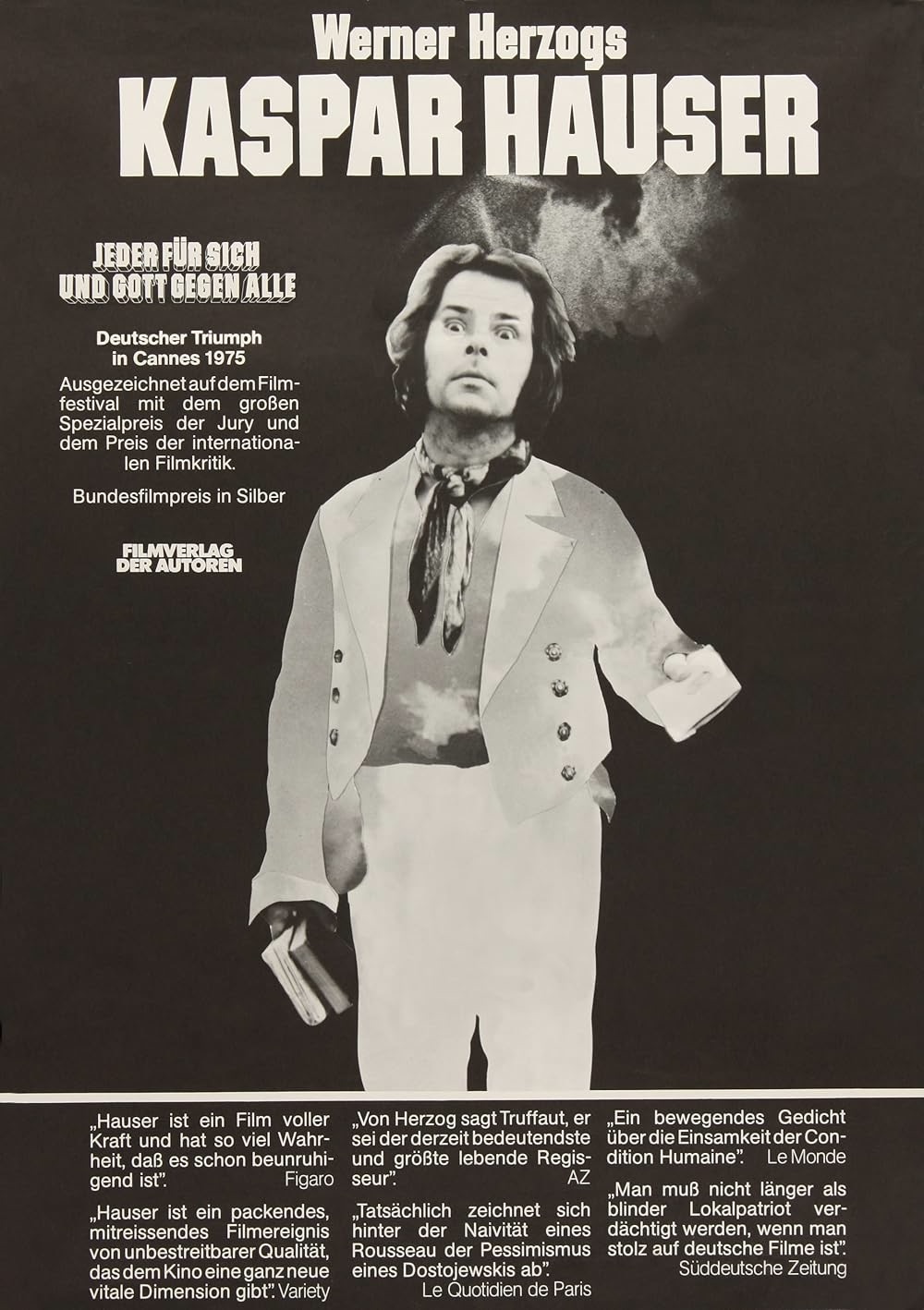
The German film poster for THE ENIGMA OF KASPAR HAUSER aka Every Man for Himself and God Against All (1974).

In May 1828 a young man appeared in a town square in Nuremberg, Germany carrying a prayer book and two letters written by his former caretaker. He spoke very little and was unable to answer any questions about his identity, where he came from or why he was there. One of the letters stated that he had come to the city to meet the captain of the 6th cavalry regiment with the hope of becoming a cavalryman. The other letter claimed he had been born in 1812 and had been raised in complete isolation from other people although he had been taught rudimentary reading and writing skills. His name was Kaspar Hauser but his mysterious nature and childlike presence baffled the townspeople and he was housed as a vagabond at the local prison until he was made a ward of the city and put under the protective care of Lord Stanhope, a wealthy aristocrat. Stanhope devoted himself to Hauser’s further education and re-entry into society and the young man’s bizarre demeanor aroused the curiosity of the public as well as doctors, professors and members of the clergy. Unfortunately, Hauser’s life came to an abrupt end in April 1833 when the mysterious man who first brought him to Nuremberg returned and stabbed him to death, escaping without a trace. The case has been a source of fascination for years in Germany and numerous films, television series and made-for-TV movies have been made about him but The Enigma of Kaspar Hauser aka The Mystery of Kaspar Hauser aka Every Man for Himself and God Against All (German title: Jeder fur Sich und Gott Gegen Alle, 1974), directed by Werner Herzog, is probably the most famous and critically acclaimed of all the versions made to date.

Continue reading

Metamorphosis of a German Housewife

The German film poster for PART-TIME WORK OF A DOMESTIC SLAVE (German title: Gelegenheitsarbeit einer Sklavin, 1973)

When German director Alexander Kluge first burst upon the international film scene in 1966 with his debut feature Abschied von Gestern – (Anita G.) aka Yesterday Girl, he was at the forefront of the emerging New German cinema. The movie was proclaimed “Outstanding Feature Film” at the 1967 German Film Awards with Kluge also winning for “Best Direction” and it also won numerous awards at the Venice Film Festival. After such a glorious beginning, Kluge was soon overshadowed by R.W. Fassbinder, Werner Herzog, Wim Wenders and other rising German directors as their work enjoyed wider acclaim and distribution outside Germany. That certainly didn’t discourage Kluge from moviemaking and his filmography to date includes more than 100 shorts, features and TV movies, most of which have been criminally overlooked by the same film critics who embraced his more famous peers. Yesterday Girl earned him the moniker of “The German Godard” and you can see stylistic similarities between the two directors but Kluge forged his own personal brand of cinema and one of his most important and audacious works is Gelegenheitsarbeit einer Sklavin (English title: Part-Time Work of a Domestic Slave, 1973).

Continue reading

Thomas Schamoni’s Almost Forgotten 1970 Experiment from the New German Cinema Movement

The New German Cinema of the late sixties-early seventies introduced the world to some of the most original and provocative filmmakers of the 20th century such as Rainer Werner Fassbinder, Wim Wenders, Werner Herzog and Volker Schlondorff, but some of pioneers never attracted much attention outside their own country and their films are in danger of being forgotten. Among them are Helma Sanders-Brahms, Peter Lilienthal, Hans W. Geissendorfer and Thomas Schamoni, who is probably the most obscure of them all. Schamoni worked for most of his career in television, turning out documentaries and made-for-TV movies, but in 1970 he directed his only feature film, A Big Grey-Blue Bird (German title: Ein grober graublauer Vogel). A lo-fi mashup of sci-fi and spy genre elements reminiscent of Jean-Luc Godard’s Alphaville (1965), it is a playful and surprisingly entertaining cinematic “experiment” that should have found a wider audience.

Continue reading