
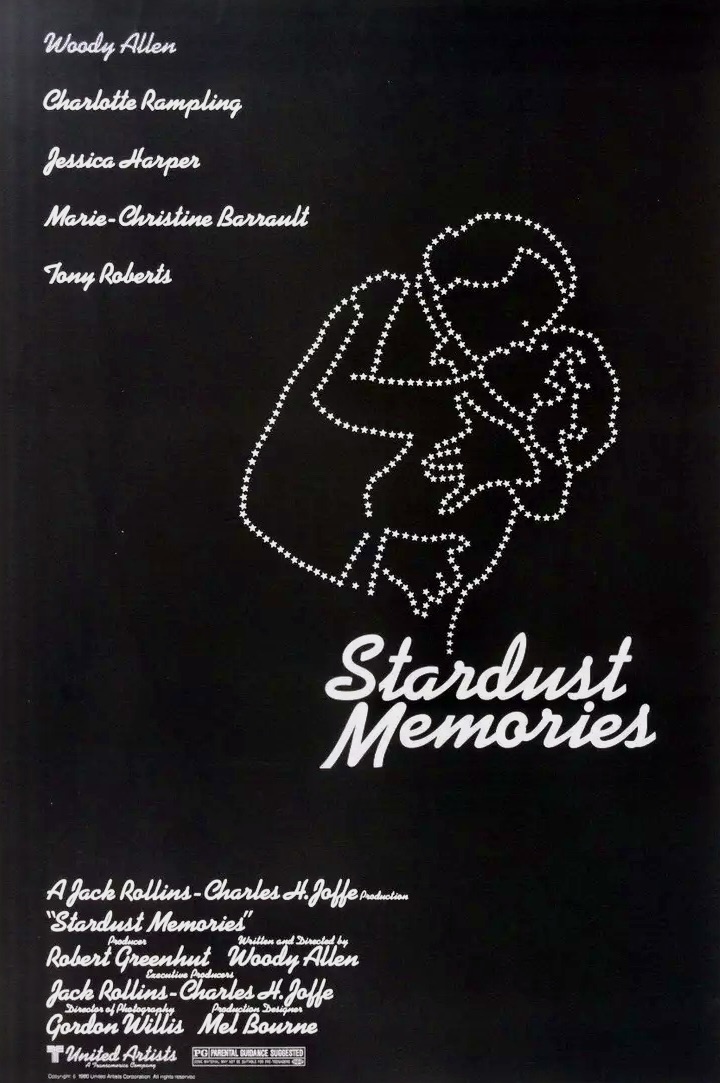
After directing more than fifty feature films including the three-part New York Stories (1989) with contributions from Francis Ford Coppola and Martin Scorsese and the re-edited/re-dubbed version of a Japanese spy thriller retitled, What’s Up, Tiger Lily? (1966), Woody Allen has one of the most impressive filmographies of any living director in Hollywood. Regardless of what you think about him as a person due to the controversy that surrounded his marriage to adopted stepdaughter Soon-Yi Previn, one can’t deny all of the critical acclaim he has amassed over the years, which includes 24 Oscar nominations, three of which won the Academy Award for Best Screenplay (Annie Hall, Hannah and Her Sisters and Midnight in Paris). Not all of his films have been box office hits and some have been minor efforts or polarizing like September (1987) or Deconstructing Harry (1997), but the true acid test for any fan or critic who loves Woody Allen movies is Stardust Memories (1980), his most misunderstood and generally maligned tenth feature about the downside of being famous.
Continue readingTag Archives: Louise Lasser
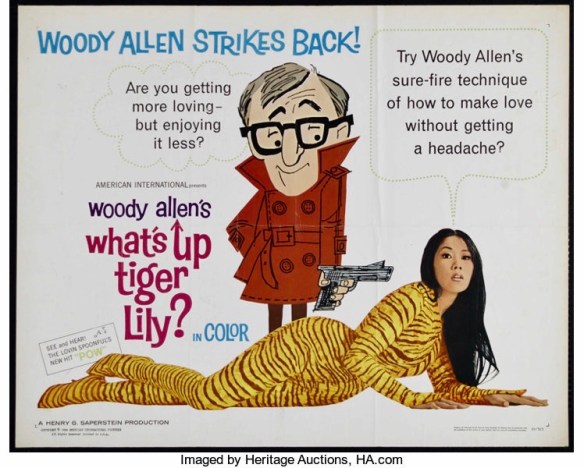
Woody Allen’s Comedy Experiment
By today’s standards, it doesn’t seem like such a novel movie concept — take a low-budget film, re-dub the soundtrack adding new dialogue, music and sound effects, and create an entirely new experience. You can trace pioneers in this technique back to the syndicated TV series Fractured Flickers hosted by Hans Conried in the early sixties and maybe even before that (Fractured Flickers took silent movies and gave them new soundtracks with voices, sound effects and music). Certainly one of the more famous practitioners of this idea is Woody Allen, who explored the possibilities of redubbing found footage – in his case, a Japanese spy movie – with What’s Up, Tiger Lily? (1966). Continue reading
Vagabond Screwballs
Slither (1973) is a film of firsts in many ways. It marked the directorial debut of Howard Zieff, who would go on to become one of the most sought-after comedy directors in Hollywood during the ’70s (Hearts of the West [1975], House Calls [1978], Private Benjamin [1980]). It featured the first screenplay by W. D. Richter who would later pen the 1978 remake of Invasion of the Body Snatchers, the 1979 remake of Dracula, and Brubaker [1980] as well as direct the cult film, The Adventures of Buckaroo Banzai Across the 8th Dimension [1984]. And it was James Caan’s first starring role after his critically acclaimed success in The Godfather [1972] and the beginning of his reign as a Hollywood leading man after struggling to break through in smaller scale movies like Rabbit, Run [1970] and T.R. Baskin [1971]. Continue reading
