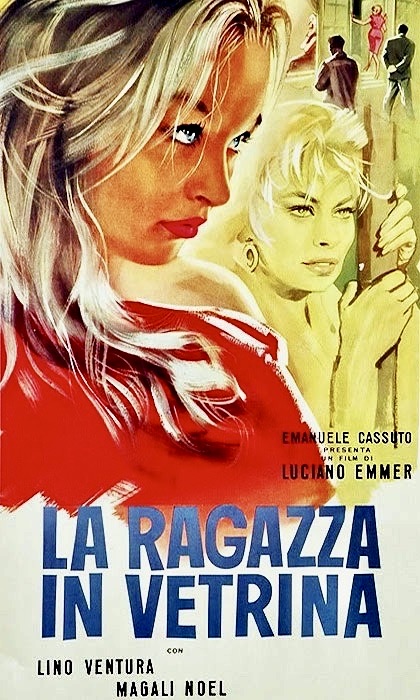
The controversial problem of immigration in Italy has been a problem for decades, not just with internal migration of workers from the south to the north, but also with the influx of refugees from Africa and other areas around the Mediterranean. Not surprisingly, there have been numerous Italian films to address this situation over the years but only a handful of them have received praise and recognition outside their own country. Among them are Pietro Germi’s Il Cammino della Speranza (The Path of Hope, 1950), in which a group of Sicilian workers try to emigrate illegally to France, I Magliari (The Swindlers, 1959), Francesco Rosi’s drama about an out-of-work Italian miner (Renato Salvatore) in Germany, and Lina Wertmuller’s Tutto a Posto e Niente in Ordine (All Screwed Up, 1974), which focuses on immigrants from southern Italy trying to find work in Milan. To this short list, I would like to add Luciano Emmer’s rarely seen La Ragazza in Vetrina (The Girl in the Picture Window, 1961), a tale about two immigrant miners in Belgium who enjoy a weekend getaway in Amsterdam.
Continue readingTag Archives: Lino Ventura
Moving Target
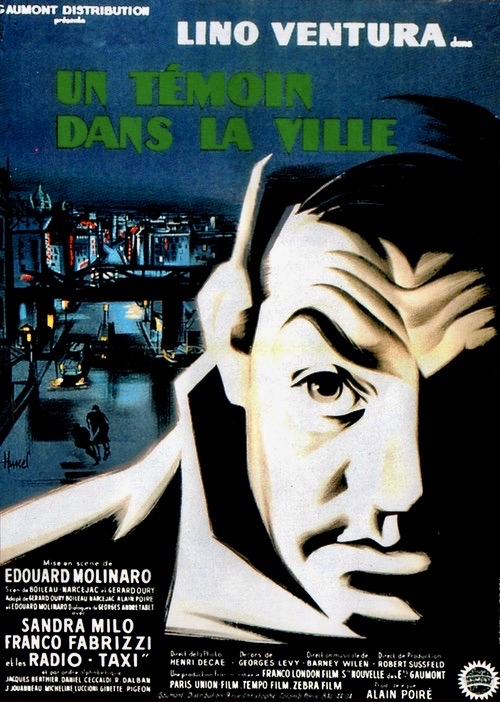
French director/screenwriter Edouard Molinaro may not be a household name in America but practically everyone knows his international breakout hit, La Cage aux Folles, from 1978. It spawned an equally successful sequel, La Cage aux Folles II (1980), but also became the basis for the smash Broadway musical La Cage aux Folles in 1984 and eventually was remade by director Mike Nichols as The Birdcage in 1996 with Robin Williams, Nathan Lane, Gene Hackman and Dianne Wiest. La Cage aux Folles was no fluke success and Molinaro was already renowned in France for his film comedies such as Male Hunt (1964) with Jean-Paul Belmondo, Oscar (1967) featuring Louis de Funes and the black farce A Pain in the…(1973), which was remade by Billy Wilder as Buddy Buddy (1981). None of this would lead you to believe that Molinaro launched his feature film career with several film noir-influenced thrillers and Un temoin dans la ville (English title: Witness in the City, 1959) is a near masterpiece, deserving to stand alongside Louis Malle’s Elevator to the Gallows (1958), Claude Sautet’s Classe Tous Risques (1960) and Jean-Pierre Melville’s Le Doulos (1962). Continue reading
The Ambrose Bierce Civil War Trilogy

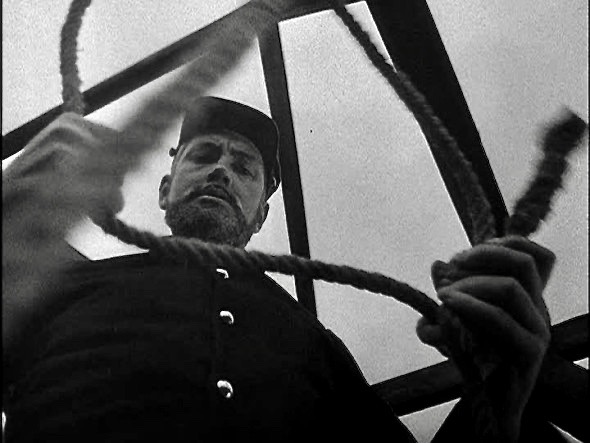
A Union soldier prepares a noose for an accused saboteur in An Occurrence at Owl Creek Bridge, an episode in the three part film, Au Coeur de la vie (In the Midst of Life, 1963).
Stephen Crane’s The Red Badge of Courage, Jessamyn West’s The Friendly Persuasion, Walt Whitman’s collection of poems Drum-Taps and Margaret Mitchell’s Gone With the Wind are among some of the most famous examples of historical fiction and literature about the American Civil War. More recent works would have to include Charles Frazier’s Cold Mountain and Michael Shaara’s trilogy (Gods and Generals, The Killer Angels and The Last Full Measure) but some of the most evocative and unsentimental writing about the War Between the States can be found in the Civil War short stories of Ambrose Bierce, who served in the Union Army’s 9th Indiana Volunteer Infantry. I find it surprising that no major American feature films have been based on his work yet several of his short stories have been adapted for the screen in Poland, England and France. And the most memorable one of all remains Robert Enrico’s Au Coeur de la Vie (In the Midst of Life, 1963). Continue reading