Joe Meek: Studio Recording Wizard

British record producer Joe Meek surrounded by photos of some of his acts in the 1991 BBC documentary THE VERY STRANGE WORLD OF THE LEGENDARY JOE MEEK.

Most record collectors and music lovers of the baby boom generation fondly remember some of the top forty hits created by such innovative producers like Phil Spector, Bob Crewe and Eddie Kramer during the 1960s. Another major talent also emerged in England during this time period who took a unique, hands-on approach to producing records – Joe Meek. With an arsenal of sound effects and recording devices he kept secret from everyone, Meek had a meteoric rise and fall between 1961 through 1967 but is still famous today for “Telstar,” performed by The Tornadoes. It was a monster hit in the U.K. and became the number one single in the U.S. on Billboard’s top 40 chart during the week of December 22, 1962. As a producer, Meek was not a one-hit wonder and had other best-selling singles such as “Johnny Remember Me,” a ghost ballad performed by actor turned pop star John Leyton, and “Have I the Right?” by the Honeycombs. Unfortunately, personal problems, poor financial management and competition with major labels contributed to his downfall (he committed suicide in February 1967). But a fascinating window into his life and career was produced for the Arena documentary series for the BBC in 1991 entitled The Very Strange Story of the Legendary Joe Meek.

Continue reading
Cinerama Disaster

In the disaster film genre, Krakatoa, East of Java (1969) holds the distinction of being the only one presented in the Cinerama widescreen format but is also the most erroneously titled movie of all time. As many historians and movie critics have pointed out, Krakatoa is west of Java but veracity is not one of Hollywood’s strengths in producing historical epics. And Krakatoa, East of Java is not a factual recreation of the famous 1883 volcanic eruption in the Indian Ocean but a lavish B-movie adventure that uses the cataclysmic event only as the background and climactic resolution to its cavalcade of international stars and multiple subplots that play out as pure soap opera.  Continue reading

Richard Lester’s Feature Film Debut with the Mad Jazz Beat

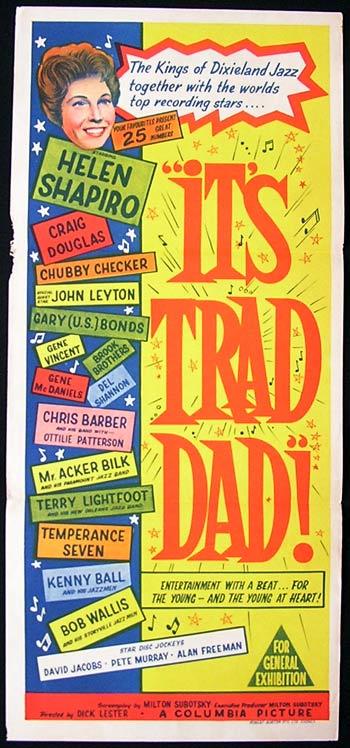
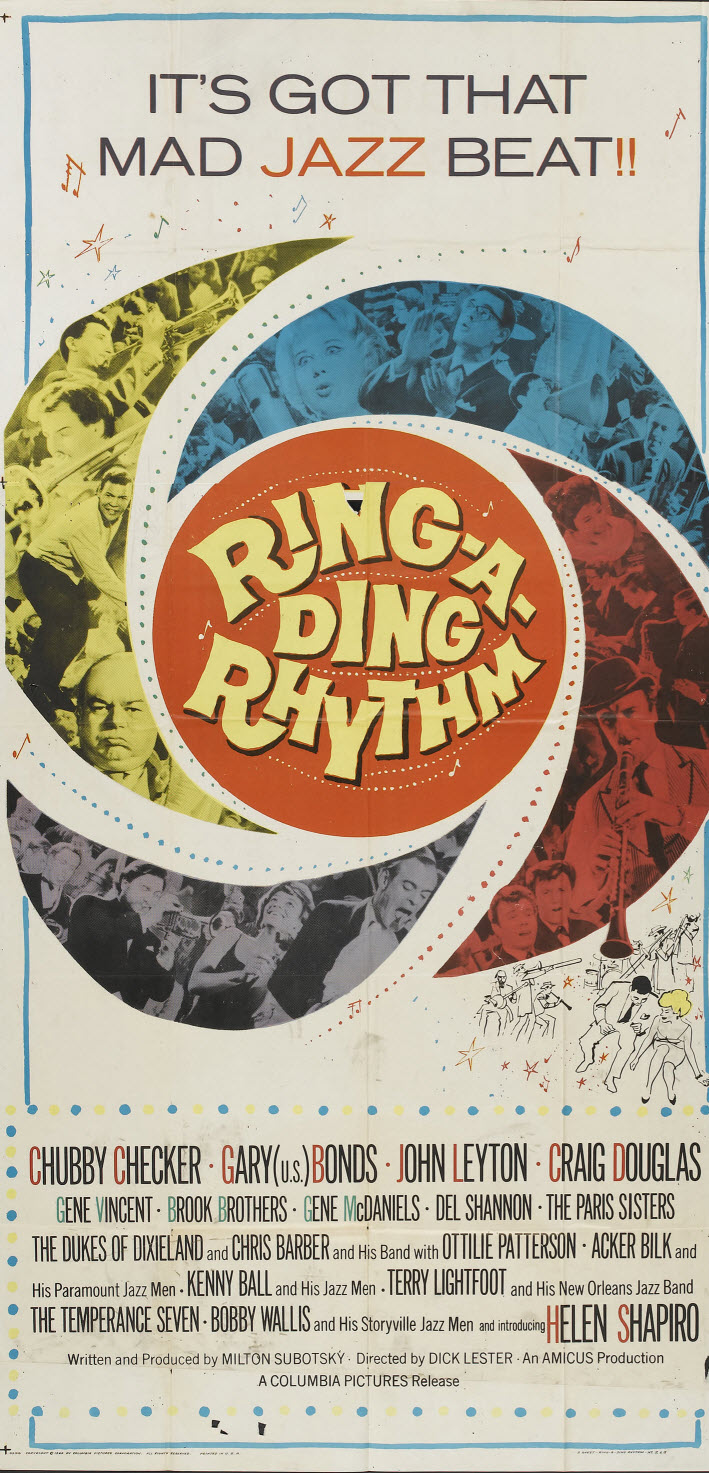
Ring-A-Ding RhythmWhile producer Sam Katzman was busy exploiting the youth culture in the U.S. with quickie productions like Twist Around the Clock (1961) and Don’t Knock the Twist (1962), his contemporary Milton Subotsky was doing the same in England but with a different musical focus. London was in the midst of a British jazz revival driven by the music of New Orleans and Dixieland and this is the sound that inspired It’s Trad, Dad! (1962, aka Ring-a-Ding Rhythm), which also marks the feature film debut of Richard Lester, whose subsequent film was A Hard Day’s Night (1964) for The Beatles.  Subotsky didn’t just stack the deck with jazz groups though; he also added a generous helping of current pop acts and even tried to scoop Katzman with showcasing Chubby Checker in the new novelty dance, the twist (Katzman still beat him to the punch with Twist Around the Clock which was released first in the U.S.).      It's Trad, Dad! Continue reading