One of the most famous Japanese directors of his generation (1912-2012) to emerge from the post-WW2 years was Kaneto Shindo but, outside of a handful of films, most of his work remains largely unseen in the U.S. That is a shame because much of his filmography provides a fascinating glimpse into the lives and mindsets of Japanese people, especially the working class, in the difficult years following the country’s defeat in the war. One of his earliest and most provocative depictions is Dobu (1954), which is also known as The Ditch, but is more accurately translated as The Gutter. And the main protagonist of the film is Tsuru (Nobuko Otowa), who could easily claim to be the most memorable guttersnipe of all time. When the film opens, she is a filthy, wandering beggar on the verge of starvation who collapses in a shantytown known as Kappunuma and here she will remain for the rest of her brief life.
Continue readingTag Archives: Ikiru
The Mighty Mountain Will Punish the Bad
Many people believe they are masters of their own fates but occasionally mother nature steps in to remind them that there are outside forces they cannot control such as a mountain wilderness or a blizzard or an avalanche. Such is the case in Snow Trail (Japanese title: Ginrei no hate, 1947), an engaging B-movie crime drama in which three bank robbers flee to the snow-covered slopes of Mount Hakuba, located in the northern alps of Nagano Prefecture. With the law in close pursuit, the trio soon find themselves in dire straits with no experience in mountain climbing or dealing with extreme weather conditions. Nature is simply indifference in such matters.
Continue readingHome Alone
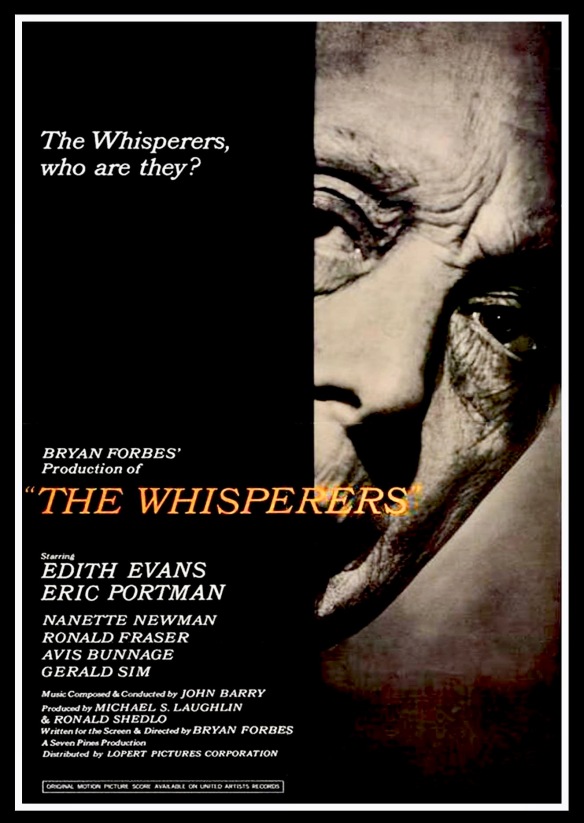
No one wants to think about growing old, becoming infirm and having to rely on others for assistance, particularly after a life of relative independence. While some are lucky enough to have family and friends to help out, many elderly people have no one for support and are left to fend for themselves among strangers. The situation becomes even more desperate without savings or financial assistance. Certainly this isn’t a topic that the commercial cinema has often explored for obvious reasons and great films on this subject are rare indeed but occasionally a masterpiece has emerged. Vittorio De Sica’s Umberto D. [1952], Akira Kurosawa’s Ikiru [1952], and Yasujiro Ozu’s Tokyo Story [1953] are prime examples while a handful of other films remain memorable for the performances alone – Victor Moore and Beulah Bondi in Make Way for Tomorrow [1937], Art Carney in Harry and Tonto [1974] and Edith Evans in The Whisperers [1967], Bryan Forbes’s often overlooked and forgotten adaptation of Robert Nicolson’s novel, Mrs. Ross. Continue reading
Akira Kurosawa’s Record of a Living Being

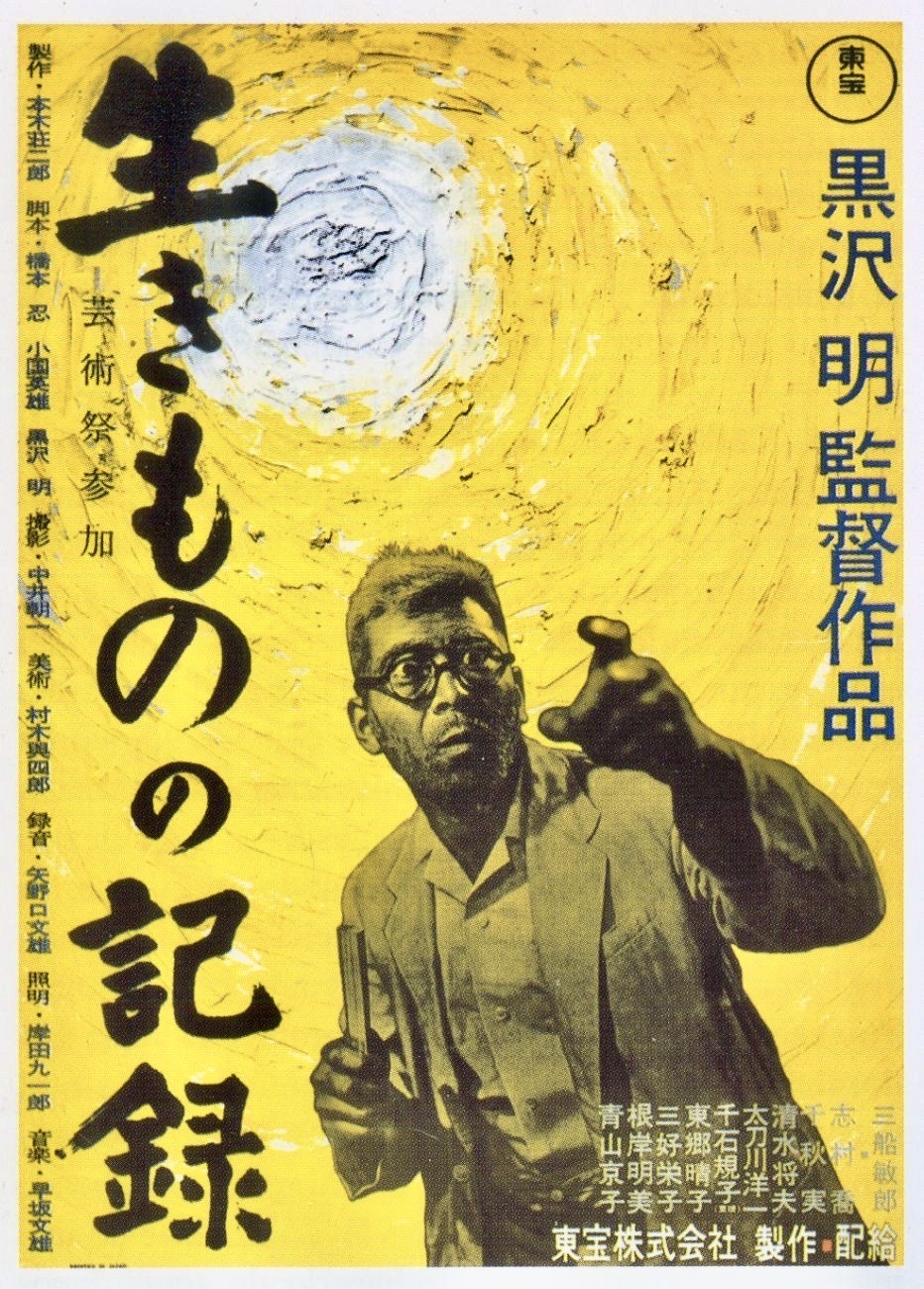
The Japanese film poster for I Live in Fear (1955), directed by Akira Kurosawa and starring Toshiro Mifune.
One of the first Japanese commercial features to directly address the fear of nuclear holocaust and the implications of the atom bomb, Record of a Living Being, which is better known as I Live in Fear (1955, aka Ikimono no Kiroku) was an unusual and unexpected movie for director Akira Kurosawa. He had recently completed Seven Samurai (1954), a huge box office and critical success in both Japan and around the world, but his new work was much smaller in scale compared to that sprawling period epic. Continue reading