
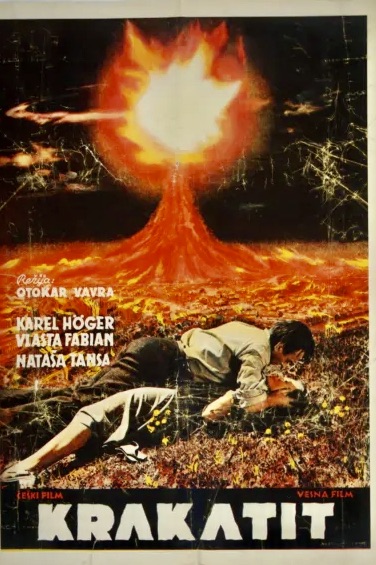
The Big Bang

Why would a scientist create a weapon of mass destruction that was capable of destroying the planet and ending life as we know it? J. Robert Oppenheimer, the theoretical physicist who led the Manhattan project and is known as the “father of the atomic bomb,” would later become guilt-ridden over his invention but his original intention was altogether different. He wanted to create a weapon so powerful and dangerous that it would intimidate all world leaders into putting an end to war but, of course, that idealistic concept ended in failure because human beings are flawed creatures. This same scenario is mirrored in the Czech sci-fi drama, Krakatit (1948), in which an engineer named Prokop (Karel Hoger) creates a powder that can become explosive and release atomic energy when activated by radio signals or other means. Like Oppenheimer, Prokop quickly comes to regret his discovery but a case of amnesia caused by an accidental explosion complicates the engineer’s desperate search for an associate, Jiri Tomes (Miroslav Homola), who stole the formula.

Continue reading
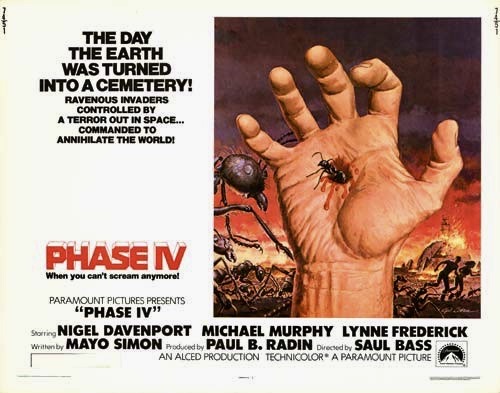
Ants in Your Pants and Worse!

There have been killer ant movies before – Them! (1954), The Naked Jungle (1954), and Empire of the Ants (1977) come to mind – but Phase IV, released in 1974, may be the first and only killer ant art film. With its abstract, almost experimental approach to narrative and character development, it’s a much closer cousin to something like…say, Last Year at Marienbad (1961) than Them! While it was marketed as a science fiction film and clearly belongs in that genre, the film was both puzzling and disappointing to a certain sector of that audience that expected a killer ant movie to deliver thrills, chills and a satisfying ending.  Yet, once you accept the fact that Phase IV is not a conventional sci-fi film and will not conform to the genre conventions that you expect, you may find it absolutely chilling and brilliant. 

Continue reading

Attack of the Molecular Men

The Japanese film poster for THE H-MAN (1958).

The atom bomb and its devastating after effects have served as the basis for some of the science fiction genre’s most popular and successful films and it’s no surprise that many of them hail from Japan where Gojira (1954, U.S. title: Godzilla) became the first in a long line of radioactive monsters bent on stomping Tokyo. Whether intended as metaphorical retribution for the A-bomb destruction of Hiroshima and Nagasaki in 1945 or cautionary tales about the dangers of nuclear power, these sci-fi fantasies became Toho’s studios’ most profitable exports during the late fifties and early sixties and eventually spawned subgenres of their own, one of which was the “mutant” series. The masterminds behind Gojira and most of the Toho sci-fi releases were director Ishiro Honda and special effects technician Eiji Tsuburaya and their first effort in the “mutant” series – Bijo to Ekitainingen (1958) – still stands as one of their most unusual and distinctive films.

Continue reading