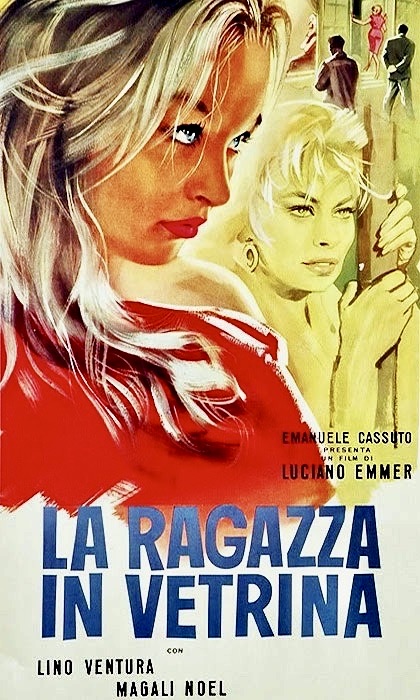
The controversial problem of immigration in Italy has been a problem for decades, not just with internal migration of workers from the south to the north, but also with the influx of refugees from Africa and other areas around the Mediterranean. Not surprisingly, there have been numerous Italian films to address this situation over the years but only a handful of them have received praise and recognition outside their own country. Among them are Pietro Germi’s Il Cammino della Speranza (The Path of Hope, 1950), in which a group of Sicilian workers try to emigrate illegally to France, I Magliari (The Swindlers, 1959), Francesco Rosi’s drama about an out-of-work Italian miner (Renato Salvatore) in Germany, and Lina Wertmuller’s Tutto a Posto e Niente in Ordine (All Screwed Up, 1974), which focuses on immigrants from southern Italy trying to find work in Milan. To this short list, I would like to add Luciano Emmer’s rarely seen La Ragazza in Vetrina (The Girl in the Picture Window, 1961), a tale about two immigrant miners in Belgium who enjoy a weekend getaway in Amsterdam.
Continue readingTag Archives: Pietro Germi
Pietro Germi’s Sicilian Marriage Farce
One doesn’t usually expect a film about infidelity, divorce and murder to be a comedy but that’s one reason Divorzio all’italiana (English title: Divorce, Italian Style, 1961) directed by Pietro Germi, became an unexpected international hit. A caustic satire about the Italian male – or more specifically, Sicily’s male dominated culture – the film also poked fun at Italy’s hypocritical judicial system which can forgive crimes of passion but not legally recognize divorce as a solution for failed marriages. Another factor in the movie’s success was Marcello Mastroianni’s beautifully rendered portrayal of the preening, self-absorbed protagonist, a performance which not only won him an Oscar nomination for Best Actor (the first time in Academy Award history that the lead in a foreign language film received that honor) but still ranks as one of the actor’s key films, following closely on the heels of Fellini’s La Dolce Vita (1960) and Antonioni’s La Notte (1961).
Continue readingStop the World…I Want to Get Off!
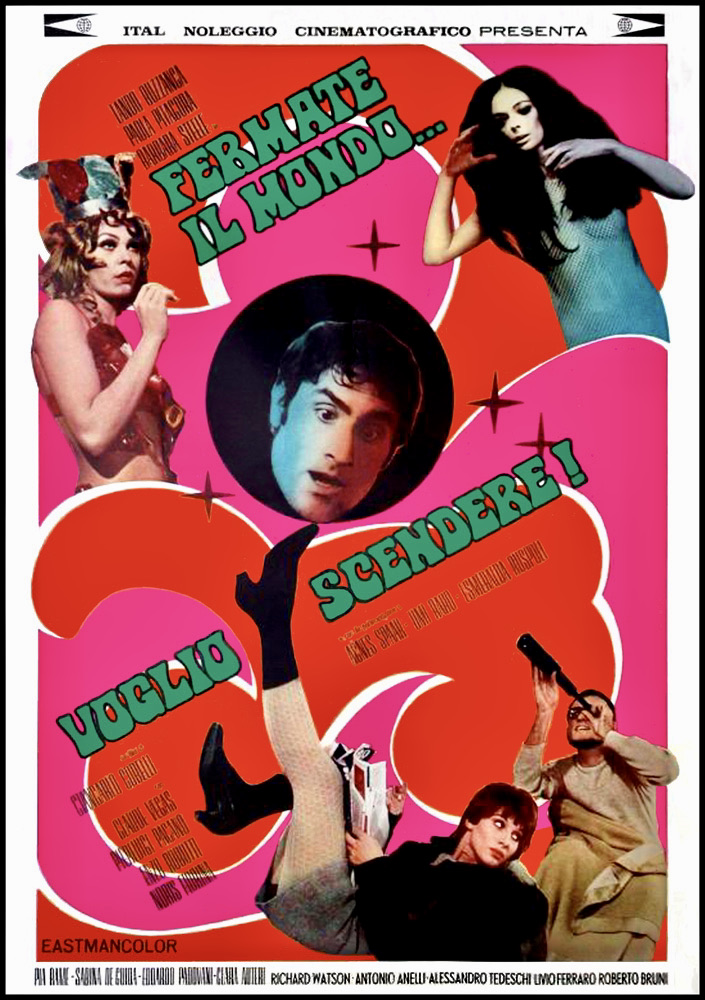
No, I am not referring to the 1961 musical by Anthony Newley and Leslie Bricusse, which enjoyed successful stage productions in London and Broadway before being adapted for the screen in 1966. I’m talking about the 1970 satire, Fermate il Mondo…Voglio Scendere! (the title translates as Stop the World…I Want to Get Off! In English), which was the directorial debut of Italian actor Giancarlo Cobelli, based on a screenplay he wrote with fellow thespians Giancarlo Badessi and Laura Betti, a close friend and frequent collaborator with Pier Paolo Pasolini. The film is a frenzied attack on consumerism and the Italian media but its bursting-at-the-seams energy emanates not so much from outrage as it does from a madcap sense of anarchy.
Continue reading