
Sun Tribe Redux

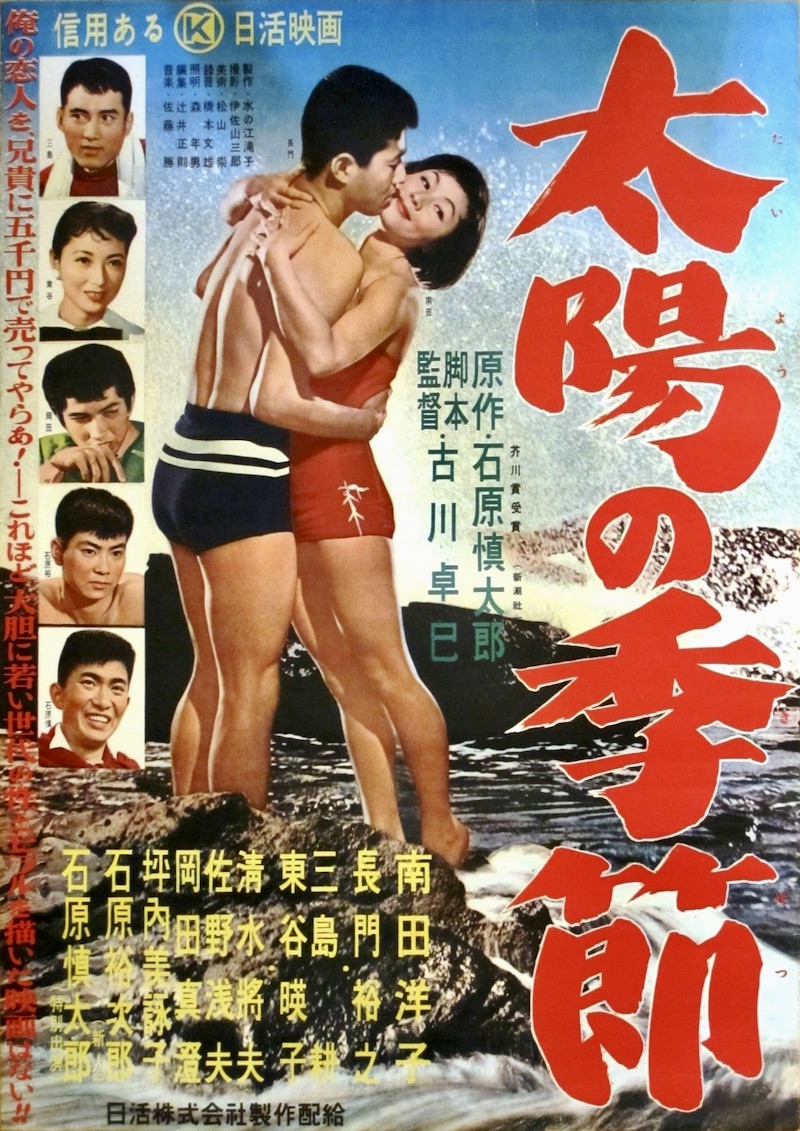
The Japanese film poster for SEASON IN THE SUN (1956) aka Taiyo no Kisetsu.

When Ishihara Shintaro died on February 1, 2022 at age 89, most obituaries focused on his career as a politician in Japan. He first served as a member of the House of Councillors (1968 to 1972) and then as a member of the House of Representatives (1972-1995) before becoming the Governor of Tokyo from 1999 to 2012. A controversial figure in his own country, Shintaro was famous for his ultra-nationalist stance on Japan and extreme right-wing views such as discriminating against Japanese-Koreans, the disabled, women, LGBT and other social minorities. He is now considered an early proponent of “hate speech” and often denied historical accounts of atrocities committed by the Japanese against the Chinese in the infamous Nanjing Massacre of 1937, which in Japan is the same as being a Holocaust denier. What is most surprising about Shintaro, however, is his earlier career as an author and highly successful screenwriter for movie studios like Nikkatsu, Daiei and Shochiku. His critically acclaimed first novella, Taiyo no Kisetsu (English title: Season of the Sun), was published in 1955 and he adapted it into a film for director Takumi Furukawa. It became a box office sensation and inspired several successors in a film movement that became known as the “Sun Tribe” (aka Taiyozoku) movies.

Continue reading

Kiju Yoshida’s Escape from Japan

The Japanese poster for ESCAPE FROM JAPAN (1964)

The Japanese New Wave of the late 1950s/early 1960s introduced the world to a number of rising directors who are now icons of cinema like Nagisa Oshima, Hiroshi Teshigahara, Shohei Imamura and Masahiro Shinoda but it has only been in recent years that Yoshishige Yoshida aka Kiju Yoshida has started to receive the belated acclaim he deserves. His 220-minute masterpiece Eros + Massacre (1969), which told the parallel stories of two student activists and Sakae Osugi, an anarchist and free love advocate, startled critics with its radical take on sex and politics, not to mention a fragmented narrative approach with unusual camera compositions of widescreen black and white imagery. Long before that, Yoshida learned his trade at Shochiku Studio at a time when the company began making films about the disaffected post-war generation such as Oshima’s Cruel Story of Youth (Seishun Zankoku Monogatari, 1960) and Good-for-Nothing (Rokudenashi, 1960), Yoshida’s debut film about an aimless youth and his attraction to the secretary of a rich friend’s father. The director would eventually part ways with Shochiku over creative differences and start his own production company in 1964 but his final movie for the studio, Escape from Japan (Nihon Dasshutsu, 1964), shows Yoshida imposing his own aesthetic and stylistic approach to what is essentially a B-movie melodrama.

Continue reading