Moviegoers often complain about the Hollywood practice of remaking a film that was popular the first time around so why make it again. The answer is obvious. A good story is worth retelling again and again and author Peter B. Kyne is one of those writers whose various novels and stories have been adapted to the screen more than 100 times, especially during the silent and early sound era. Many of these works were also adapted by screenwriters without his consent or any compensation from the studios but most film buffs will recognize his most popular creation, which was a 1913 novella entitled Three Godfathers (It first appeared in The Saturday Evening Post in November 1912). D.W. Griffith made a short silent version of it in 1913 with Harry Carey called The Sheriff’s Baby. There was a Universal silent version in 1916 which also starred Harry Carey, then a remake directed by John Ford in 1920 called Marked Men, and yet another remake by Ford in color and starring John Wayne in 1948 entitled 3 Godfathers. Other adaptations include a made-for-TV version entitled The Godson in 1974 and even a 2003 Japanese anime called Tokyo Godfathers from director Satoshi Kon as a homage to the original story. But one version that is often overlooked is Hell’s Heroes (1929) directed by William Wyler.
Continue readingTag Archives: Hays Office
When Ginger Met Ronald
Chemistry between actors is a curious thing. It can result in some kind of indecipherable but wondrous alchemy that crackles and pops or a concoction that simply refuses to strike fire like soggy matches. It works best or most memorably when the least likely actors are paired together in a movie and click beyond all expectations – Fonda and Stanwyck in The Lady Eve, Bogart and Hepburn in The African Queen or Lancaster and Kerr in From Here to Eternity. When it doesn’t work, you end up with something inert and lifeless like Laurence Olivier and Marilyn Monroe in The Prince and the Showgirl or Sophia Loren and Anthony Perkins in Desire Under the Elms. There is also that gray area in between where it both sparks and fizzles out simultaneously, allowing you to see the potential in a promising pairing. Such is the case with Lucky Partners (1940), which stars Ginger Rogers and Ronald Colman in a whimsical romantic comedy based on the 1935 French comedy written directly for the screen by the prolific dramatist/actor/director Sacha Guitry. That’s part of the problem right there. Continue reading
Before Bogart Became Bogie
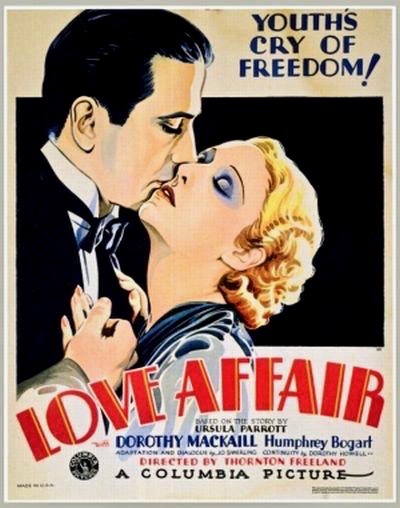
For that small number of gifted actors who become screen legends, the path to stardom is rarely predictable. Sometimes it’s a case of pure luck. Other times it’s achieved after years of honing their craft and screen persona through hard earned experience. I can’t think of a better example of the latter than Humphrey Bogart who made twelve films (two of them short subjects, 1928’s The Dancing Town and 1930’s Broadway’s Like That) before his breakout supporting role as the vicious gangster Duke Mantee in The Petrified Forest (1936). The irony is that despite playing that same character on Broadway where he won unanimous critical acclaim, Warner Bros. wanted Edward G. Robinson for the role. If it hadn’t been for the film’s star, Leslie Howard, who played opposite Bogart on Broadway and demanded that he be cast in the film or he would quit, Bogart might not be as famous today. Continue reading