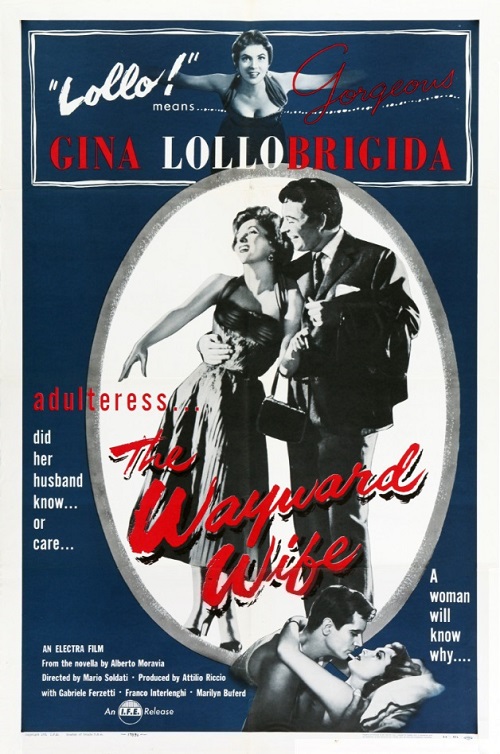
There is little doubt that Gina Lollobrigida’s rise to fame in the post-WW2 years was attributed to her beauty and sex appeal but there was another reason she achieved international recognition – she was a gifted actress who was magnetic and believable in any film genre. In fact, some of her best work is evident in a few key films of the early 1950s but is often overshadowed by the glossy Hollywood productions she made during her peak years such as Solomon and Sheba (1959), Never So Few (1959) and Come September (1961). Rene Clair’s romantic fantasy Beauties of the Night (1952) is generally credited as Lollobrigida’s breakthrough film and Luigi Comencini’s Bread, Love and Dreams (1953) brought her international acclaim as an actress (She was nominated for Best Foreign Actress by BAFTA and won Best Actress from the Italian National Syndicate of Film Journalists). But she had already proven herself as someone who could convincingly move from war drama (Achtung! Banditi!, 1951) to costume swashbuckler (Fanfare La Tulip, 1952) to sex farce (Wife for a Night, 1952) and La Provinciale (English title: The Wayward Wife, 1953), directed by Mario Soldati, is an impressive early dramatic showcase for Lollobrigida that is almost forgotten today.
Continue readingTag Archives: Alberto Moravia
Mondo Man

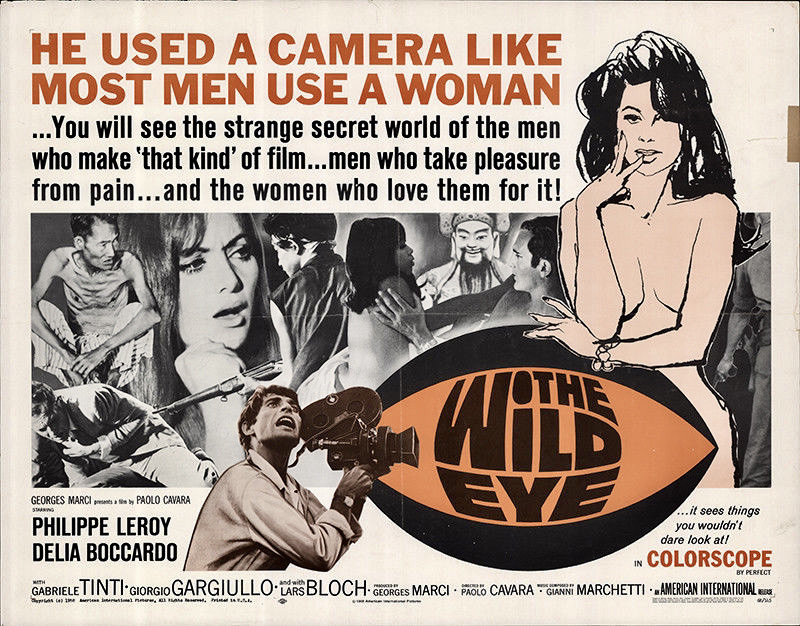
Gualtiero Jacopetti and Franco Prosperi are generally acknowledged as the “Godfathers of Mondo” and took a sensationalist approach to documentaries that revelled in bizarre and shocking cultural practices around the world. Mondo Cane (A Dog’s Life, 1962) was their wildly popular debut film and it spawned a new genre that included their later work Women of the World (1963), Mondo Cane 2 (1963), Africa Addio aka Africa: Blood and Guts (1966) and Goodbye Uncle Tom (1971), a critically reviled and polarizing account of the origins of the American slave trade that was filmed as a you-are-there dramatization. What is usually left out of the Jacopetti-Prosperi backstory are the contributions of Paolo Cavara, who co-directed and co-wrote Mondo Cane and Women of the World with Jacopetti. He broke off his association with the other two filmmakers after their second collaboration and went solo with two more Mondo films (Malamondo [1964], Witchdoctor in Tails [1966]) before turning his camera on a fictionalized version of himself in The Wild Eye (L’occhio Selvaggio, 1967), an unforgiving portrait of a ruthless Mondo filmmaker that should be better known today.
Continue readingThe Neopolitan Trinity
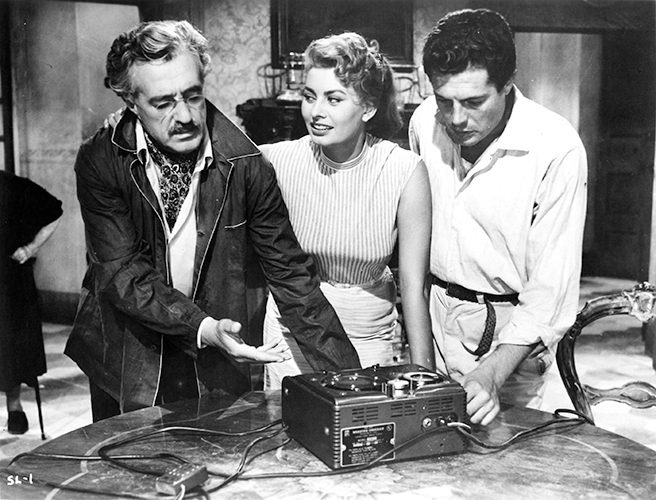
Often overlooked or dismissed as a minor comic trifle, Peccato che sia una canaglia (English title: Too Bad She’s Bad) has, in recent years, acquired a much more favorable reassessment from film scholars and film buffs due to occasional revivals on Turner Classic Movies and a 2004 DVD release from Ivy Video. It not only has a delightful, rakish charm and evocative on-location filming in Rome but showcases three of the most iconic names in Italian cinema directed by the legendary Alessandro Blasetti, whose career began in the silent era and spanned six decades. Also noteworthy is the fact that the film is based on the short story Il fanatico by Alberto Moravia, the celebrated Italian novelist who saw many of his novels turned into major films – la ciociara became Vittorio De Sica’s Two Women, Il disprezzo became Jean-Luc Godard’s Contempt and Il conformista became Bernardo Bertolucci’s The Conformist. Continue reading