
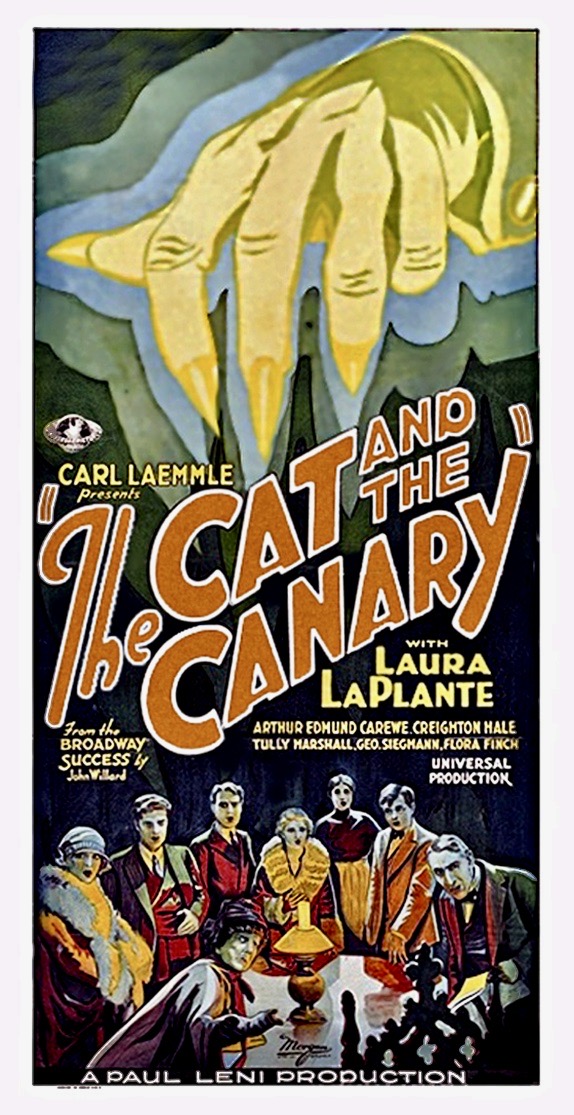
Some believe “Old Dark House” thrillers began with J.B. Priestley’s 1927 novel Benighted, which was adapted for the screen by James Whale as The Old Dark House in 1932. The reality is that the template had already been created by Mary Roberts Rinehart in her 1908 novel The Circular Staircase, which she reworked into a highly successful 1920 Broadway production entitled The Bat with playwright Avery Hopwood. Author and actor John Willard also had a Broadway smash hit with his 1922 play The Cat and the Canary, which shared a number of familiar horror/mystery elements with Rinehart’s creation, most significantly the gloomy mansion in an isolated setting with a menacing character prowling the corridors.
Continue readingTag Archives: waxworks
A Concert Pianist’s Worst Nightmare

What is the worst thing that could happen to a celebrated world class pianist? It would have to be something that destroyed his famous hands, wouldn’t it? The Hands of Orlac, based on a novel by Maurice Renard, has been adapted for the screen numerous times but the 1924 version by German director Robert Wiene remains a masterpiece of silent horror cinema.
Continue readingKarl Loves His Work

Popular Czech actor Rudolf Hruskinsky is the demonic central character in Juraj Herz’s The Cremator (1969).
One of my favorite movements of the 20th century in cinema was the emergence of the Czech New Wave. Out of this creative period, which lasted from roughly 1962 through 1970, the film world was introduced to such innovative filmmakers as Milos Forman (Loves of a Blonde, 1964), Ivan Passer (Intimate Lighting, 1965), Jiri Menzel (Closely Watched Trains, 1966), Vera Chytilova (Daisies, 1966) and Jan Nemec (A Report on the Party and the Guests, 1966). In recent years, other Czech directors have been reappraised and elevated in stature thanks to the proliferation of DVD and Blu-ray restorations of such movies as The Sun in a Net (1961) by Stefan Uher, Pavel Juracek’s Case for a Rookie Hangman (1970) and Valerie and Her Week of Wonders from Jaromil Jires (1970). We can now add to that list The Cremator (1969), Juraj Herz’s macabre fable, which is finally being recognized as one of the key films from the Czech New Wave. Continue reading
