Charlotte Rampling’s Wild Card

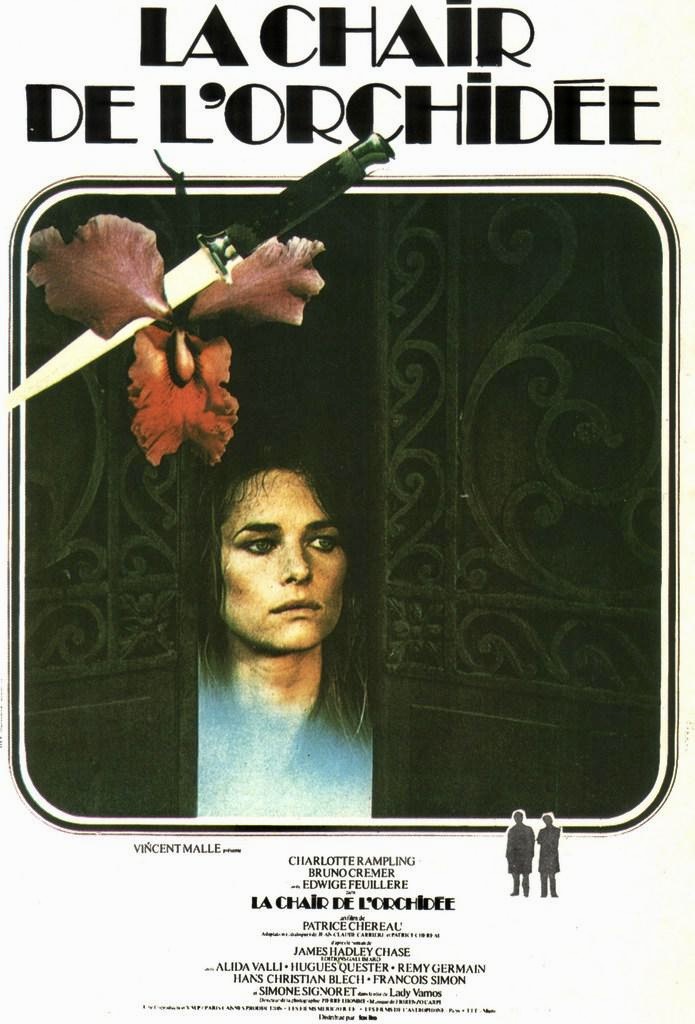
The French film poster for the 1975 thriller THE FLESH OF THE ORCHID, directed by Patrice Chereau.

Charlotte Rampling has been an international star since the mid-1970s when she appeared in Zardoz (1974), The Night Porter (1974) and Farewell, My Lovely (1975), but during her early career, critics were more likely to comment on her beauty and sex appeal over her acting talent. It wasn’t until she began appearing in the films of Francois Ozon (Under the Sand [2000], Swimming Pool [2003]) and other independent, cutting-edge directors like Dominik Moll (Lemming, 2005) and Laurent Cantet (Heading South, 2005) that Rampling finally came into her own as a critically acclaimed actress and cult favorite. She has rarely steered clear of edgy material or doing nude scenes or choosing unconventional roles over more audience friendly fare and her movies from the late sixties through the mid-nineties reflect this. Some were pretentious misfires like The Ski Bum (1971) or eccentric one-offs (Yuppi du, 1975) or mainstream showcases for her talent such as Woody Allen’s Stardust Memories (1980) and Sidney Lumet’s The Verdict (1982). Yet, even her lesser known work from this period is often worth seeking out and La Chair de I’orchidee (English title, The Flesh of the Orchid, 1975), the debut film of French director Patrice Chereau, is certainly a wild card. A psychological thriller that seems to take place in an alternate universe where everyone is misanthropic, corrupt, greedy or violent, Chereau’s first film is based on a 1948 pulp fiction novel by James Hadley Chase.

Continue reading

Resistance Begins at Home

In 1940 after France had fallen to the German army, journalist Jean Bruller and his wife, who lived outside Paris, were forced to share their home with a Nazi officer for an extended period of time. That experience inspired Bruller to write the novella Le Silence de la Mer (The Silence of the Sea) under the pseudonym Vercors. The book was secretly published in late 1941 and became known as “the first underground book of the occupation.” It also became an inspiration to the French Resistance in its depiction of using silence as a weapon against the enemy when no other option was possible. It might seem like an unusual choice for French director Jean-Pierre Melville’s feature film debut when you consider that he is mostly famous for his crime and gangster thrillers like Bob le Flambeur (1956), Le Deuxieme Souffle (aka Second Wind, 1966) and Le Samourai (1967). Then again, many consider Melville’s 1969 WW2 drama L’armee des Ombres (aka Army of Shadows) about French underground fighters in Nazi-occupied Paris his masterpiece. Add to this the fact that Melville was also an active member of the French Resistance and The Silence of the Sea makes perfect sense as his feature debut.

Continue reading

Masks Are Powerful

The demonic mask featured in ONIBABA (1964), Kaneto Shindo’s classic tale of murder and retribution set in 14th century Japan.

There is one cinema gimmick that always works for me and can sometimes lift a movie out of the ordinary and take it somewhere unexpected. This usually occurs when someone either puts on a mask or appears in one. The simple act of doing this immediately brings something theatrical and visually arresting to the scene that taps into our subconscious on an almost primeval level.    

Continue reading

Georges Franju & Jean Cocteau: Thomas the Impostor

World War I has been the subject of some of the most powerful and prestigious films in cinema from King Vidor’s The Big Parade (1925) and Lewis Milestone’s All Quiet on the Western Front (1930) to Stanley Kubrick’s Paths of Glory (1957) and more recently, Sam Mendes’ 1917 (2019), nominated for ten Oscars including Best Picture. All of those films captured the grim horrors of the battlefield, the demoralization and death toll of the troops and the often reckless or unnecessary military strategies of commanding officers. Going against the grain is Thomas l’imposteur (Thomas the Impostor), based on Jean Cocteau’s 1923 novel which was inspired by his own experiences during WW1 as an ambulance driver for the Red Cross. Directed by Georges Franju from a screenplay by himself, Cocteau and Michel Worms, the 1965 film views war through the experiences of two idealistic dreamers, one an aristocrat, the Princess de Bormes (Emmanuelle Riva), the other an orphan (Fabrice Rouleau), who lies about his age and invents a fake backstory for himself so he can enlist. The result is a unique take on the Great War which combines the ambiance of a dark fairy tale with a realistic but emotionally detached approach to the events as they affect the two main protagonists.

Continue reading

The Lovely Bones

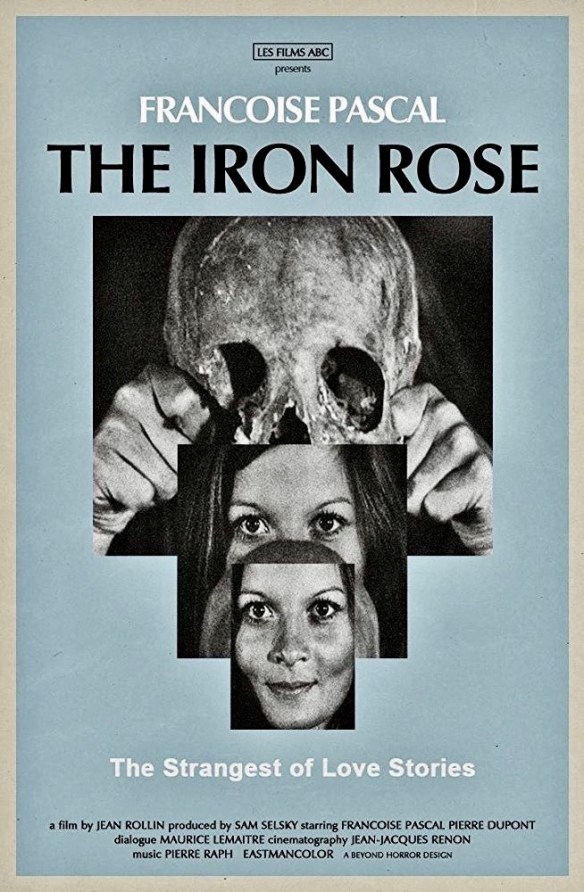
Often relegated to the ranks of sexploitation filmmakers, French director Jean Rollin has enjoyed a critical reassessment in recent years that he never experienced during his prolific filmmaking years in France, where he was mostly dismissed by the country’s leading critics. Many of his films utilized horror film conventions (graveyards, vampires, zombies) as well as exploitation tactics (gore and nudity) but combined them in a way that were uniquely his own. The Iron Rose (1973, aka La rose de fer), however, was a complete departure from Rollin’s previous efforts and was unlike anything he would ever attempt again. Closer in form to an experimental film than something that would fit comfortably into the horror genre, the movie is a macabre mood piece with poetic touches that recalls the films of Jean Cocteau and Georges Franju.   Continue reading