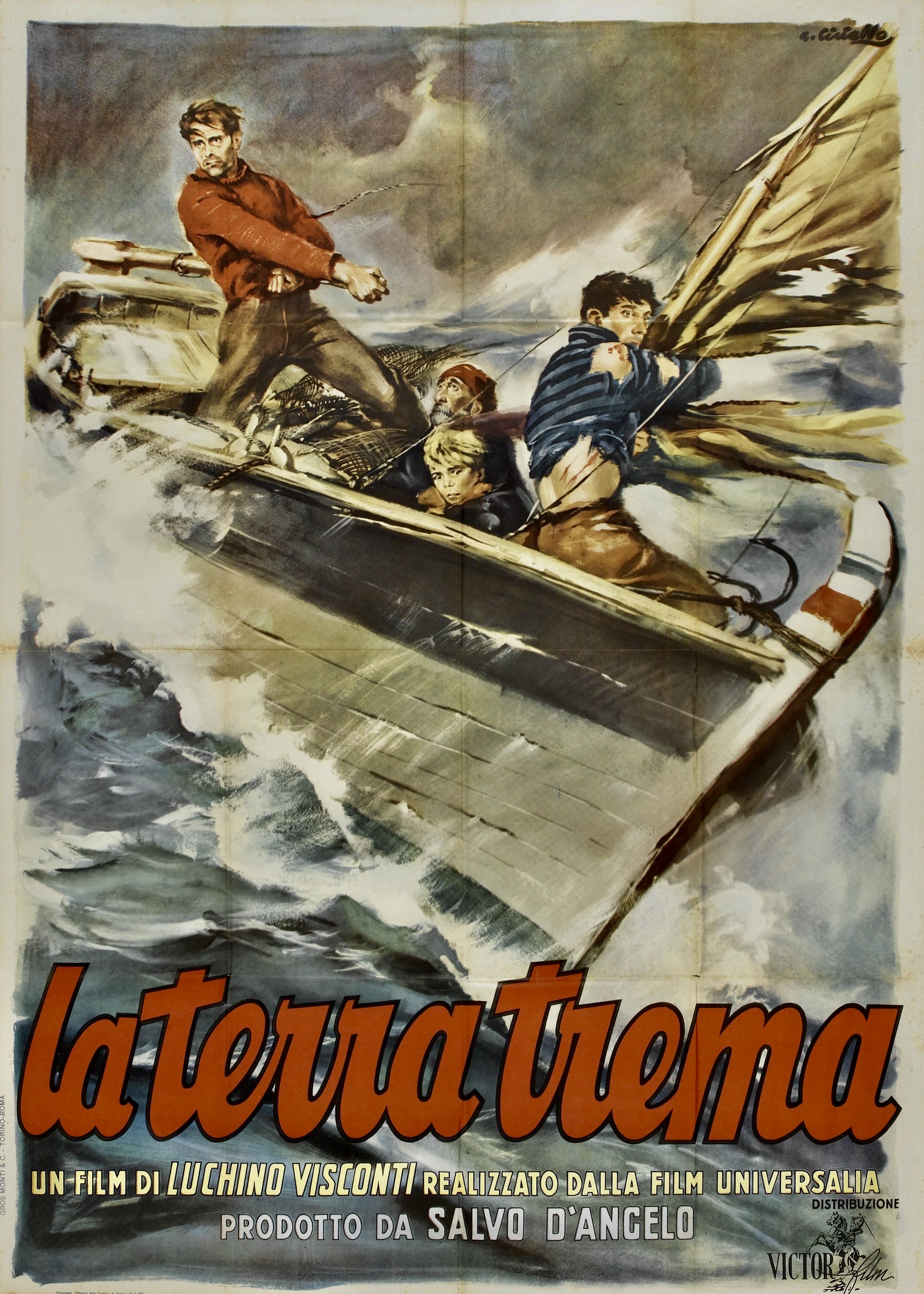
The Fishermen of Aci Trezza

Every film lover remembers a point when they begin to view cinema as an art form and not just ephemeral entertainment. A turning point for me was the PBS series Film Odyssey, which presented classics from the Janus Collection, hosted by Los Angeles Times’ film critic Charles Champlin in 1971. That marked my first exposure to Ingmar Bergman (Wild Strawberries), Federico Fellini (La Strada), Jean Cocteau (Beauty and the Beast) and Akira Kurosawa (Rashomon), among others. But it was the film history class I took at the University of Georgia in 1974 that really opened my eyes to the possibilities of film as a creative medium. I learned about the auteur theory in that class with screenings of Sam Fuller’s The Steel Helmet and Nicholas Ray’s Bigger Than Life and developed an appreciation for silent cinema (D.W. Griffith’s Orphans of the Storm, Aleksandr Dovzhenko’s Earth) and the virtues of the Studio System (represented by George Sidney’s Scaramouche and Leo McCarey’s An Affair to Remember). What made the biggest impact on me, however, were the Italian neorealism films of the post-WW2 era, especially Luchino Visconti’s La Terra Trema [1948] (The English translation is The Earth Trembles).

Continue reading

Scorched Earth

VIDAS SECAS aka BARREN LIVES (1963), a Brazilian film by Nelson Pereira dos Santos.

You don’t have to believe in climate change to experience and understand the devastating effects of a drought. The northeastern part of Brazil is no stranger to this condition which has plagued the region for decades yet people continue to live there. If you are a wealthy landowner, you can survive the seasonal hardships but if you are a poor migrant worker, life is a constant struggle. Vidas Secas (English title: Barren Lives, 1963), directed by Nelson Pereira dos Santos, is the portrait of a family of four and their dog as they wander the arid deserts and sun-baked landscapes of northwestern Brazil in search of work, water and food. Set in 1941 and covering a two-year period in their lives, the film is considered a landmark work in the Cinema Novo movement, which emerged in the late fifties and focused on marginalized communities and people, often using non-professional actors, real settings and black and white cinematography in the manner of Italian Neorealism. 

Continue reading

All the Youthful Days

A scene from Hsiao-Hsien Hou’s THE BOYS FROM FENGKUEI (1983).

For many young people, the time period immediately after their high school graduation is a crucial phase in which their lives could take many different paths depending on the decisions they make. This is especially true for those who don’t go to college and either go to work, are drafted into the military or hang out with friends before adult responsibilities consume their lives. Falling into the latter category is 1983’s The Boys of Fengkuei (The original Taiwanese title Feng gui lai de ren roughly translates as All the Youthful Days), an evocative coming-of-age drama from internationally renowned director Hsiao-Hsien Hou.

Continue reading