
The Education of Miss Blum

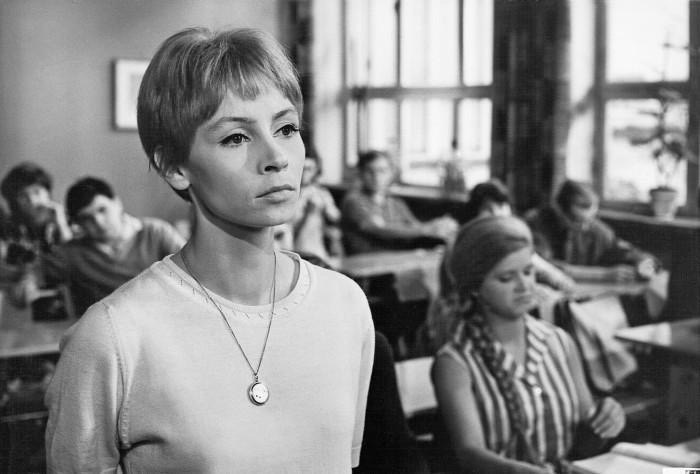
Karla (Jutta Hoffmann) has some doubts about her effectiveness as a teacher in the East Germany drama KARLA (1965), which was banned for many years.

There have been enough movies about teachers facing challenging classroom situations and unsympathetic staff and school board members to comprise a film genre of its own. And it is not limited to just classic flicks from Hollywood like Goodbye, Mr. Chips (1939), Bright Road (1953) The Blackboard Jungle (1955), Up the Down Staircase (1967), To Sir, With Love (1967), Stand and Deliver (1988) and Dead Poets’ Society (1989). Other countries have produced their own cinematic touchstones on the subject such as the U.K. (The Browning Version [1951], If… [1968], The Prime of Miss Jean Brodie [1969]), France (Zero for Conduct [1933], The Class [2008]), Japan (Twenty-Four Eyes [1955] or Russia (Village Teacher [1947]). All of these address numerous issues like juvenile delinquency, racism, illiteracy and the value of mentorship but few, if any, have presented the complex problems facing Karla, the heroine of Herrmann Zschoche’s 1965 East German drama which was extremely controversial in its day.

Continue reading
East German Film Rarities

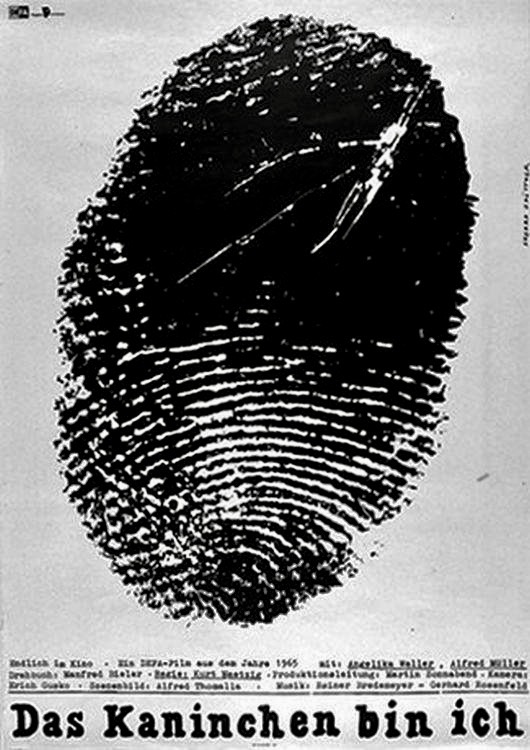
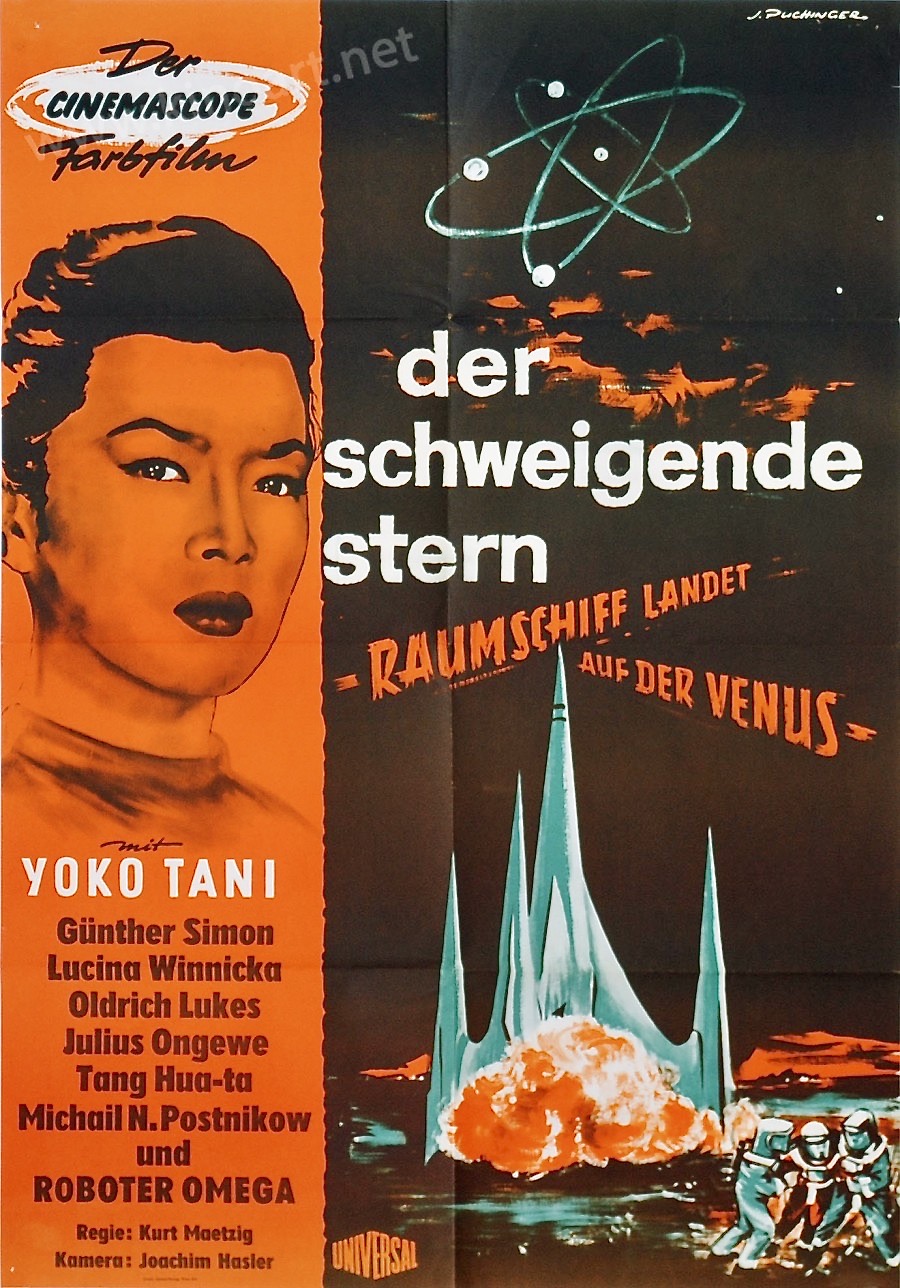
While most hardcore film buffs are well versed in the movies of Fritz Lang, Robert Siodmak, F.W. Murnau and their latter compatriots Werner Herzog, R.W. Fassbinder, Wim Wenders and Volker Schlondorff, directors such as Kurt Maetzig, Joachim Kunert and Gerhard Klein are completely unknown or unfamiliar to Western audiences for an obvious reason. They worked for DEFA (Deutsche Film Aktiengesellschaft), the nationalized film industry of East Germany, and as a result, very few of their movies were distributed outside of socialist countries during the Cold War Era when DEFA was in its prime. A rare exception was Kurt Maetzig’s Der Schweigende Stern aka The Silent Star, a science fiction adventure which was released in the U.S. in an edited, English dubbed version as First Spaceship on Venus in 1962. Much more complex and thematically intriguing is Maetzig’s Das Kaninchen Bin (English title: The Rabbit is Me, 1965) along with Joachim Kunert’s Das Zweite Gleis (English title: The Second Track, 1962) and Gerhard Klein’s Die Fall Gleiwitz (English title: The Gleiwitz Case, 1961).

Continue reading

Gojko Mitic, the All-Purpose Native American from Yugoslavia

Gojko Mitic plays the title role in the East German western, Chingachgook, the Great Snake (Chingachgook, die grosse Schlange, 1967), directed by Richard Groschopp.

Westerns not made in the U.S. have always carried a patina of the exotic for fans of the genre. There have been the countless spaghetti westerns from Italy and Spain, Australia has turned out several distinctive efforts (The Man from Snowy River, Mad Dog Morgan, The Proposition) and even Japan has their own brand of western as represented by samurai films like The Seven Samurai and Yojimbo. But have you ever seen a western from East Germany during the 1960s when their film industry was under the control of the Socialist government? If not, Westerns with a Twist, a trilogy from DEFA (aka Deutsche Film-Aktiengesellschaft) starring Gojko Mitic is a great place to begin. This trio of “red westerns” includes The Sons of Great Bear (1966), Chingachgook, the Great Snake (1967) and Apaches (1973).   Continue reading