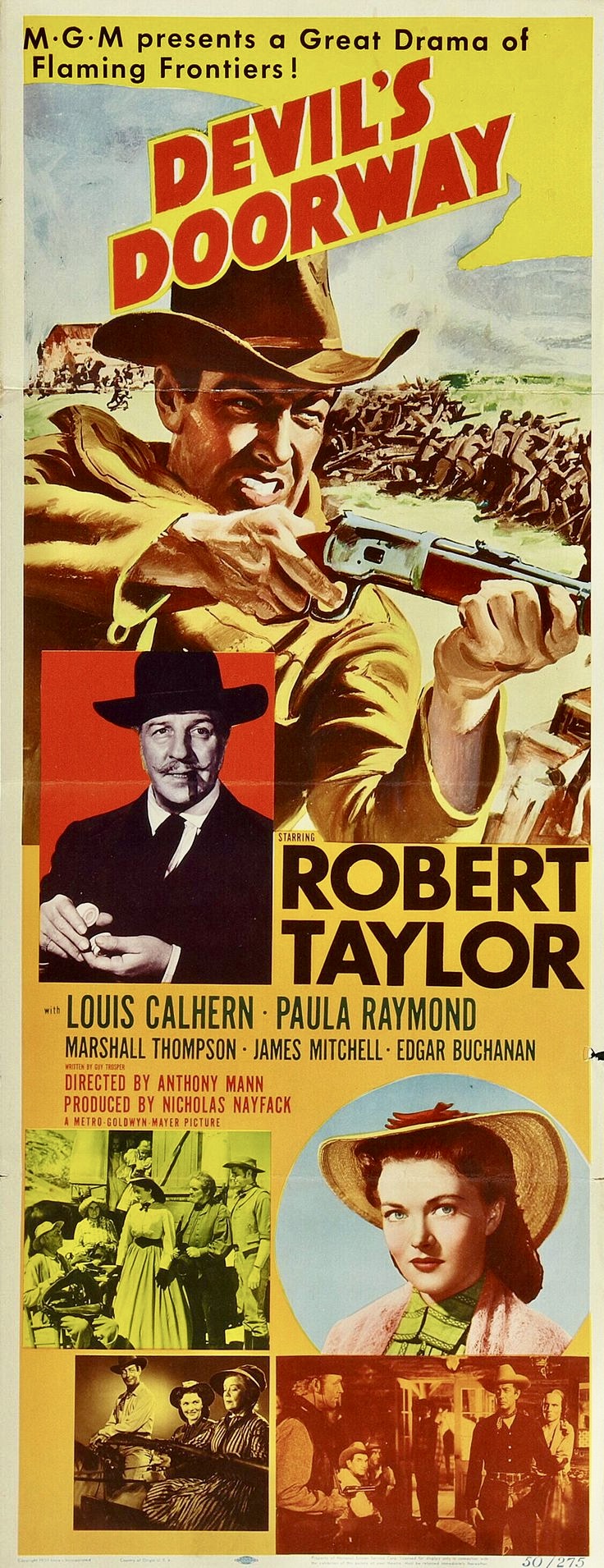
1950 marked an important turning point in the evolution of the Hollywood Western and Broken Arrow, directed by Delmer Daves, was largely responsible for that. A sympathetic treatment of the plight of the Apache people and their way of life, the film was the first major studio western to depict Native Americans as something other than bloodthirsty savages or naive primitives. The real hero of Broken Arrow was Cochise (Jeff Chandler), the Apache leader, and not the cavalry scout (James Stewart) who marries an Apache woman (Debra Paget). The film’s liberal views on race and the white man’s treatment of the Native-American were considered daring at the time and garnered much critical acclaim. It also earned three Oscar nominations including one for Best Screenplay (by Michael Blankfort). The downside of all this is that Broken Arrow‘s success completely overshadowed Devil’s Doorway, which was released the same year and also addressed the terrible treatment of this nation’s original settlers.
Continue readingTag Archives: Debra Paget
Yma Sumac: Inca Goddess
Yma Sumac, that rarest of exotic songbirds, officially became an extinct species on Saturday, Nov. 1, 2008 in Silver Lake, California. Her passing was barely noticed by the media despite the fact that her impact on pop culture in the early fifties had an international impact. From her first U.S. album release, Voice of the XtaBay (1950), and Hollywood film debut Secret of the Incas (1954) starring Charlton Heston, to everything that followed in her curious career, Sumac has been many things to many people.
Continue readingFritz Lang’s Two-Part Indian Epic
The film industry is rife with tales about directors who struggled and failed to bring their dream projects to the screen and the subject would make a fascinating, behind-the-scenes non-fiction book about the precarious nature of moviemaking. Among the more famous examples are Orson Welles, who pitched a film version of Joseph Conrad’s Heart of Darkness to RKO executives, who instead chose Welles’ second idea, Citizen Kane, Josef von Sternberg’s ambitious 1937 production of I, Claudius, which was started but never completed due to disagreements between the director and Charles Laughton plus the injury of leading lady Merle Oberon in a car accident, and Robert Altman, who wanted to make a film version of the 1997 documentary Hands on a Hard Body and had even cast it but died before production could begin. Yet, for all the films-that-might-have-been, there are many examples of directors who finally succeeded in making their passion projects and one of them is Fritz Lang. His lifelong desire to make a film of the 1917 novel, The Indian Tomb, written by his former wife Thea Von Harbou, was finally realized in the late 1950s when he started production on a lavish movie adaptation that would be released in two parts as The Tiger of Eschnapur and The Indian Tomb, both 1959.
Continue reading


