
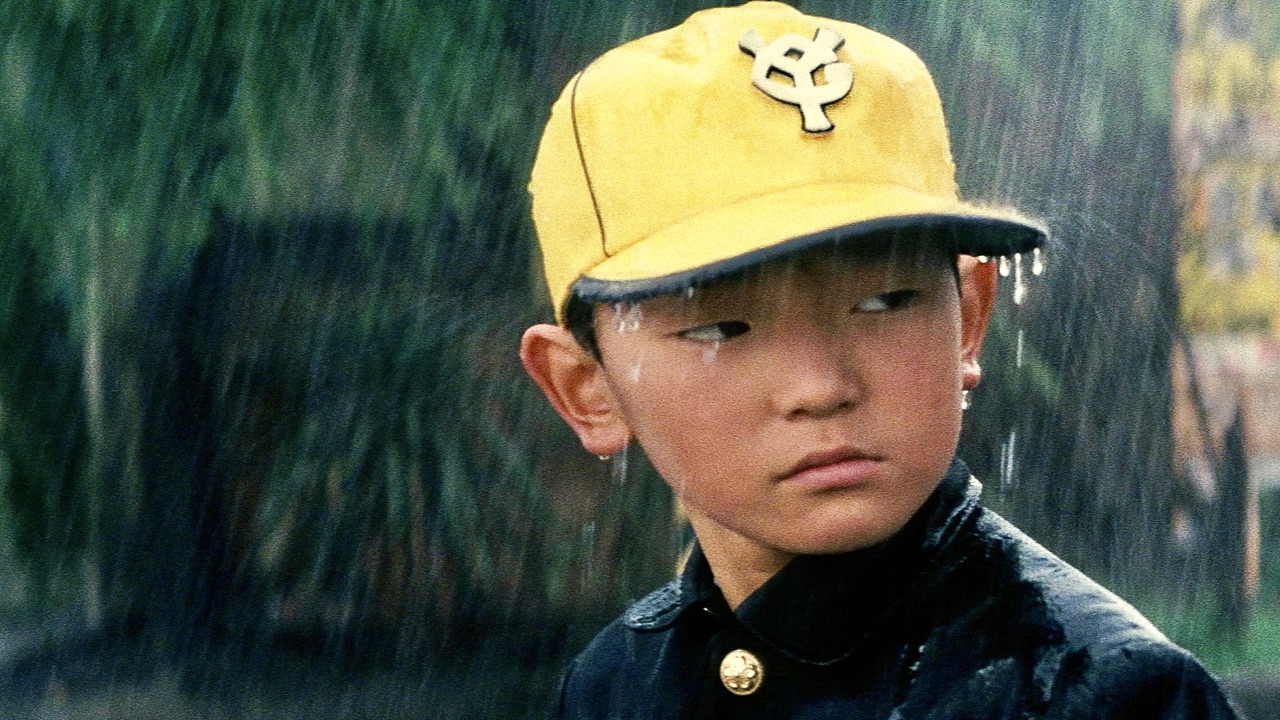
Not everyone has an idyllic childhood and some unfortunates don’t even have a childhood at all. That is certainly the case with Toshio (Tetsuo Abe), a ten-year-old who is being used by his father Takeo (Fumio Watanabe) and stepmother Takeko (Akiko Koyama) in an ongoing scam which entraps car drivers. The ploy involves stepping out into traffic, pretending to be hit by a car, and falling to the ground and feigning an injury. If the driver doesn’t offer to settle the incident on the spot with a cash payment, the fake victim threatens to call the police to settle the matter. In many cases, the drivers are only too happy to pay the scammers a cash settlement to avoid a lawsuit or court case. Toshio and his family of three (including a tiny tot named Peewee) have been on the move across Japan, enacting this scenario for some time with Takeko playing the fake accident victim. But the time has come for the parents’ ten-year-old to take on this role and he has little choice in the matter. So begins Nagisa Oshima’s Shonen (English title: Boy, 1969), a harrowing portrait of parental abuse and negligence, which was based on a true case that made national news in Japan in 1966.
Continue reading
 Cinema Sojourns