
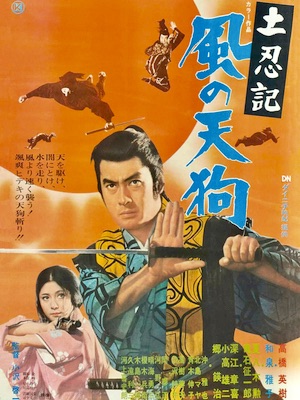
The samurai film in Japanese cinema was often classified as a chanbara, a sub-category of the jidai-geki (period drama) which was more action oriented. The chanbara was at the peak of its popularity in Japan from the early 50s to the early 70s with occasional revivals of the form up through the present and some of the most famous examples of the genre are Teinosuke Kinugasa’s Gate of Hell (1954), Hiroshi Inagaki’s Samurai Trilogy (1954-1956), and Akira Kurosawa’s Seven Samurai (1954) and Yojimbo (1961). One aspect of the samurai film that always struck me was that it seemed like a period variation on the American western and the fact that Kurosawa was a huge fan of director John Ford seems obvious when you look at Seven Samurai and Yojimbo, whose main protagonists are samurai-for-hire, not unlike professional gunfighters or bounty hunters in the wild west. Both of Kurosawa’s films went on to inspire two popular westerns respectively – John Sturges’s The Magnificent Seven (1960) and Sergio Leone’s A Fistful of Dollars (1964). Reminiscent of Kurosawa’s chanbara efforts is Haunted Samurai (Japan title: Kaze no Tengu, 1970), an often overlooked samurai action-adventure from director Keiichi Ozawa that came toward the tail end of the genre’s peak period but also seems custom made for an American western remake.
Continue reading Cinema Sojourns