
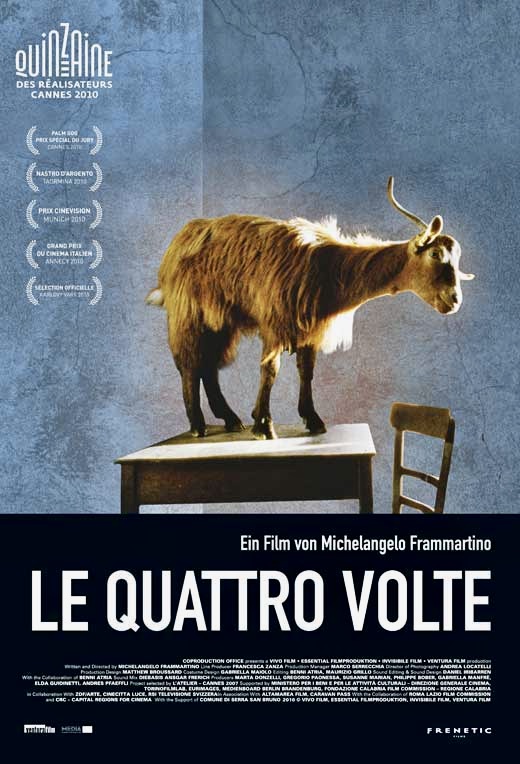
Smoke fills the screen and drifts toward the sky. We see black earth that is steaming and could be cooling lava. Then we notice small holes punched into the dark topography where smoke is being released. A wide shot reveals that we are looking at a mound of charred material that is being raked by a worker at the top of the heap. Where are we and what are we looking at? Michelangelo Frammartino’s Le Quattro Volte (2010), which roughly translates as The Four Times, is an immersive but often disorienting portrait of life in the village of Caulonia, Italy, which often requires the viewer to make sense of a visual detail or local ritual without a frame of reference. This is not detrimental, however, to the film’s exploratory narrative but one which is enriched by a sense of mystery and wonder.
Continue reading Cinema Sojourns