

It is hard to believe that Raoul Walsh, the man who directed The Roaring Twenties (1939), High Sierra (1941), They Died with Their Boots On (1941), Objective, Burma! (1945), White Heat (1949) and other classic genre films for Warner Brothers, never received an Oscar nomination. Film historian David Thomson pondered this in The New Biographical Dictionary of Film, writing, “Was it just that he was so reliable, so direct and “simple” an entertainer? Or was it a matter of not making the proper “big” pictures?” Even after his peak years at Warners, Walsh continued to make audience pleasing hits such as Battle Cry (1955), the fourth biggest box office success of its year. Even some of the B-pictures Walsh made during his final years in Hollywood look like A-pictures now such as the 1953 western, Gun Fury.
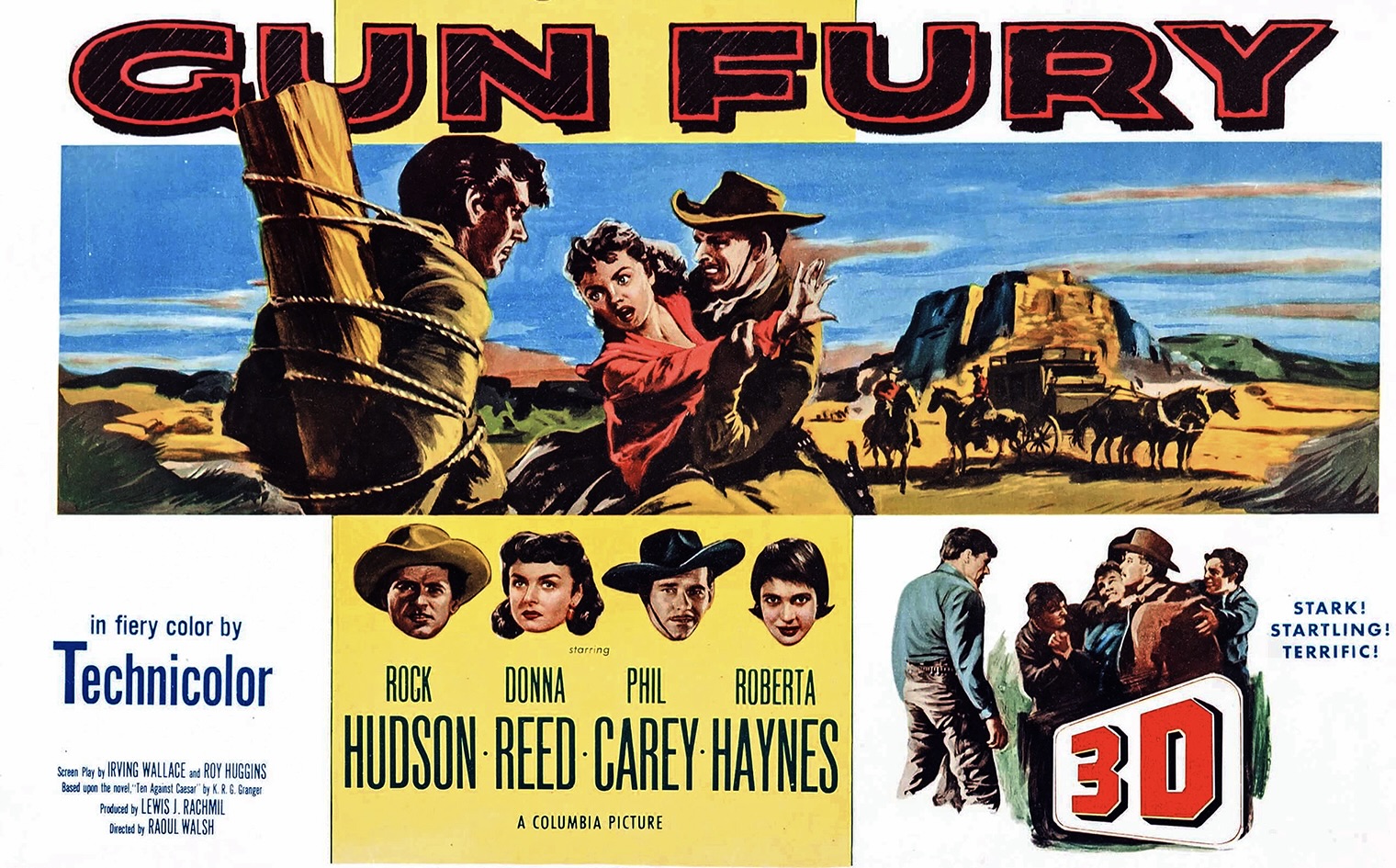
Originally filmed and released in 3-D, Gun Fury (1953) is one of the better Westerns produced in that format and works just as well in a flat version as it does with all its gimmickry intact and various objects being hurled at the viewer. It is also interesting to note that Walsh, like director Andre De Toth (House of Wax, also 1953), was blind in one eye so he wasn’t able to actually experience the visual perspective of a 3-D viewer. Yet Gun Fury might be one of the best examples of that short-lived marketing gimmick.

The story takes place in the post-Civil War years and opens with Jennifer Ballard (Donna Reed) traveling by stagecoach to meet her fiancé, Ben Warren (Rock Hudson). Accompanying Jennifer on her voyage is fellow coach rider Frank Slayton (Phil Carey), who is traveling under the name Mr. Hampton for a reason. He is actually an ex-Confederate turned outlaw who quickly takes a strong liking to Ms. Ballard and his true nature is revealed once Jennifer and Ben are reunited. Slayton and his gang rob the stagecoach carrying the soon-to-be-married couple, abduct Jennifer and leave Ben for dead after shooting him. What follows is a tale of revenge and retribution as the injured Ben follows in pursuit, using his cunning to eventually divide and undermine the quarreling gang members and rescue his fiancée.

A robust and entertaining action adventure that fills all of the requirements of a modestly-budgeted genre film, Gun Fury actually generates a considerable amount of tension during its brisk 83 minute running time despite a formulaic plot. The stunning natural settings (filmed near Sedona, Arizona) are also a major virtue but the real draw here is the ensemble cast which features three actors who would soon emerge as major stars – Rock Hudson, Donna Reed and Lee Marvin.

The same year Marvin had appeared as a vicious thug in Fritz Lang’s The Big Heat and he is just as menacing here as Blinky, a sidekick of the disreputable Slayton. Neville Brand is also memorably loathsome as his compadre, Brazos. Both actors make the most of their minor roles but Marvin has the edge, particularly in a sequence where he tries to put the moves on Slayton’s wildcat Mexican mistress Estella (Roberta Haynes) and she knocks him senseless.

In Marilyn Ann Moss’s biography of Raoul Walsh, Marvin recalled working with the director on this film: ‘I don’t think he was much interested in dialogue. He was an action director. He loved horses, stagecoaches and explosions. He was an old timer and rolled his own cigarettes. If you had a scene to do with dialogue, he’d say, “You’re over here, you’re over there, roll it.” Then he’d look down and roll a cigarette and when all this talking had stopped he’d turn to the script girl and say, “Did they get it all?” She’d say, “Yeah,” and he’d say, “Print it.” But for the action stuff he’d get all excited…’OK, we’re over here with a 35mm lens. Now the stagecoach comes rolling down the pass and the gunmen gallop out from behind this rock.” Raoul would come to life!’

Leo Gordon, who plays Jess, Slayton’s friend turned enemy in Gun Fury, should be familiar to most classic film fans for his frequent roles as villains in crime and western films like Riot in Cell Block 11 (1954) and Hondo (1953). Like Marvin, he was a WW2 veteran and fellow gun nut who was amused at some of his fellow actors’ inexperience with firearms on the set. He also recalled the difficulties of shooting in 3-D in Dwayne Epstein’s biography, Lee Marvin: Point Blank: “The cameraman would say, ‘Could you push your hat up, a little bit? I can’t see your eyes.’ That’s why you’ll notice in those pictures all the guys are running around with a forelock hanging out from their forehead. Lee said, ‘To hell with that. All they gotta see is my mouth when I’m talking.’ He’d pull it down to the bridge of his nose. They just accepted it. It worked.”

Gordon, Marvin and Brand are the epitome of bad-ass behavior in Gun Fury but none of them can match Phil Carey when it comes to extreme behavior: he chews up the scenery with gusto as the wicked, amoral Slayton.

Yet, despite the over-the-top nature of the performances, including Rock Hudson’s pacifist turned bloodthirsty avenger, there is a palpable sense of menace generated from the start, particularly in regards to Donna Reed’s victimized heroine. The threat of gang rape is implied throughout and the character of Jennifer is never glamorized; in fact, she is subjected to one physical ordeal after another, particularly after one escape attempt where she is tied and dragged behind by a horse.

Gun Fury was based on the novel Ten Against Caesar by Robert A. Granger and adapted for the screen by Roy Huggins (an Emmy nominated TV writer best known for Captains and the Kings and Run For Your Life) and best-selling novelist Irving Wallace (The Chapman Report, The Prize). Unfortunately, the film was released after the more popular 3-D western Hondo, which may have stolen some of its thunder plus the fact that the popularity of 3-D was quickly subsiding.

At the time of Gun Fury, Rock Hudson was still struggling to find his way as an actor but that would quickly change after director Douglas Sirk saw his potential and helped mold his performances, guiding him to stardom with his first major hit Magnificent Obsession (1954) followed by another commercial triumph, All That Heaven Allows in 1955. Gun Fury was also Hudson’s fourth collaboration with Raoul Walsh after an uncredited bit part in Fighter Squadron (1948), his first movie, and starring roles in The Lawless Breed and Sea Devils (both 1953). On the final day of shooting, Hudson had an appendicitis attack and went directly to the hospital. When the doctor told him he needed an appendectomy immediately, he refused to have it for fear his recovery time would cost him the role in his upcoming film All That Heaven Allows. Luckily, he had the surgery and Universal didn’t replace him with another actor for that part as he had feared.

Donna Reed was also on the verge of a major acting breakthrough when she made Gun Fury. It was one of five films that Reed made in 1953, the other four being Trouble Along the Way, Raiders of the Seven Seas, The Caddy and From Here to Eternity, the movie that earned her the Best Supporting Actress Oscar.

Roberta Hayes, who played the part of the Mexican spitfire Estella and was often typecast as Mexican, Native American or Polynesian women because of her dark complexion, was still in the early phase of her Hollywood career but was not happy about being in Gun Fury. “I really didn’t want to make that movie,” Hayes said in an interview in Mark Griffin’s biography of Rock Hudson, All That Heaven Allows. “When I went to Columbia, I had been promised the part of the prostitute in From Here to Eternity but they gave that to Donna Reed instead…then they put us both in Gun Fury. I thought it was a horrible movie and not only was it a complete waste of time but it was even in 3-D, if you can believe that.” However, Hayes did enjoy working with some of her co-stars, adding “Lee Marvin was very protective of me…I think he was already an alcoholic but a really nice guy. As for Rock Hudson, I never heard anyone say a bad word about him.”

At the time of its release, Gun Fury was mostly seen by reviewers as a typical western programmer but a few film critics pointed out its virtues such as Variety which stated, “Even without 3-D Columbia’s Gun Fury would be a superior western.” And The Hollywood Reporter called it, “a hard-driving affair smacking of authenticity and well thought out construction.”

Over the years Gun Fury has been released on various formats but fans of the movie were grateful to see Twilight Time release a special edition Blu-ray in September 2017 containing 3-D and flat versions of the film. It is now out of print but you might be able to find a copy still from online sellers.

*This is a revised and expanded version of an article that originally appeared on the Turner Classic Movies website.
Other links of interest:
https://harvardfilmarchive.org/programs/action-action-action-a-raoul-walsh-retrospective
https://www.iowapublicradio.org/arts-life/2021-01-27/remembering-donna-reed-100-years-later
https://warfarehistorynetwork.com/article/lee-marvin-actor-turned-marine-in-world-war-ii

