

If you are a devoted cinephile with a keen interest in the constantly evolving state of international cinema, then you know that there are always new filmmakers and cultures to explore in the cinematic universe. One of my recent discoveries was the existence of Sakha cinema, which represents the Yakutia province of northwestern Siberia in Russia. This region, which is 5,000 miles from Moscow and is subject to the coldest temperatures on record in the northern hemisphere, is famous for its natural resources, mountain ranges and arctic conditions. More recently, it is attracting international attention for its booming film industry which emerged after 1992 when the president (at that time) Mikhail Nikolaev established a national film industry which is affectionally called Sakhawood (in a nod to India’s Bollywood film factory). Writer/director Stepan Burnashev, a native of Yakutia, is one of the more renowned filmmakers to emerge from Sakhawood and Khara Khaar (English title: Black Snow, 2020) was my first exposure to his work.

One of the defining traits of Sakhawood cinema is to depict the people, culture and lifestyles of the Yakut people in ways that celebrate it but to also comment on the problems and day to day existence for inhabitants of this remote region. Black Snow certainly fits the bill in the latter regard, offering an insider look at an indigenous community that is reeling from the effects of a poor economy and environmental abuse. At the center of Burnashev’s story is Gosha (Fedot Lvov), a truck driver who also runs a side hustle business to help support a family that includes his sister, brother-in-law and father.

We learn in an opening scene set inside a truck stop diner that other truckers in the region have seen Gosha change from a good-natured fellow worker to a more reclusive and driven personality. “Money changes people,” mutters one acquaintance, “Got too big for his britches. Only has money on his mind.” And it soon becomes clear that Gosha has developed a brusque, impersonal manner when dealing with everyone, including family members and people in the community.

Although he makes his living driving back and forth across the frozen tundra to deliver food and necessities from the city to his village, Gosha is also profiting from the sale of fake vodka, an illegally produced alcohol that is often made from toxic ingredients like isopropyl, chloroform and methanol and can be fatal to consumers. Because of this, Gosha’s father has stopped speaking to him and some villagers resent him, calling him a poisoner of his own people. Yet, he has a steady customer base, mostly composed of hard core alcoholics who can’t afford to pay cash but will trade him large carcasses of reindeer meat in exchange and Gosha is willing to bargain with them.

The difficulties of life in a remote region like Yakutia where temperatures can descend to -40 degrees centigrade is front and center in Black Snow. Not only do we hear talk from some villagers about how big industry is exploiting the natural resources of the region for personal profit but we also learn that the bureaucracy of the local government is ineffective and behind the times (the residents are still waiting for a long promised cell tower so they can have mobile phones). It some ways the impoverished circumstances of Gosha’s community is not much different than life on a Native American reservation in the U.S.

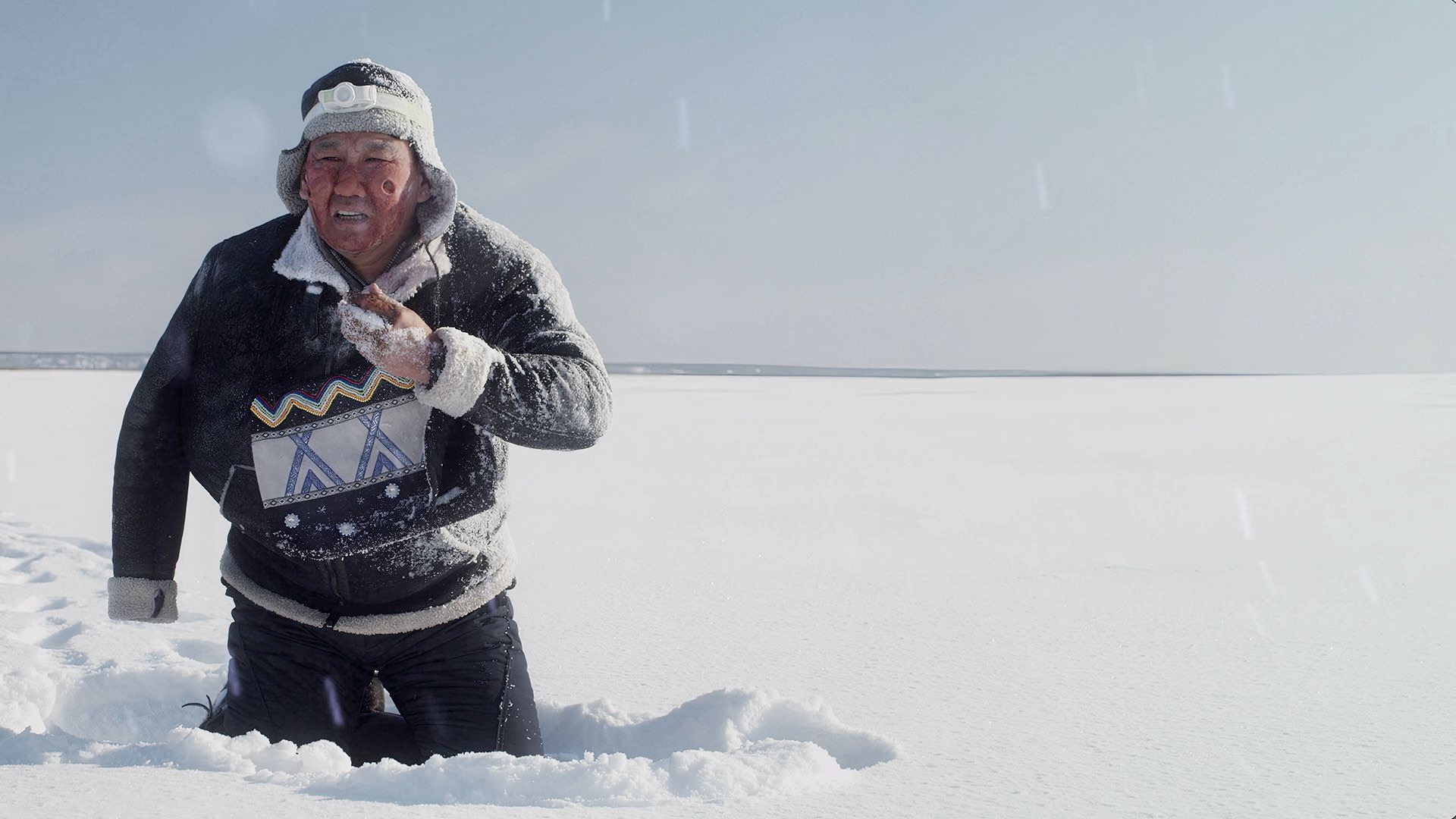
Gosha is indifferent to most of these concerns and pursues his own business interests with a single-minded tunnelvision. Yet, what begins as an intimate character study soon transitions into a bleak and harrowing tale of survival. When Gosha departs on a five day trek to the city for more supplies, he encounters a major problem on the road. As night falls, his truck breaks down with a flat tire. Struggling alone in the freezing cold to change the huge truck tire, Gosha accidentally slips, hits the jack and the rig collapses on his hand, pinning him to the ground.

At this point Black Snow enters nightmare territory and we watch in real time as Gosha suffers in agony while his chances for survival in the cold become questionable. Comparable in some ways to 127 Hours, Danny Boyle’s 2010 biopic about professional hiker Aron Ralston (James Franco) and his infamous accident in Robbers Roost, Utah, Black Snow is a much more realistic and punishing watch for viewers. For one thing, Burnashev rarely cuts away from Gosha’s dilemma with the exception of two brief hallucination sequences (which last barely a minute each). In 127 Hours, Boyle was able to periodically distract the audience and minimize the unwatchable aspect of his narrative with flashbacks to Ralston’s life before he got his arm pinned under a large boulder in a narrow canyon. But there is no relief for the viewer in Black Snow. You are simply stuck with Gosha in the freezing cold as he howls and whimpers in pain. When he is finally forced to take action or freeze to death, it is bound to be a stay-or-flee moment for viewers.

Yes, Black Snow is not for the faint of heart and it is unlikely to be anyone’s idea of a fun time at the movies. Escapist entertainment be damned! At the same time, Black Snow is a raw slice of life that unfolds like some unflinchingly candid ethnographical documentary and offers a rare glimpse at life in an isolated and frigid corner of the world.

Most of Burnashev’s films are made on a low budget using non-professional actors and he is upfront in interviews about his intentions, stating, “Yakutian cinema doesn’t offer escapism; it offers reflection.” He also noted on another occasion that Yakutian cinema is not about making money but an attempt “produce interesting films that will say something.”

Burnashev made his feature film debut in 2012 with Kuta, a thriller about a hunting expedition gone awry. Since then, he has produced and directed twelve more features, with Black Snow, Aita (2022), and Yt (2024), garnering praise and award nominations at various film festivals. Aita is a crime thriller in which a police inspector tries to stop villagers from taking the law in their own hands and Yt is a seven story anthology film, co-directed with Dimitrii Davydov, focusing on funny and dramatic portrayals of family relationships.

Davydov is another rising star in Yakutian cinema who scored an international breakthrough with Scarecrow (2020), a gripping folk tale about a female healer who is treated like a pariah in her village. Alexsei Romanov, the founder of the Yakutian collective Sakhafilm, is also a filmmaker to watch for his 2024 critically acclaimed drama, Khaar Kuyaar Nomokhtoro (English title: The Legends of Eternal Snow).

Black Snow is available on Blu-ray and DVD from Rising Sun Media. You can also stream it on digital platforms such as Prime and Tubi.
Other links of interest:
https://folklife.si.edu/magazine/mtff-sakha-cinema
https://time.com/5774579/film-industry-russia-yakutia

